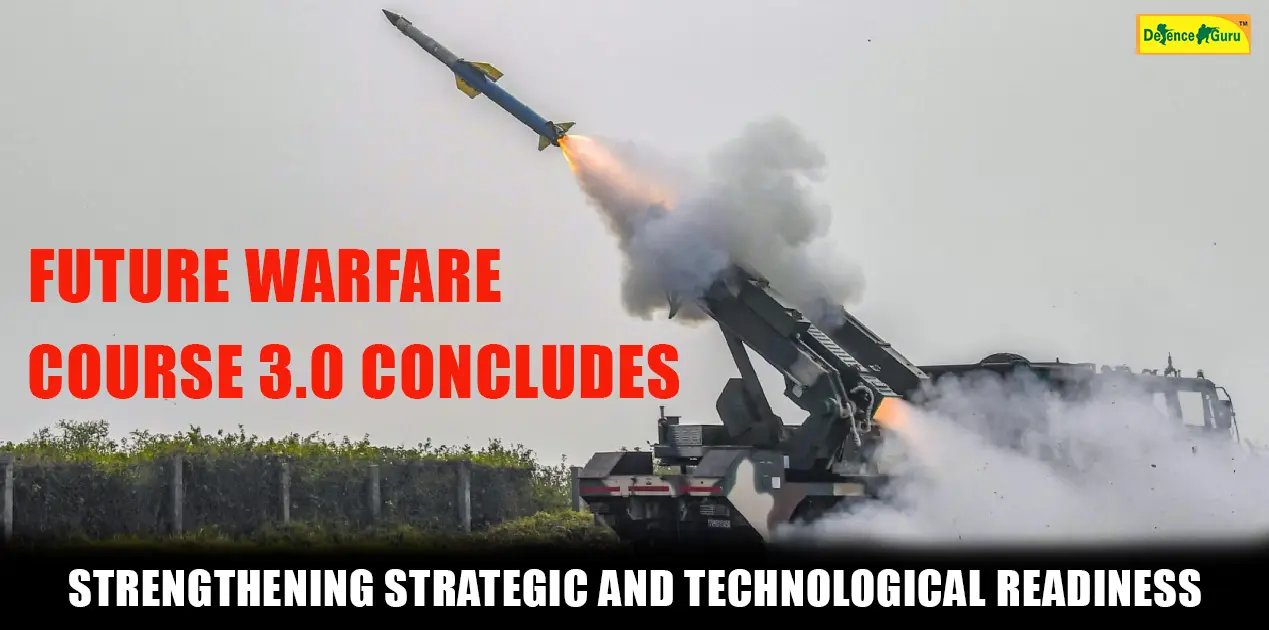
Future Warfare Course (FWC-03) Concludes at Manekshaw Centre
The third edition of the Future Warfare Course (FWC-03) concluded on 25 February 2026 at the Manekshaw Centre, New Delhi, marking the completion of an intensive and forward-looking military learning initiative. The programme was conducted by the Doctrine, Organisation and Training (DOT) branch under Headquarters Integrated Defence Staff (HQ IDS) from 2 to 25 February 2026.
Designed to recalibrate military thinking for emerging battlefronts, the course stood as a deliberate stride toward shaping leaders capable of navigating the shifting grammar of modern conflict.
Vision of the Chief of Defence Staff
Curated under the strategic foresight of the Chief of Defence Staff (CDS), General Anil Chauhan, FWC 3.0 delivered a rigorous synthesis of operational orientation, strategic coherence, and technological fluency. The curriculum was neither abstract nor theoretical; it was crafted as a pragmatic compass for officers expected to function in volatile, technology-saturated theatres.
A total of 39 officers drawn from the Army, Navy, and Air Force participated, reflecting a consciously tri-service character aligned with integrated warfighting doctrines.
Phase One: Civil–Military Convergence
The opening phase of the course introduced participants to a wide constellation of stakeholders beyond uniformed service. Representatives from startups, MSMEs, private industry, academia, and defence public sector undertakings (DPSUs) engaged directly with the officers. This deliberate civil–military fusion echoed India’s broader aspiration for strategic autonomy and self-reliance in national security architecture.
The interaction was not ceremonial; it was immersive. Officers were exposed to indigenous innovation ecosystems, defence manufacturing capabilities, and disruptive technological prototypes reshaping the character of warfare.
Phase Two: Technological Immersion in Hyderabad
From 15 to 17 February 2026, the second phase unfolded in Hyderabad, where participants engaged with academia and specialised subject matter experts. Interactions included engagements with space technology enterprises and counter Unmanned Aircraft System (C-UAS) firms—domains that increasingly define tactical and strategic advantage.
Field visits were complemented by live demonstrations of advanced systems, granting officers tactile familiarity with cutting-edge solutions rather than abstract briefings alone. The emphasis was unmistakable: future commanders must comprehend technology not as spectators, but as informed integrators.
Strategic Exposure and Cognitive Dimensions
Beyond technological exposure, the course incorporated visits to the Information Fusion Centre – Indian Ocean Region (IFC-IOR) at Gurugram and the Indian Institute of Technology Delhi. These engagements broadened participants’ appreciation of maritime domain awareness, data fusion, and advanced research ecosystems.
A particularly distinctive element was the familiarisation with cognitive warfare. Through structured interaction with media and social media interfaces, officers were sensitised to the information battlespace—where perception, narrative, and influence often precede kinetic engagement.
Multi-Domain Operations and Strategic War Gaming
Anchored in the doctrine of Multi Domain Operations (MDO), FWC-03 culminated in a two-day Strategic War Gaming Exercise. This capstone event was mentored by retired Ambassadors and representatives from the Ministry of Home Affairs (MHA), ensuring that military deliberations were cross-pollinated with diplomatic and internal security perspectives.
The exercise required participants to synthesise operational art with geopolitical nuance, internal security complexities, and foreign policy imperatives. It compelled them to reconcile battlefield logic with statecraft realities.
Reinforcing Strategic Consciousness
By the conclusion of FWC-03, participants had traversed a demanding intellectual arc—spanning technology, strategy, diplomacy, and cognitive contestation. The course fortified not only military competence but strategic discernment, equipping officers to interpret global currents alongside tactical variables.
FWC-03 thus emerged not merely as a training capsule, but as a crucible- refining tri-service officers to operate with clarity, adaptability, and strategic depth in an era where warfare evolves faster than doctrine.