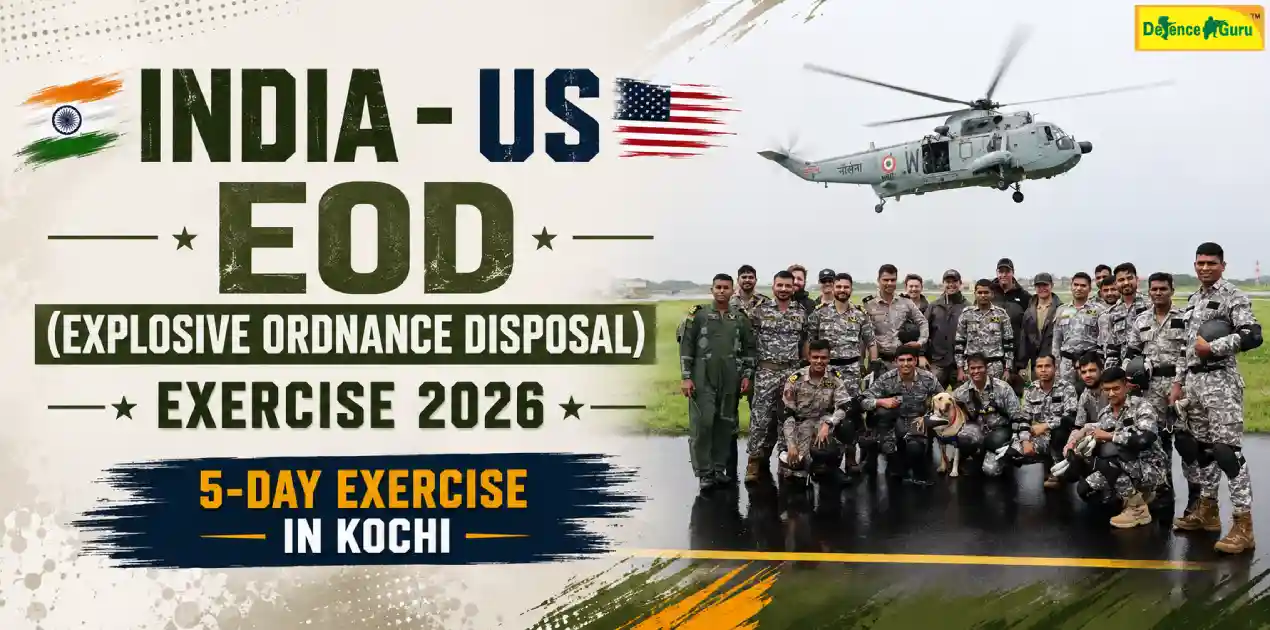
Indian and American Naval Forces have come together for the eighth edition of their EOD Explosive Ordnance Disposal exercise in Kochi, Kerala. This 5- day exercise started on 10th August and ends on 14th August 2026. This Joint Drill is hosted at the Indian Navy’s Southern Command for 5 days; this exercise will bring together diving specialists and EOD groups from both Navies. There will be an exchange of experts and specialists, hands-on situation-based drills, and cross-training.
This exercise falls under bilateral cooperation between the countries since 2005. For decades, the exercise between these two military giants stood as one of the most strategic and critical domains of naval operations.
What EOD Actually Performs
Explosive Ordnance Disposal is a very specialised and dangerous job overall in the world, but it is considered more dangerous in the Navy globally than in any other armed force in the world. The reason behind this is the dangers associated with the profession. Navy EOD Specialists should master all forms of ground-based bomb disposal skills while also acquiring elite parachute insertions, deep-sea diving, and maritime operations to safely counter torpedoes, underwater mines, and sea hazards.
What difficulty do they face?
Divers usually work in difficult situations where even the slightest mistakes can have a huge impact. Specialists must go deep underwater, where there is zero visibility. There, they have to neutralise or defuse unexploded ordnance. Working underwater means heavy gear, and this heavy gear generates stress; pressure changes and dangerous currents make this job riskier.
They have to learn deep diving as well as expert bomb disposal, both on land and at sea. Their training is a very long process of 2 years. And yet their work is not over; they have to learn and train themselves for parachute jumps, helicopter drops, and fast boat landings to reach anywhere, anytime.
Why does the exercise matter at all?
This is a joint exercise more than just training; it shows how deeply India and the USA are concerned about their oceanic activities and the mutual bonds. Since 2005, both nations have sent their elite forces for training, year after year, decade after decade. This shows how truly they trust each other and their level of mutual understanding.
These drill/excercise make them prepared for any actual threats. From new shipping routes to the building of new trade routes, oceans have been witnessing new changes. In this technological age, we are finding new ways to share our products through air and oceans. From pipelines to electric lines, countries are utilising the giant oceans; meanwhile, sometimes we find some old but active underwater mines. To tackle all these situations, cooperation is the only solution for both India and the USA. Their response to the above threats will be more nuanced and well-prepared.
This exercise is truly necessary for India not just to build a specialised team like EOD or maximise their Naval strength but to cooperate with global powers in real time. In this 21st century, we can’t isolate ourselves; we have to build our relationships with global powers. In this Multilateral world, we have to learn, adapt, and be ready for any future threats. In maritime threats, change is constant. Our steady relationship with countries like the USA remains very important.
The China factor
This India - US Navy exercise is also important through a geopolitical lens, as China’s presence in the Indian Ocean is expanding day by day. Although this exercise is not aimed at any country, it surely aims to sustain stability in the region. As competition is rising day by day in the sea, cooperating and working with a giant power like the USA will help India. Also, this kind of exercise will become a necessity in coming times.
Moving Ahead
This 5-day exercise, which ends on 14th August, will add another year and another chapter of cooperation, connectivity and partnership. In the era of uncertainties and maritime threats, these exercises play a major role in keeping both Navies prepared and connected for real-time threats and whatever comes in the future.
Read more
Meet India's 1st Female 'Top GUN' Squadron Leader Bhawana Kanth
Indian Army Boxer Defeats Pakistan 5-0 on Kargil Vijay Diwas at Commonwealth Games