
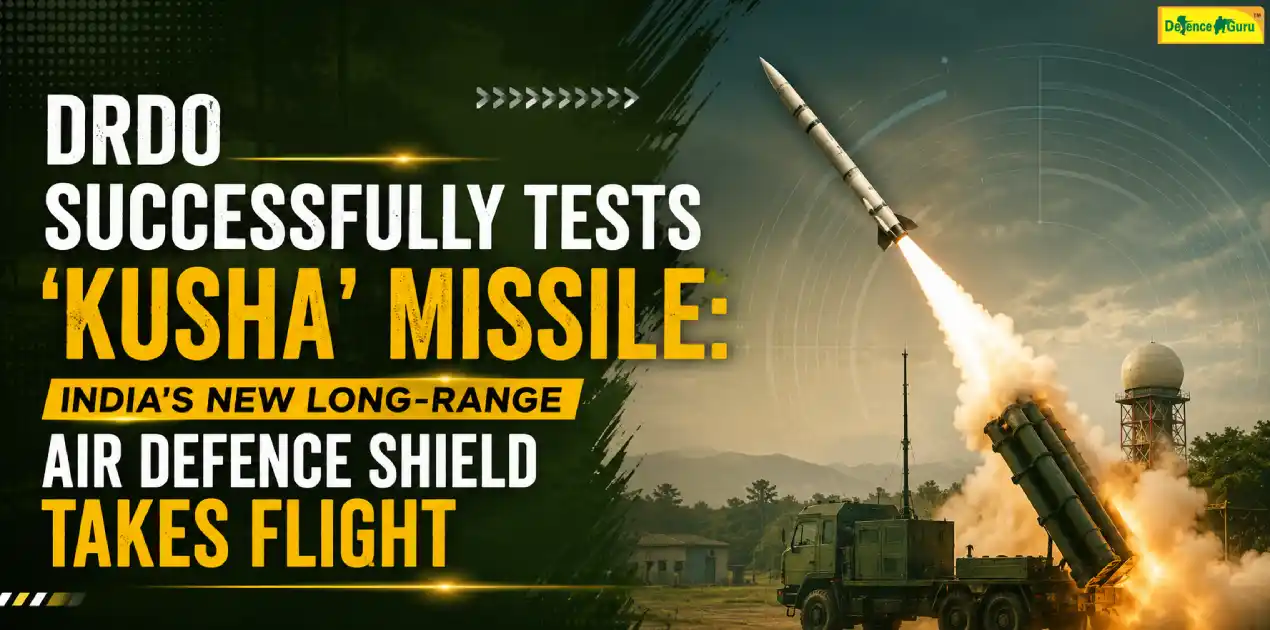
India has achieved another major milestone in strengthening its air defence capabilities.
On 23 July 2026, the Defence Research and Development Organisation (DRDO) successfully carried out the first-ever flight test of the 'Kusha' Long-Range Surface-to-Air Missile (LRSAM) from Dr. APJ Abdul Kalam Island off the coast of Odisha.
The test was a complete success, with the missile accurately intercepting a high-speed, high-altitude electronic target. This achievement marks a significant step towards making India more self-reliant in advanced missile defence systems.
A Big Leap for India's Air Defence
Imagine an enemy fighter jet, cruise missile, or armed drone entering Indian airspace from hundreds of kilometres away.
Before it can become a threat, the Kusha missile system is designed to detect, track, and destroy it in the air.
That is exactly why this missile is considered one of India's most ambitious air defence projects. With its long-range engagement capability, Kusha will strengthen the country's ability to protect strategic cities, military bases, and critical infrastructure from modern aerial threats.
What Happened During the Test?
The maiden flight test was conducted against an electronic target that simulated a high-speed, high-altitude aerial threat.
As soon as the target was launched, the Kusha missile system tracked it, calculated its trajectory, and successfully intercepted it.
The successful interception proves that the missile's guidance, radar coordination, command system, and interception capability are working as intended.
For any missile system, the first successful flight test is one of the biggest milestones before it moves towards further trials and eventual induction into the armed forces.
What Can the Kusha Missile Destroy?
One of the biggest strengths of the Kusha missile system is its versatility.
It has been designed to neutralise multiple types of aerial threats, including:
- Fighter aircraft
- Cruise missiles
- Unmanned Aerial Vehicles (UAVs) or drones
- Large surveillance and support aircraft
- Other high-speed airborne threats
This makes it an all-round air defence weapon capable of protecting India against evolving battlefield challenges.
More Than Just a Missile
The Kusha programme is not just about building a missile.
It is a complete long-range air defence system, which includes:
- Long-range interceptor missiles
- Advanced surveillance and tracking radars
- Command and Control Centre
- Integrated communication network
- Fire control systems
All these components work together to detect incoming threats, make quick decisions, and launch an interception within seconds.
The most impressive part is that every major component has been developed in India by various DRDO laboratories along with industry partners.
Why Is This Test So Important?
Only a handful of countries in the world possess the technology to build advanced long-range surface-to-air missile systems.
With the successful maiden test of Kusha, India has moved one step closer to joining that exclusive group.
This achievement offers several major advantages:
- Reduces dependence on imported air defence systems
- Strengthens India's indigenous defence manufacturing capability
- Supports the vision of Aatmanirbhar Bharat
- Enhances protection against future aerial threats
- Boosts confidence in India's defence research ecosystem
In simple words, this means India will increasingly rely on home-grown technology instead of expensive foreign systems for critical air defence.
Raksha Mantri Rajnath Singh Congratulates DRDO
Defence Minister Rajnath Singh described the successful flight test as an important milestone in India's defence research journey.
He stated that the Kusha programme demonstrates India's growing capability to develop sophisticated long-range missile systems, an achievement that only a few nations have accomplished.
He also highlighted that indigenous systems like Kusha will significantly reduce India's dependence on imports while giving a major boost to the country's overall air defence capability.
DRDO Chairman Monitored the Launch
The entire launch operation was closely monitored by the Defence Secretary and DRDO Chairman Rajesh Kumar Singh.
Following the successful interception, he congratulated the scientists, engineers, and industry partners who contributed to making the maiden flight test a success.
What Happens Next?
Although the first flight test has been successful, this is only the beginning of the missile's journey.
Like every advanced defence system, Kusha will undergo several more developmental and user trials under different operational conditions.
These tests will evaluate:
- Different target profiles
- Various engagement ranges
- High-altitude and low-altitude interceptions
- Multiple target scenarios
- Overall system reliability
Once these trials are completed successfully, the missile system is expected to move closer to induction into India's armed forces.
Final Thoughts
The successful maiden flight test of the Kusha Long-Range Surface-to-Air Missile is more than just another missile launch; it represents India's growing confidence in developing world-class defence technology.
As aerial warfare continues to evolve with advanced fighter aircraft, stealth platforms, cruise missiles, and drones, systems like Kusha will play a crucial role in protecting the nation's skies.
For defence aspirants and every Indian interested in military technology, this achievement is another reminder of how India's indigenous defence ecosystem is rapidly progressing towards global standards.
With Kusha taking its first successful flight, India's air defence shield has become stronger than ever before.
Read more:
DAC Clears ₹52,000 Crore Defence Procurement Boost for Army, Navy and Air Force
DRDO, IAF Successfully Flight-Test RudraM-II Air-to-Surface Missile