
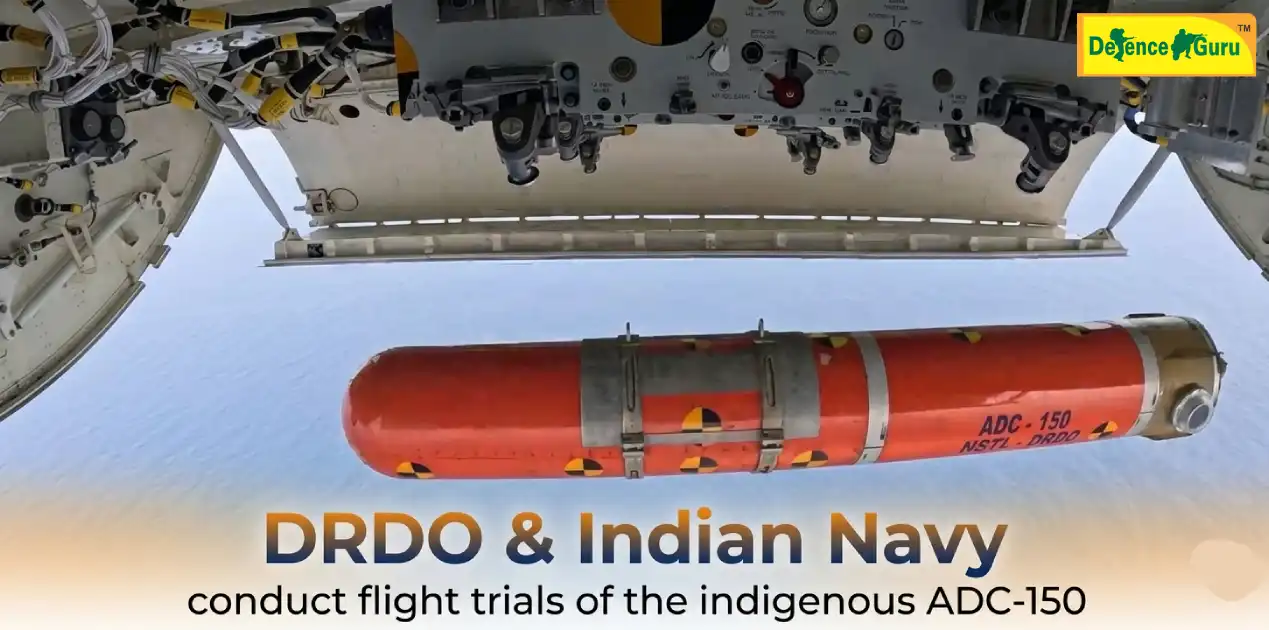
DRDO and Indian Navy Successfully Test Indigenous ADC-150 Air Droppable Container from P8I Aircraft
The maritime expanse off the coast of Goa recently witnessed a significant technological exercise as the Defence Research & Development Organisation (DRDO), working in close concert with the Indian Navy, executed a sequence of four flawless in-flight release trials of the indigenous Air Droppable Container ‘ADC-150’.
These trials unfolded between 21 February and 1 March 2026, with the system deployed from the long-range maritime patrol aircraft Boeing P‑8I Poseidon under a spectrum of demanding and extreme release conditions. Each test demonstrated the system’s reliability, validating its design and operational integrity in real-world maritime scenarios.
A Strategic Boost to Naval Logistics
The ADC-150, conceived and engineered indigenously, is purpose-built to transport and release a payload of up to 150 kilograms directly from an aircraft to vessels stationed far out at sea. Its role is not merely logistical—it is tactical.
In the vast stretches of the blue ocean where naval ships may find themselves isolated from immediate support, the ability to swiftly deliver critical supplies, emergency equipment, or urgent medical provisions becomes indispensable. The ADC-150 offers precisely that capability—an airborne lifeline descending from the sky when maritime units face unforeseen adversity.
With this innovation, the Indian Navy gains a sharper logistical edge. The system allows rapid aerial replenishment for ships deployed hundreds of nautical miles from the shoreline, eliminating delays that surface vessels alone might incur.
Collaborative Engineering Across DRDO Laboratories
The development of the ADC-150 was not the achievement of a single laboratory but rather a symphony of expertise from multiple research establishments under DRDO.
The Naval Science & Technological Laboratory (NSTL), located in Visakhapatnam, served as the nodal agency coordinating the project. Meanwhile, the Aerial Delivery Research & Development Establishment (ADRDE) in Agra engineered the parachute deployment mechanism, ensuring the payload descends steadily and safely during delivery.
Certification and airworthiness clearance were entrusted to the Centre for Military Airworthiness & Certification (CEMILAC) in Bengaluru, whose meticulous evaluation ensured that the system met stringent flight safety standards. Instrumentation and data acquisition support during the trials were provided by the Defence Research & Development Laboratory (DRDL) in Hyderabad.
This coordinated effort across multiple scientific establishments highlights the integrated strength of India’s defence research ecosystem.
Rapid Development and Imminent Induction
What stands out in the story of ADC-150 is the remarkably compressed development timeline. The system was conceived, designed, validated, and flight-tested swiftly to meet the operational requirements of the Indian Navy’s P8I aircraft fleet.
Now that all developmental flight trials have concluded with resounding success, the ADC-150 is poised for operational induction into the Indian Navy in the near future. Once deployed, it will serve as a critical enabler for maritime missions—quietly ensuring that ships operating in distant waters are never truly beyond the reach of support.
In the grand theatre of naval operations, innovations like the ADC-150 may not always capture headlines. Yet they perform a silent, vital role—bridging distances, sustaining missions, and ensuring that when help is needed in the middle of the ocean, it can quite literally fall from the sky.
Read more:
INS Tarangini Arrives at Trincomalee, Sri Lanka
DRDO conducts successful flight-trials of Very Short-Range Air Defence System