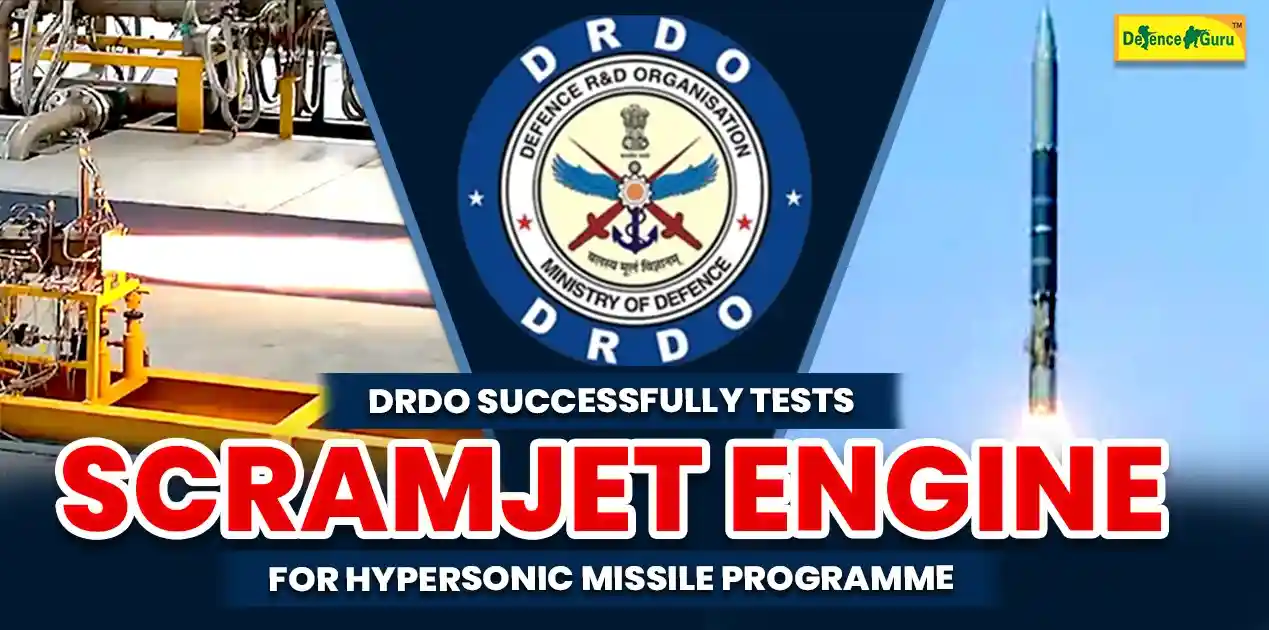
In a major breakthrough for India’s hypersonic weapons development, the Defence Research and Development Organisation (DRDO) has successfully conducted a long-duration ground test of a full-scale, actively cooled scramjet engine—a critical component for hypersonic cruise missiles.
The test was carried out on 9 January 2026 by the Defence Research & Development Laboratory (DRDL), Hyderabad, a key DRDO laboratory, at its advanced Scramjet Connect Pipe Test (SCPT) Facility. The engine demonstrated stable operation for more than 12 minutes, marking a significant technological milestone.
A Crucial Step in Hypersonic Capability
This achievement builds on an earlier sub-scale scramjet test conducted in April 2025 but represents a far more advanced stage by validating full-scale engine performance over an extended duration. The combustor and the specialised test facility were indigenously designed by DRDL and realised in collaboration with Indian industry partners.
With this success, India strengthens its position among a select group of nations with proven hypersonic propulsion expertise.
Why This Test Matters
Hypersonic cruise missiles operate at speeds exceeding Mach 5—more than five times the speed of sound, or approximately 6,100 km/h—and must sustain those speeds for prolonged periods. This capability depends on air-breathing scramjet engines, which use supersonic combustion instead of conventional propulsion systems.
The recent ground test successfully validated:
- The design and thermal management of the actively cooled scramjet combustor
- The reliability of long-duration supersonic combustion
- The operational capability of India’s state-of-the-art SCPT testing infrastructure
Leadership Reactions
Raksha Mantri Shri Rajnath Singh congratulated DRDO, its industry partners, and academic collaborators, calling the achievement a strong technological foundation for India’s Hypersonic Cruise Missile Programme.
DRDO Chairman and Secretary, Department of Defence R&D, Dr Samir V. Kamat, also praised the teams involved, highlighting the test as a landmark accomplishment in advanced aerospace propulsion.
Strategic Significance
The successful validation of a full-scale scramjet engine brings India closer to deploying hypersonic cruise missiles capable of:
- Rapid long-range precision strikes
- Enhanced survivability against modern air defence systems
- Strengthened strategic deterrence
This milestone reflects India’s growing competence in cutting-edge aerospace technologies and reinforces the country’s long-term vision of defence self-reliance and technological leadership.