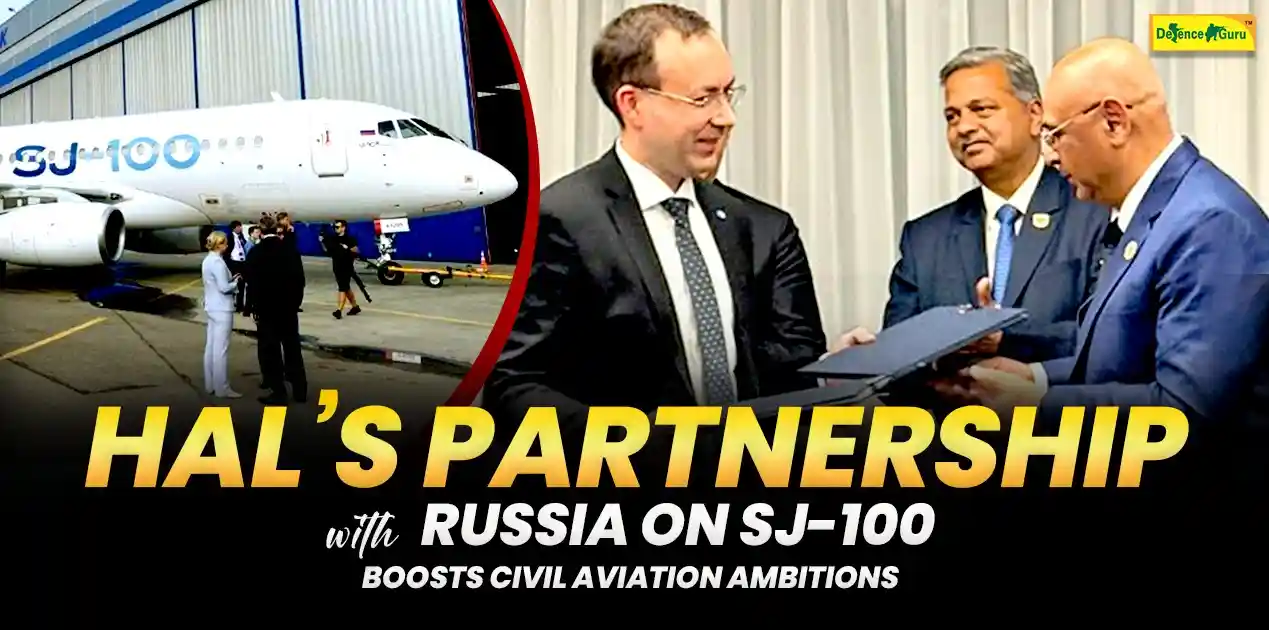
HAL–Russia SJ-100 Deal Signals India’s Big Leap into Civil Aviation
Hindustan Aeronautics Limited (HAL), India’s flagship public-sector aerospace company, has entered a strategic partnership with Russia’s United Aircraft Corporation (UAC) to bring the Superjet-100 (SJ-100) regional passenger aircraft to India. The move marks a decisive shift for HAL as it steps beyond its defence-centric legacy and positions itself in India’s rapidly expanding civil aviation market.
The SJ-100 is a twin-engine regional jet designed to carry nearly 100 passengers and operate over distances of up to 3,000 kilometres. Equipped with modern fly-by-wire systems and an advanced glass cockpit, the aircraft is capable of operating from shorter and less developed runways. This makes it particularly suitable for strengthening air connectivity between India’s tier-2 and tier-3 cities—an objective closely aligned with the government’s UDAN regional connectivity initiative.
HAL estimates that India could require between 150 and 200 aircraft in this segment over the coming years. As part of the licensing agreement signed during the Wings India 2026 aviation event in Hyderabad, HAL will take charge of the aircraft’s production, marketing, maintenance, and supply of spare parts within the country.
The rollout plan has been designed in stages. In the initial phase, HAL intends to lease around 10 to 20 fully built SJ-100 aircraft from Russia, allowing Indian airlines to evaluate their performance. These aircraft are expected to begin arriving within the next 18 months, with parallel discussions underway with aircraft leasing firms based in Gujarat’s GIFT City to accelerate deployment.
Subsequently, HAL will initiate semi-knock-down assembly operations at its Nashik and Kanpur facilities, with the first India-assembled aircraft projected to be completed within three years. Full-scale indigenous production under the ‘Make in India’ framework is targeted for 2029, making the SJ-100 the country’s first domestically produced civilian passenger aircraft since the Avro HS-748 era several decades ago.
Beyond manufacturing, the collaboration represents a renewed phase of India-Russia cooperation in aviation, coming at a time when India has emerged as the world’s third-largest domestic aviation market. HAL Chairman and Managing Director DK Sunil has highlighted regional connectivity as a key growth engine, noting that civilian aviation platforms are expected to become a significant contributor to HAL’s revenue in the near future.
At present, civil aviation contributes only about 4–5% of HAL’s overall revenue. However, the company is aiming to raise this share to nearly 25% within the next ten years. By combining Russian aircraft technology with India’s production capabilities, the initiative supports greater self-reliance, reduces import dependency, and strengthens India’s long-term ambition to evolve into a global aviation manufacturing hub.
This collaboration not only deepens economic and technological ties between India and Russia but also signals HAL’s strategic diversification in an industry poised for sustained growth.
Read more:
Who Was Captain Shambhavi Pathak? Pilot Killed in Ajit Pawar Plane Crash
Group Captain Shubhanshu Shukla to be Conferred with Ashoka Chakra