Joint Military Drill Showcases Advanced Airborne Capabilities
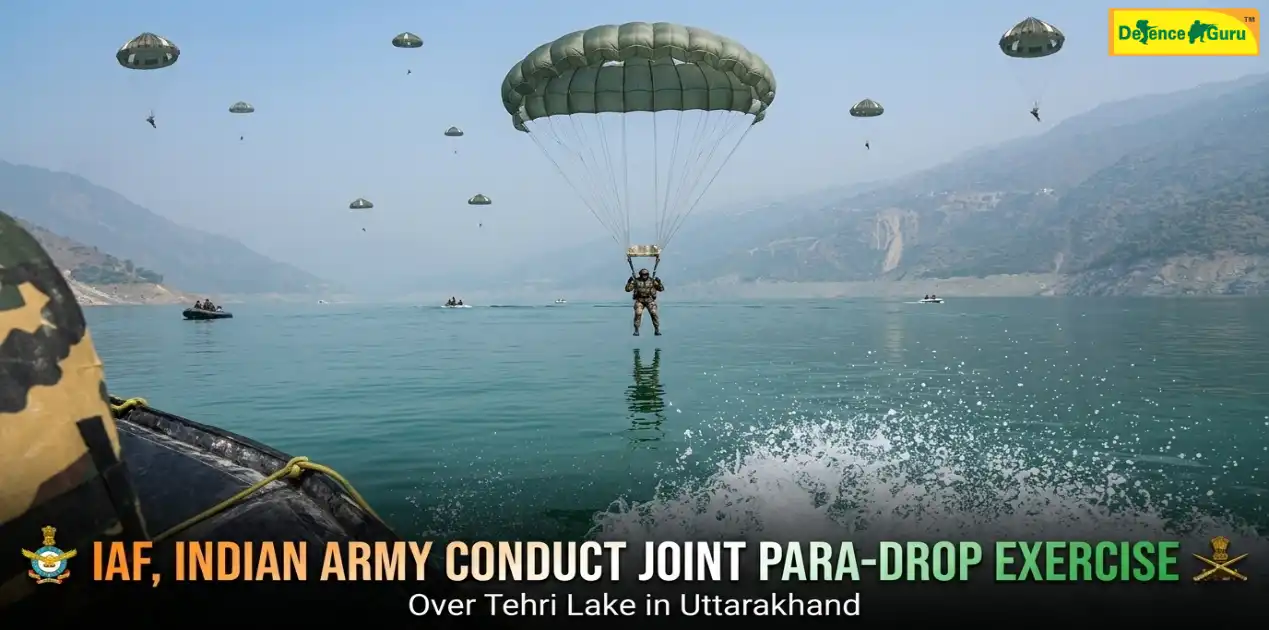
The Indian Air Force (IAF) conducted a joint para-drop exercise with the Indian Army over Tehri Lake in Uttarakhand on 8 March 2026, demonstrating advanced airborne capabilities and strong coordination between the two services.
Videos and images released by the IAF showed paratroopers jumping from aircraft and deploying their parachutes over the lake. The visuals highlighted the precision, discipline, and operational readiness of India’s airborne forces during complex missions.
Combat Free-Fall and Static Line Jumps
During the exercise, IAF aircraft carried out Combat Free-Fall (CFF) and Static Line para-drop operations, both of which are essential techniques used by airborne units in military operations.
-
Combat Free-Fall (CFF): A technique mainly used by special forces where soldiers jump from high altitude and deploy parachutes later to avoid detection.
-
Static Line Jump: A method commonly used for rapid troop deployment, where the parachute automatically deploys as soon as the soldier exits the aircraft.
These techniques are widely used during special operations, tactical insertions, and rapid deployment missions.
Precision Operations in Challenging Terrain
The exercise also demonstrated the ability of the Indian Armed Forces to conduct precision airborne operations in complex terrain, including mountainous and high-altitude regions like those found in Uttarakhand.
Such drills help troops prepare for real combat scenarios where quick insertion of soldiers and equipment is required in difficult environments.
Strengthening Joint Operational Capability
Officials stated that the exercise highlighted the seamless synergy between the Indian Army and the Indian Air Force. Joint training like this plays a crucial role in strengthening coordination between services, which is vital for modern multi-domain warfare and rapid response operations.
Airborne missions are especially important for:
-
Special forces insertion
-
Reinforcement of forward positions
-
Emergency and humanitarian assistance missions
Increasing Focus on Joint Airborne Training
The Indian Armed Forces have been increasingly focusing on joint airborne exercises to enhance operational efficiency and combat readiness.
In recent years, similar operations have also included the high-altitude air-dropping of the indigenous “Aarogya Maitri Health Cube”, a portable hospital designed for disaster relief and humanitarian missions.
Enhancing Military Readiness Across Diverse Terrains
Exercises like the Tehri Lake para-drop drill underline the Indian military’s capability to rapidly deploy troops and equipment across diverse terrains, from mountains to remote regions.
Such operations not only strengthen India’s combat preparedness but also enhance its ability to respond quickly during disasters, humanitarian crises, and emergency situations.
Read more:
Indian Air Force Loses Two Pilots in Su-30MKI Crash
VayuShakti 2026: The Unmatched Power of India’s Air Dominance