India, UAE Agree to Elevate Defence Cooperation, Set Ambitious Trade and Energy Targets
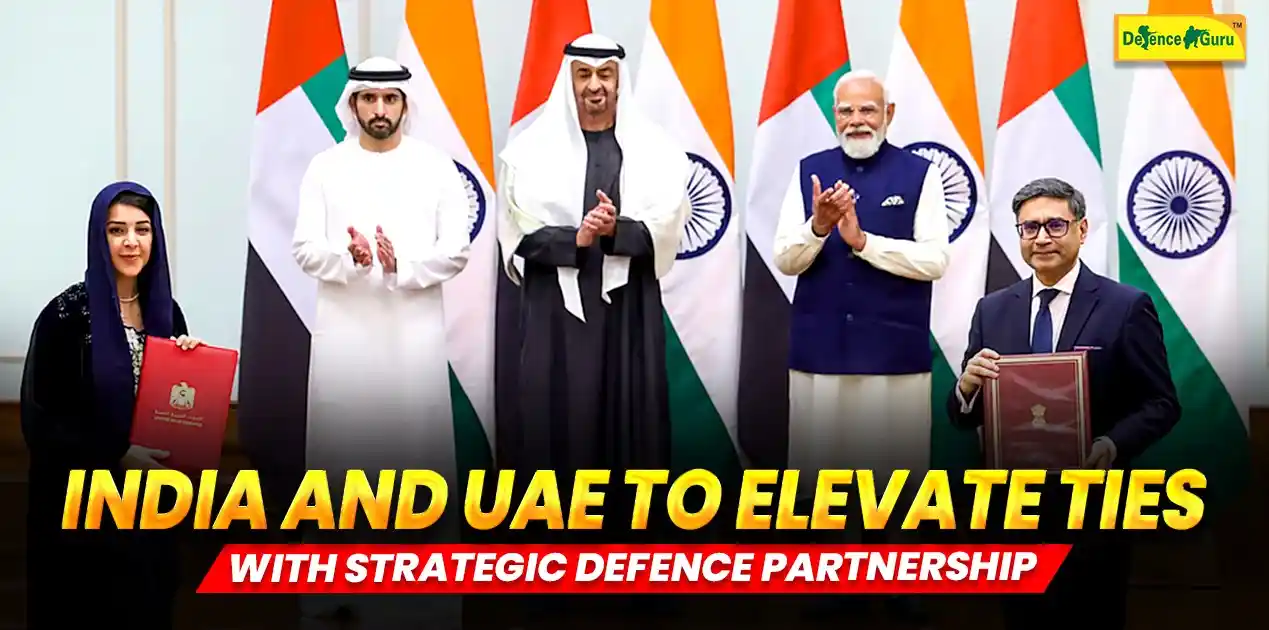
India and the UAE on Monday decided to further intensify their rapidly growing partnership by moving towards a Strategic Defence Partnership. This reflects increased cooperation and interaction between the two nations on issues like defence, security, and emerging technologies.
The announcement came after discussions between Indian Prime Minister Narendra Modi and UAE President Sheikh Mohamed bin Zayed Al Nahyan, who paid a brief working visit to the National Capital. Both leaders have assessed the progress of bilateral relations over the last couple of years and set out the priorities for the future on both sides.
The signing of the LoI was one of the major takeaways of the meeting that will facilitate a bilateral framework of cooperation in the defence sector. Reports said the future joint venture would include cooperation in the field of defence industries, joint research and development, training and education, joint military exercises, expertise exchange, and more interoperability of the respective armies of the two nations.
Cooperation will also include special operations, cybersecurity, and counter-terrorism issues, which are common to their concerns about modern security threats. They reaffirmed their strong opposition to terrorism in all its forms and stressed that no state should support or shelter terrorism.
According to government sources, the defence relationship is meant to increase reciprocal security capacities and is in no way targeted at any third country. Indeed, the leaders reaffirmed their commitment to sovereignty, territory, and strategic autonomy.
The economic cooperation aspect also dominated discussions, where the UAE and Indian nations established a target to double their bilateral business to USD 200 billion by 2032. The trade volumes between the UAE and India are also experiencing considerable growth due to the implementation of the Comprehensive Economic Partnership Agreement (CEPA).
Another important area of focus was energy security. Both sides confirmed a ten-year long-term liquefied natural gas (LNG) supply agreement. Under this agreement, India’s Hindustan Petroleum Corporation Limited (HPCL) would import an annual supply of 0.5 million metric tonnes of LNG from ADNOC Gas beginning from the year 2028. This move is projected to further improve energy security for India, along with enhancing the UAE’s position as a solid energy partner.
The issue of cooperation in renewable sources of energy, clean hydrogen, and sustainable energy solutions was also raised by the leaders.
Concerning the area of technology, both parties agreed to strengthen cooperation regarding topics such as space, artificial intelligence, supercomputing, and nuclear energy. Discussions also included the construction of large nuclear reactors as well as small reactors.
A Letter of Intent has been inked for UAE involvement in the development of "Dholera Special Investment Region" in the state of Gujarat. This includes development in industrial estates, logistics, international airports, smart city development, and the energy segment. This will result in the development of industries and foreign investment.
The leaders also discussed views on regional and international developments, such as the India Middle East Europe Economic Corridor, which aims to promote trade, energy, and digital connectivity among Asia, West Asia, and Europe.
The officials said that this visit has reinforced the steady development of the relationship between the two countries from one level of partnership to another, to reach a strategic partnership level, and specifically a strategic partnership in various fields, including defence, economic, and innovation.
Read more:
India Considers Mega Deal for 114 Rafale Jets Worth ₹3.25 Lakh Crore
Meet Captain Hansja Sharma, India’s First Woman Rudra Helicopter Pilot
Major Swathi Shantha Kumar Wins UN Award for Gender-Inclusive Peacekeeping