Indian Navy’s Project 75(I) Enters Final Stretch as CCS Clearance Comes into Sight
India’s long-delayed but high-stakes Project 75(I) submarine programme is finally approaching a decisive milestone. After years of deliberations, cost negotiations between the Ministry of Defence, Mazagon Dock Shipbuilders Limited (MDL), and Germany’s ThyssenKrupp Marine Systems (TKMS) have reached near closure. The proposal is now being readied for submission to the Cabinet Committee on Security (CCS), with approval expected in the coming quarter.
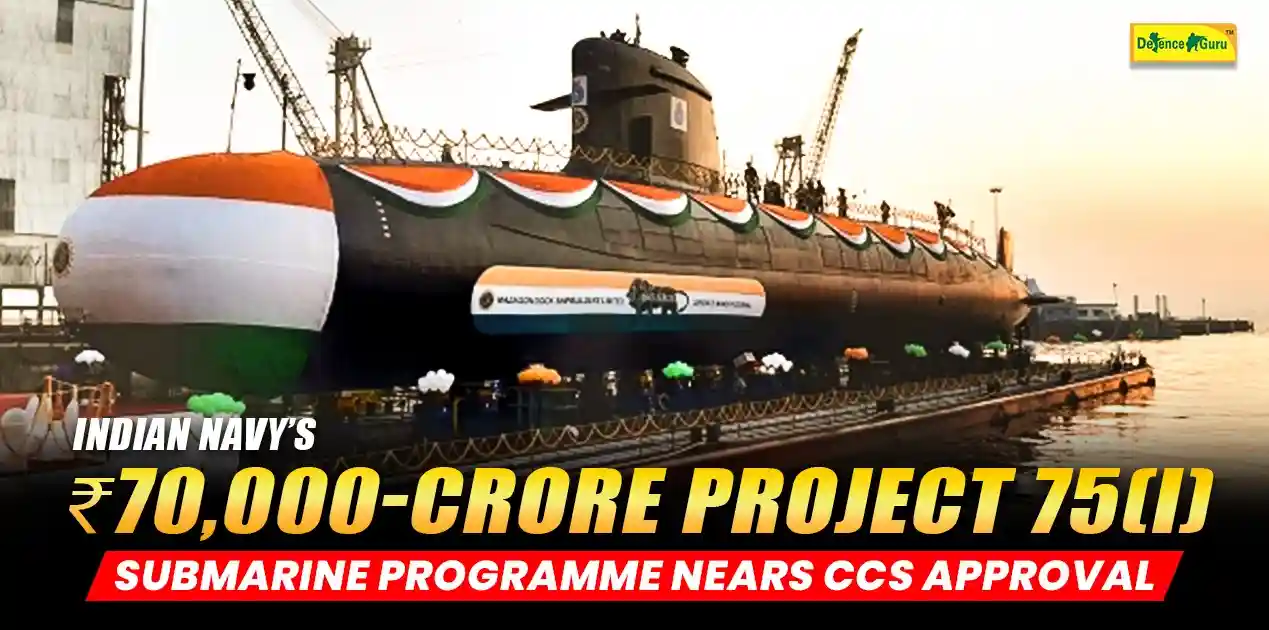
With an estimated outlay of ₹66,000–70,000 crore following multiple rounds of financial recalibration, Project 75(I) stands poised to become one of the world’s most expensive conventional submarine acquisitions—and the largest underwater warfare investment ever made by India.
Designed as the next evolutionary step after the Scorpene-class under Project 75, the programme envisages the induction of six advanced diesel-electric submarines fitted with Air Independent Propulsion (AIP). These boats will feature enhanced stealth architecture, next-generation combat management systems, and heavyweight torpedoes capable of both anti-submarine and anti-surface warfare. AIP technology, allowing submerged operations for nearly three weeks without surfacing, marks a substantial operational upgrade over the existing Kalvari-class fleet.
Under the Strategic Partnership framework, MDL has been selected as the Indian partner, building on its experience from earlier submarine construction. TKMS is expected to contribute the submarine design, AIP solution, and critical technologies derived from its Type-214 and Type-218 platforms, suitably adapted to meet Indian Navy specifications.
The financial journey of Project 75(I) has been complex. Initially approved in 2018 with an estimated cost of around ₹43,000 crore, the project saw sharp escalations due to factors such as taxation, technology transfer expenses, and long-term lifecycle support. Subsequent negotiations by the Cost Negotiation Committee have brought the figure down to a range that the government now considers strategically and economically defensible.
With price discussions largely concluded, the proposal is undergoing final financial scrutiny and inter-ministerial consultations. Defence officials indicate that CCS approval is being targeted within the current financial year, paving the way for contract signing by late FY 2025–26 and release of the first tranche of funds soon after.
From an operational standpoint, Project 75(I) is central to narrowing India’s undersea capability gap at a time when China is rapidly expanding its naval footprint in the Indian Ocean Region and Pakistan is inducting Chinese-origin AIP-equipped submarines. The new fleet is expected to significantly bolster India’s sea-denial posture, secure critical sea lines of communication, and reinforce deterrence across both the Arabian Sea and the Bay of Bengal.
Beyond combat capability, the programme carries major industrial implications. It is set to provide long-term momentum to India’s submarine-building ecosystem, anchoring sustained work at MDL while deepening expertise in modular construction, advanced systems integration, acoustic quieting, and fuel-cell AIP technologies—capabilities that are seen as essential for future indigenous submarine projects.
While some issues remain under discussion, including liability provisions, intellectual property arrangements, and indigenous content requirements, strong strategic signals from both political and military leadership suggest a clear intent to move forward. If cleared by the CCS within the expected timeline, Project 75(I) will offer the Indian Navy a stable and predictable submarine induction roadmap for the next decade—buying crucial time as India advances parallel indigenous conventional and nuclear submarine programmes.
Read more:
Sagar Defence Takes Strategic Stake in Drone Start-up Endure Air Systems
Union Budget 2026-27: MoD Gets Record ₹7.85 Lakh Crore Allocation