Nepal faces one of its worst natural disasters in August 2026 after glacial floods ravaged the Himalayan country. The disaster particularly affected areas around the Bhotekoshi and Trishuli river systems in Rasuwa and nearby districts. The Himalayan region's glacier collapse triggered a huge flow of ice, rocks, mud, and water, resulting in widespread destruction. The roads, bridges, settlements, and hydropower infrastructure were heavily damaged.
The disaster has highlighted the important role of the Nepal Army in disaster management and humanitarian assistance. Furthermore, India has extended immediate humanitarian assistance to Nepal through the Indian Air Force (IAF) and other agencies. The response reflects the close defence, humanitarian, and people-to-people relationship between India and Nepal.
What happened in Nepal?
The flash floods started on 26 August 2026 after what is believed to be a glacier collapse in the Himalayan region. Satellite imagery and expert assessments suggest a large segment of the glacier broke away at high altitude and triggered an ice-rock avalanche and a huge debris flow. The resulting surge entered the river systems and caused severe flooding downstream.
The Bhotekoshi River and Trishuli River systems were heavily affected. The sudden rise in water and debris destroyed bridges, roads, and other infrastructure. Several hydropower projects were also severely damaged, making the disaster particularly important for Nepal's infrastructure and energy sector.
The situation became complicated as people were trapped in remote and inaccessible areas, and several workers were reported trapped inside tunnels associated with hydropower projects.
Nepal Army leads search and rescue operations.
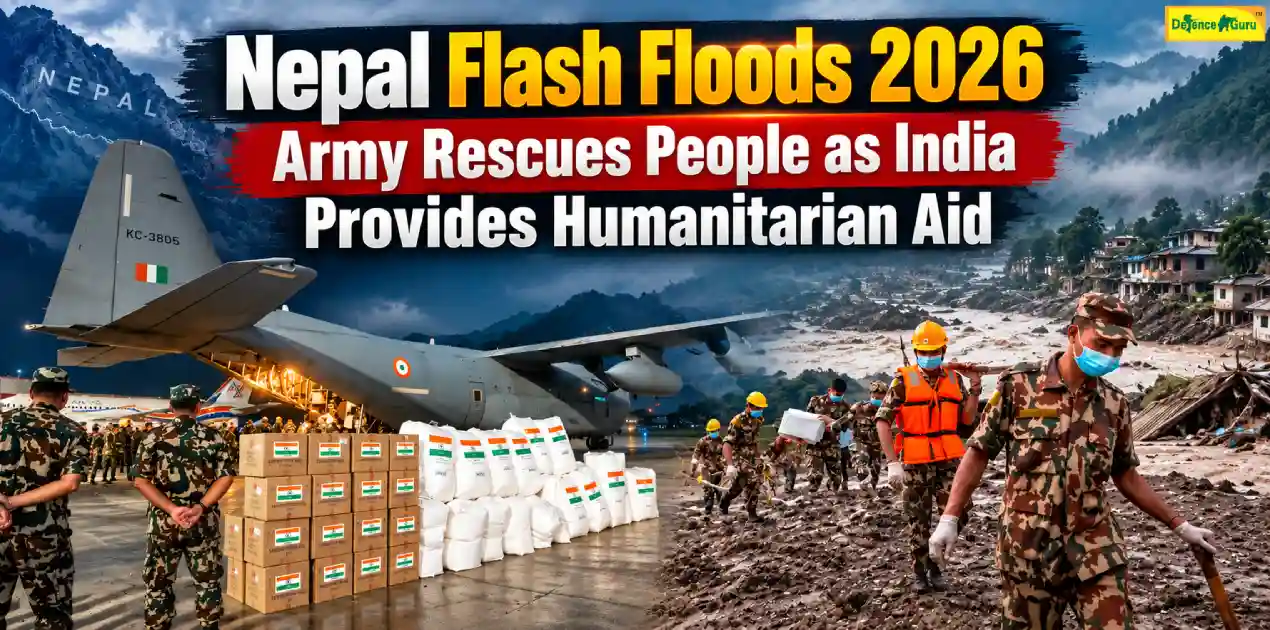
The Nepal Army has played a key role in rescue and relief operations. Army personnel have been deployed across the affected areas to search for missing people, evacuate stranded civilians, provide medical assistance, and distribute relief material.
According to the latest reports, more than 6,700 security personnel have been mobilised in the affected areas. The Nepali Army has undertaken both ground and air operations, including helicopter evacuations. By 29 August, the army had rescued more than 2,100 people through land and air operations and provided medical assistance to more than 1,700 people through emergency medical centres.
One of the most challenging missions involves people trapped inside hydropower tunnels. In one operation, Nepali Army teams rescued 191 workers from hydropower tunnels. Rescue teams continue to search for people who may still be trapped in underground facilities.
The operation presents difficulties as roads and bridges have been washed away, tunnel entrances are blocked by mud and debris, and bad weather and difficult Himalayan terrain slow down rescue efforts.
India extends humanitarian assistance.
India responded swiftly to the disaster, and Prime Minister Narendra Modi spoke with Nepal's Prime Minister Balendra Shah and expressed India's readiness to provide all possible humanitarian assistance.
The Indian Air Force has been involved in transporting relief supplies to Nepal. An IAF C-130J transport aircraft initially transported around 10 tonnes of humanitarian assistance, including medicines, temporary shelters, blankets, hygiene kits and other essential supplies.
India then sent additional consignments of relief material. Reports on 28 August said India has dispatched another 37.5 tonnes of relief supplies, followed by a further tranche of assistance along with medical and reconnaissance teams.
The C-17 Globemaster, one of the Indian Air Force's strategic transport aircraft, has also been utilised to support the relief effort. The use of C-130J and C-17 aircraft demonstrates India's ability to rapidly transport humanitarian supplies and equipment during disasters.
India offers rescue and medical support
India's assistance has not been confined to sending relief material. India has also offered specialised support for rescue operations in the affected areas.
An Indian team comprising doctors, paramedics, and personnel involved in assessing tunnel-rescue operations has been sent to support Nepal. India has also offered assistance through specialised rescue agencies, including the National Disaster Response Force (NDRF).
This cooperation is particularly crucial as several people are missing and some are believed to be trapped inside difficult-to-access hydropower tunnels. Nepal has sought assistance from India and China for specialised tunnel rescue, identification of deceased persons, and other emergency operations.
Importance for India-Nepal relations
The disaster has once again illustrated the close relationship between India and Nepal. The two countries share a long open border, strong cultural ties, and extensive people-to-people relations.
Defence cooperation is an integral part of this relationship, and the Indian Army and Nepali Army maintain regular cooperation, including military exercises, training, and humanitarian assistance. Both countries also follow the unique tradition of conferring the honorary rank of General on each other's Army Chiefs.
India's rapid humanitarian response during the 2026 Nepal floods demonstrates that defence cooperation is not limited to conventional security matters. Armed forces can also play an important role in Humanitarian Assistance and Disaster Relief (HADR).
Why this news matters for defence aspirants
For CDS, NDA, AFCAT, and other defence examinations, this is an important development as it touches upon several areas of current affairs.
Aspirants should note the following:
- The disaster occurred in Nepal in August 2026.
- The Bhotekoshi and Trishuli river systems were heavily affected.
- A glacier collapse is believed to have triggered the devastating flash floods.
- The Nepali Army is leading major search-and-rescue operations.
- Hydropower tunnels became major rescue sites.
- India provided Humanitarian Assistance and Disaster Relief (HADR).
- The Indian Air Force C-130J and C-17 aircraft were utilised in transporting relief assistance.
- India also provided medical and rescue-related support.
- The disaster highlights the importance of India-Nepal defence and humanitarian cooperation.
Conclusion
The 2026 Nepal flash floods have created a major humanitarian crisis in the Himalayan region. The disaster has caused extensive damage to infrastructure, affected hydropower projects, and left many people missing or displaced. The Nepali Army has taken the lead in rescue, evacuation, and medical operations, operating under extremely difficult geographical and weather conditions.
India's swift response through the Indian Air Force, medical teams, and humanitarian assistance has provided valuable support to Nepal at a critical juncture. More than a disaster-relief operation, the episode has demonstrated the practical importance of India's neighbourhood-first approach and its close relationship with Nepal.
For defence aspirants, the event is an important example of how modern armed forces contribute not only to national security but also to disaster response, humanitarian assistance and regional cooperation.
Read more:
Why Did Major Rishabh Sambyal Leave the Indian Army? Real Reason, Career & Retirement Explained