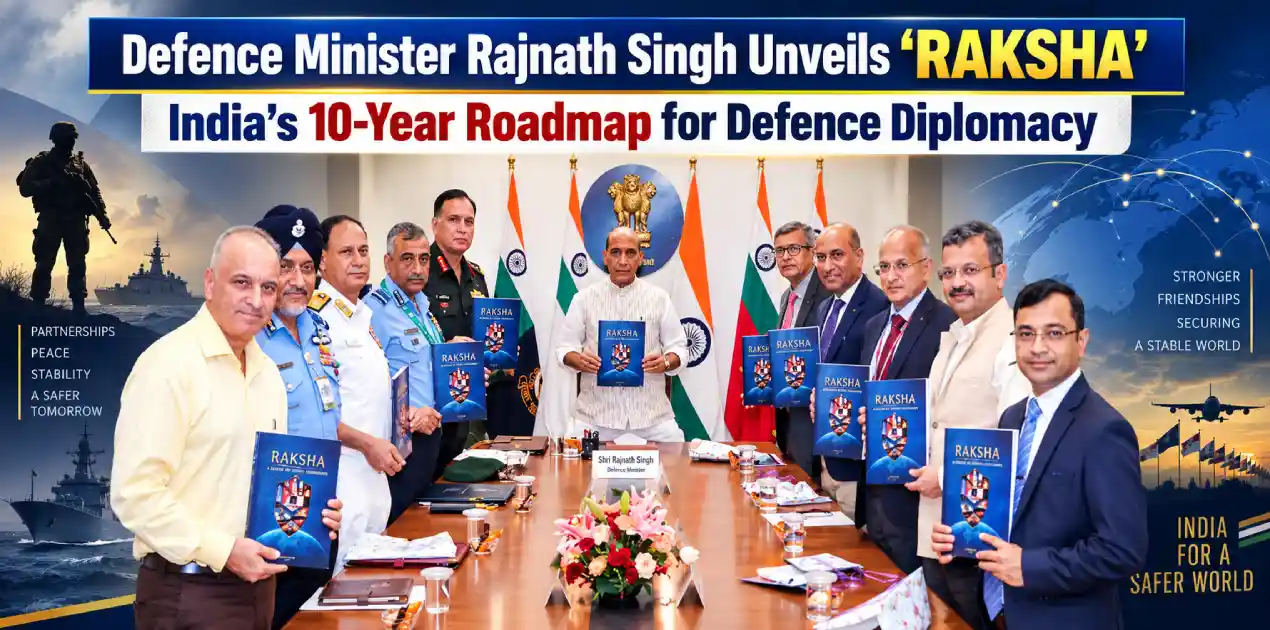
'RAKSHA', the strategic document that summarises India's future roadmap and vision with respect to the global defense partnership for the coming 10 years, was launched on September 3, 2026, by Defence Minister Rajnath Singh in New Delhi. The defense diplomacy and international security partnership is expected to be on a much clearer and more defined basis, thereby being projected well in advance within such a context. Such a launch of 'RAKSHA' happens when the security paradigm of the world has already begun taking swift transitions over the course, and thus it has only made defence diplomacy more crucial with the ever-increasing geographical tensions, emergent military technologies, growing concern over maritime security, and expanding partnerships with countries around the world.
What is RAKSHA?
RAKSHA has been conceived as a framework document to address Indian defence diplomacy in the years to come. “RAKSHA visualizes setting out a better articulated approach for India's interaction with its friendly and partner countries in defence and security-related fields,” the report explains. Under it, India does not aim to keep defense relations limited to buying or selling weapons or carrying out military exercises.
“RAKSHA is creating sustainable relations rather than merely selling and buying weapons or organizing some specific military exercise.”
It predicts establishing strong cooperative ties related to training of forces, increasing capacity building, in defense manufacturing and technology, as well as imports and exports of arms and security-related expertise and training. RAKSHA looks at creating mutually inclusive ties with friendly countries”, the report states. The paper explains India's ambitions towards playing a proactive role in peace and stability at the regional and global level.
Four Key Pillars of RAKSHA
The RAKSHA framework consists of 4 main areas of concentration:
1. Strategic partnerships
This first pillar addresses the theme of greater strategic depth in bilateral and multilateral security cooperation with partner countries. India already carries on dialogue, defence exercises, exchanges of officers, and joint training sessions with various countries. The RAKSHA proposal is on further strengthening relations in addition to building stronger strategic partnerships based on shared interests. The concept of shared interests has been gaining significance as modern-day security issues traverse borders, and multiple countries are needed to effectively deal with them.
2. Capacity building
The second pillar, this section also elaborates on improving India's cooperation with friendly countries through joint military exercises, training sessions, and the exchange of best practices with all forces. Such joint exercises enable armed forces to become familiar with each other's procedures, increase interoperability, and coordinate responses to multiple scenarios. Such measures will also help strengthen friendly countries' security capabilities, besides enhancing India's position as an ever-reliable security partner.
3. Indigenous Defence Exports
Secondly, RAKSHA looks into strengthening Make in India defense platforms by reinforcing India’s stance as a formidable global defense manufacturing powerhouse.
In the past few years, India has laid massive emphasis on home-grown defense manufacturing. At the same time, it has also encouraged defense exports and increased Indian private and public companies’ penetration into the global defense arena.
Through defense diplomacy backed by the framework of RAKSHA, indigenous defense capabilities can serve as an essential part of India’s foreign policy. Defense equipment, technology and platforms of Indian origin could forge longer-term industrial and strategic ties with partner nations.
4. Maritime Security
Maritime Security comprises the fifth key pillar of the concept of India as a Net Security Provider and First Responder in the Indian Ocean Region. Through its geographic positioning, India has played an integral role in safeguarding the stability of the Indian Ocean. From guarding sea lanes of communication to rapid response to maritime emergencies and cooperation with regional players, protecting its waters has taken center stage in the strategic landscape of the nation. A deeper aspect of this could also involve increased information sharing and maritime cooperation through combined exercises, technical training, and capacity building with regional countries.
Why is RAKSHA Important for India?
The significance of RAKSHA is also in extending beyond defense cooperation and the development of a more institutionalized Indian approach to its international security surroundings. Defense diplomacy allows New Delhi to nurture strategic friendships, improve interoperability, and support the Indian defense industry, as well as help Indian defense companies expand in new international markets. Such a framework is particularly crucial as India attempts to manage its many different regional strategic interests, even as it attempts to retain an autonomous and flexible foreign policy.
In addition, the framework also aligns with India's wider drive towards an "Aatmanirbhar Bharat," a self-reliant defense sector.
A combination of in-house production, supported by ties with trusted international allies, could contribute to both improved capabilities and the establishment of a robust role for India as a defense provider to friendly countries.
RAKSHA and India's Global Defence Role
The new policy signifies India's eagerness to have a greater role in dictating the security environment both at the regional and international level. The scale of India's defense involvement has already widened with the country's participation in multinational military exercises, humanitarian assistance and disaster relief operations, maritime security initiatives, and defence co-operation programs; RAKSHA provides a strategic direction and long-term framework for bolstering them.
The stress on long-term security, shared growth, and rule-based international order in the policy clearly denotes India’s aim of maintaining international peace and security in its own self-interest.
What Defence Aspirants Should Know
RAKSHA is a significant topic in current affairs for the candidates appearing for NDA, CDS, AFCAT, and any other defence examinations. Candidates should remember:
- RAKSHA is the latest defence diplomacy framework of India that will be applied over the next ten years to define its engagement on defense issues internationally.
- Defense Minister Rajnath Singh released it on 3rd September 2026.
- It covers four pillars: Strategic partnerships; Capacity building; Indigenous defence exports; and Maritime security.
- This framework aims to leverage these factors to build stronger global defence partnerships. It reiterates India's aim to become a global and secure defence manufacturing hub.
- The statement emphasized India’s commitment as a Net Security Provider and First Responder in the Indian Ocean Region.
- Questions on RAKSHA are expected in the current affairs part of the defence examinations. Specifically related to India’s foreign policy, defense diplomacy, its international relations, and indigenous defense production.
Conclusion
With the introduction of RAKSHA, India has taken a significant step in enhancing the country's defence diplomacy. The implementation of a 10-year strategic roadmap looks to reinforce the country's defence partnerships, augment capacity building, strengthen indigenous defence exports, and increase cooperation in the maritime domain.
This framework has been adopted at a time when defence diplomacy, as a vital component of national security, has assumed considerable importance. For India, strengthened international defence relationships could strengthen military readiness, technology co-operation, indigenous manufacturing, and regional security.
Thus, the relevance of RAKSHA for defense aspirants and the general audience cannot be overstated. It presents itself as an issue that directly links together Indian defense diplomacy, Aatmanirbhar Bharat, defense exports, military cooperation, and maritime security into a 10-year plan.
Read more:
Why Did Major Rishabh Sambyal Leave the Indian Army? Real Reason, Career & Retirement Explained