Rajnath Singh Highlights Operation Sindoor as a Benchmark of India’s Air Power and Joint Military Strength
India’s ability to deliver high-impact, short-duration military responses was clearly demonstrated during Operation Sindoor, Raksha Mantri Shri Rajnath Singh said while addressing the Air Force Commanders’ Conclave in New Delhi on December 18, 2025.
Describing the Indian Air Force (IAF) as a technologically advanced, operationally agile, strategically confident and future-ready force, the Raksha Mantri highlighted its critical role in safeguarding national interests in an increasingly complex global security environment.
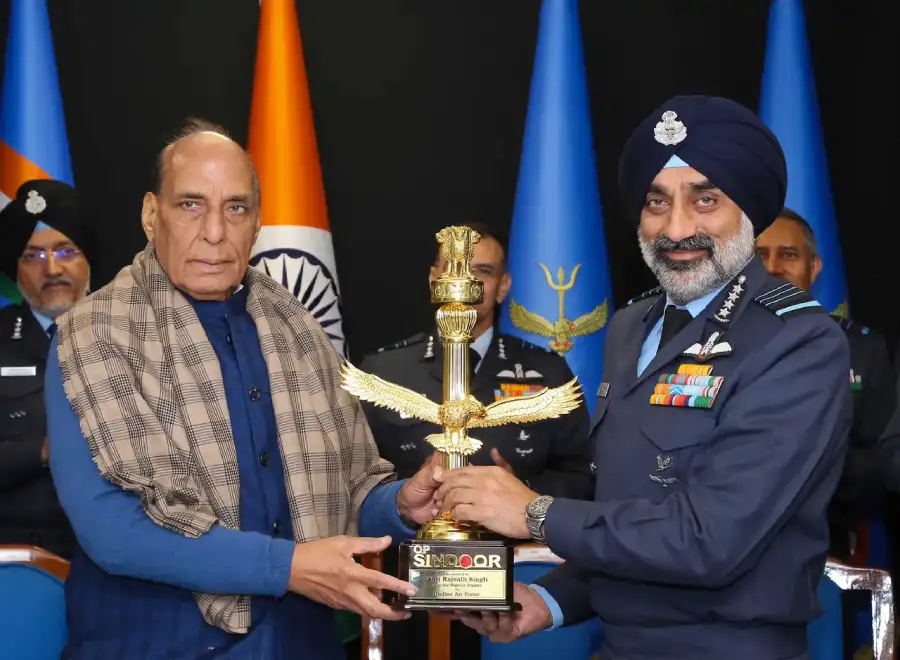
Shri Rajnath Singh praised the speed, precision and decisiveness with which the IAF neutralised terror camps during Operation Sindoor, while also effectively countering the irresponsible response from Pakistan. He underlined the deep public trust in India’s air defence systems, noting that even during attempted enemy strikes, citizens remained calm and carried on with their daily lives—clear evidence of confidence in the Armed Forces’ preparedness.
Urging senior commanders to draw key lessons from the operation, he emphasised the need for constant vigilance and readiness to counter future challenges. Understanding an adversary’s offensive and defensive capabilities, he said, is essential to maintaining a decisive edge.
Reflecting on the evolving character of warfare, the Raksha Mantri pointed out that conflicts such as the Russia–Ukraine war, Israel–Hamas conflict, Balakot air strikes, and Operation Sindoor have firmly established air power as a decisive strategic force. He stressed that air power today is not merely tactical, but a strategic instrument defined by speed, surprise and shock effect, capable of delivering clear strategic messages to adversaries.
Highlighting the Government’s vision for future warfare, Shri Rajnath Singh stated that 21st century conflict is no longer just about weapons, but about ideas, technology and adaptability. Domains such as cyber warfare, artificial intelligence, unmanned systems, satellite surveillance and space-based capabilities are reshaping modern combat. Precision weapons, real-time intelligence and data-driven decision-making, he said, are now basic necessities, not optional advantages.
He reiterated the Government’s commitment to strengthening India’s security architecture, expressing confidence that initiatives such as Sudarshan Chakra, announced by the Prime Minister, will play a vital role in protecting national assets. He also underlined that indigenous jet engine development has been taken up as a national mission.
The Raksha Mantri highlighted growing collaboration with the private sector, start-ups and MSMEs in defence modernisation through initiatives like iDEX and ADITI. As of November 2025, 672 winners have emerged from 565 iDEX challenges, including 96 related to the IAF—reflecting rising interest among young innovators in defence manufacturing.
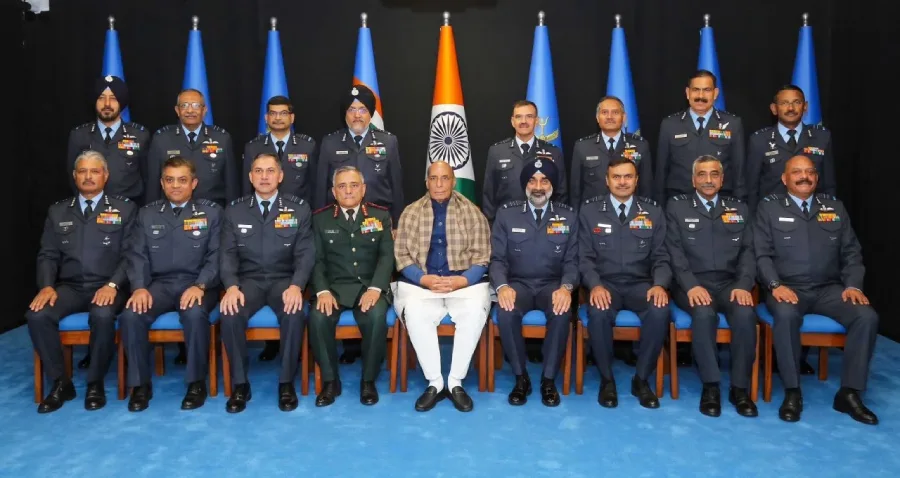
Calling Operation Sindoor a landmark example of tri-service synergy, Shri Rajnath Singh stressed the importance of jointness among the three Services to effectively counter future threats.
He also lauded the IAF’s consistent excellence in Humanitarian Assistance and Disaster Relief (HADR) operations, both within India and abroad, noting that such missions—often conducted in extreme conditions—have further strengthened public trust in India’s air warriors.
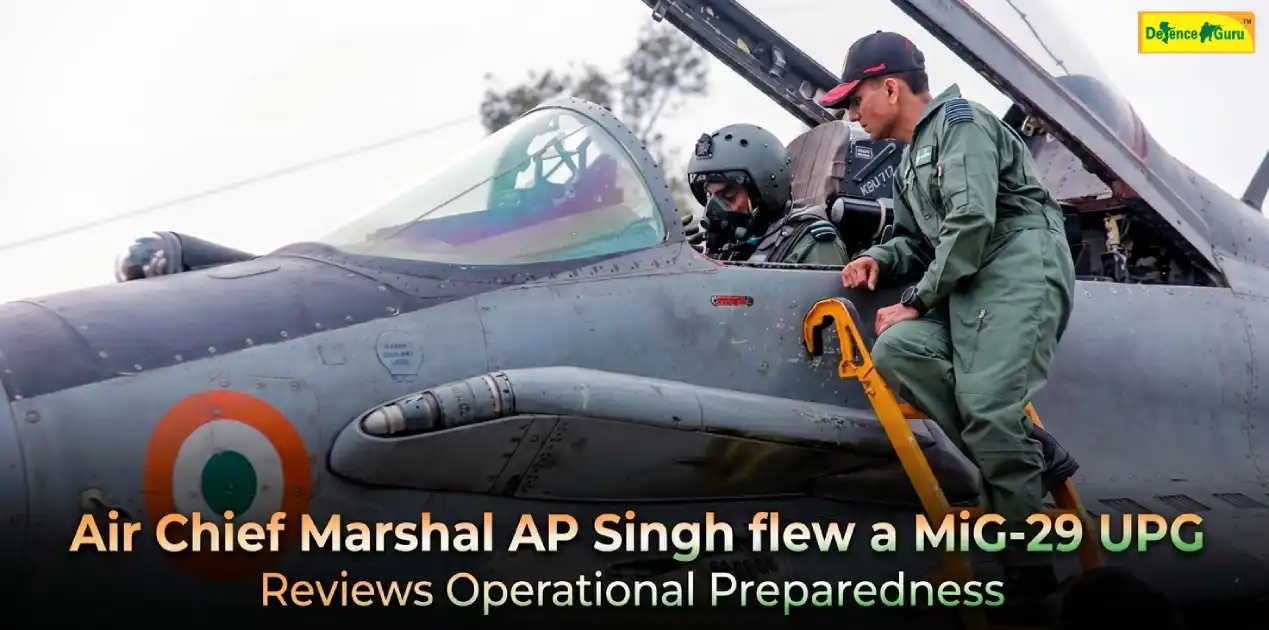
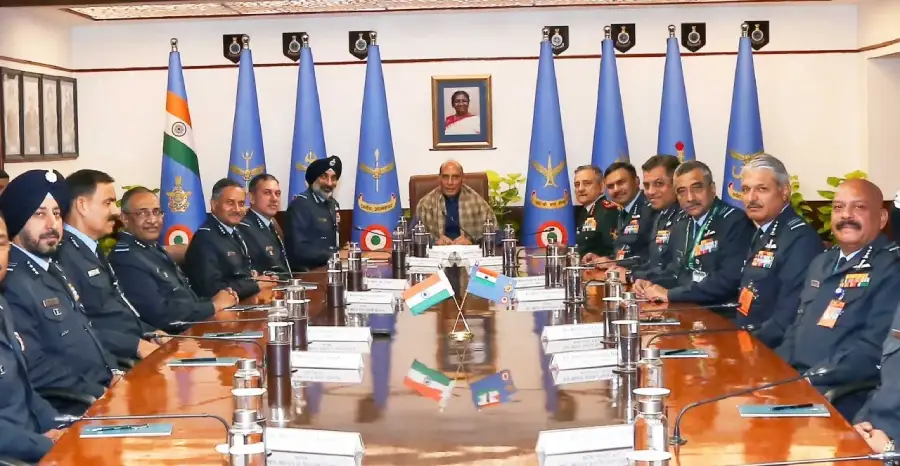
The conclave was attended by Chief of Defence Staff General Anil Chauhan and senior IAF commanders. On arrival, the Raksha Mantri was received by Chief of the Air Staff Air Chief Marshal AP Singh and briefed on the IAF’s operational readiness. The conclave serves as a key platform for strategic deliberations, operational planning and advancing Aatmanirbharta in defence capabilities.
Read more:
Indian Navy Commissions First Indigenous Diving Support Craft DSC A20 at Kochi