Clearing the NDA written exam is a big achievement, but it is only one part of the journey toward becoming an officer in the Indian Armed Forces. After qualifying for the written stage, candidates have to face the SSB interview, where their personality, behaviour, decision-making ability, communication skills, and leadership potential are assessed over several days.
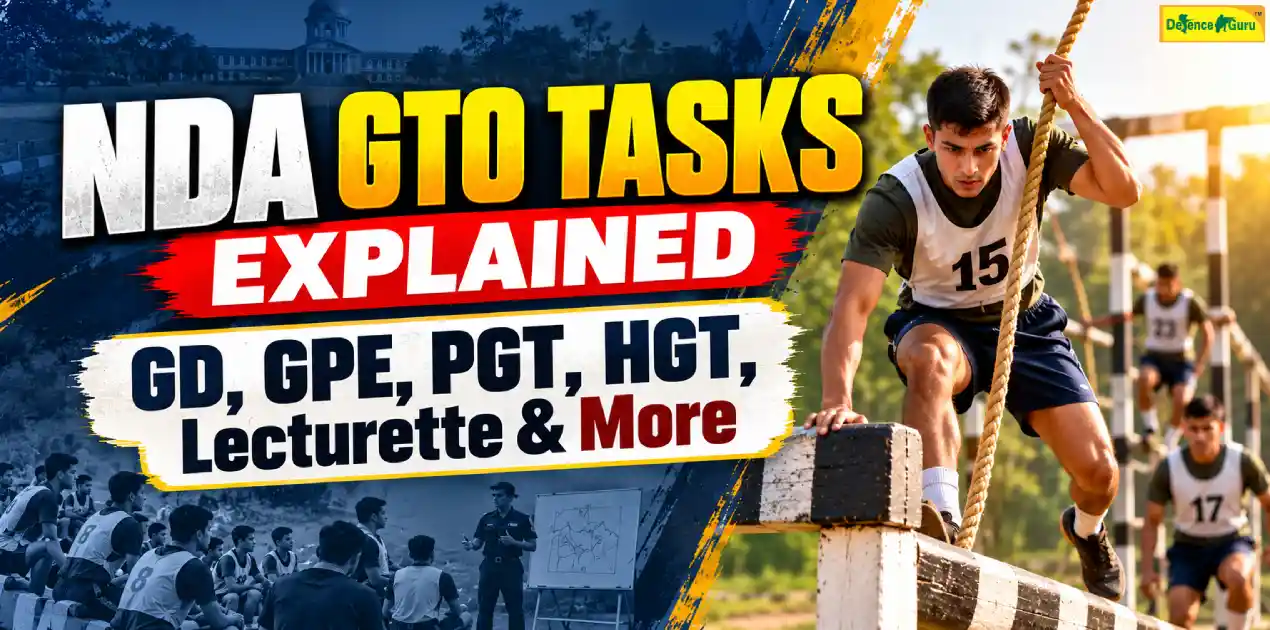
One of the most important parts of this process is the Group Testing Officer (GTO) series.
Many NDA aspirants hear terms like GD, GPE, PGT, HGT, Lecturette and Command Task and immediately start wondering what actually happens in these tests. Are they about physical strength? Do you have to be the loudest person in the group? Is it necessary to give the correct solution every time?
The simple answer is: GTO tasks are not just about being physically strong or speaking more than everyone else.
They are designed to observe how you behave when working with others, solving problems, handling pressure, and taking responsibility.
Let us understand the major NDA GTO tasks in simple language.
What Is GTO in the NDA SSB
GTO stands for Group Testing Officer. During the GTO series, candidates participate in several individual and group activities.
The assessor observes qualities that are relevant to military leadership, such as:
- Effective communication
- Cooperation and teamwork
- Practical intelligence
- Initiative
- Responsibility
- Confidence
- Ability to influence a group
- Decision-making
- Physical courage
- Determination
- Social adaptability
This does not mean you have to show all these qualities artificially.
In fact, trying too hard to "act like an officer" can often make your behaviour look unnatural. The better approach is to understand the task, participate actively, and behave like yourself while contributing positively to the group.
1. Group Discussion or GD
Group Discussion is usually one of the first activities candidates associate with GTO.
The group is given a topic, and candidates discuss it within a limited time. Topics can be related to current affairs, defence, society, education, technology, the economy, or other issues of general interest.
The objective isn't simply to find out who knows the most facts.
The GTO may observe:
- How clearly you express your thoughts
- Whether you listen to others
- Whether you respect different opinions
- How confidently you participate
- Whether you help move the discussion forward
- Whether your arguments are logical
A common mistake is to think that speaking continuously means performing well.
It doesn't.
If you speak for five minutes without listening to anyone, you may actually reduce the quality of your participation.
A better approach is to make a few meaningful points, listen carefully, and enter the discussion whenever you have something relevant to contribute.
2. Group Planning Exercise or GPE
The Group Planning Exercise, commonly called GPE, tests how candidates approach a situation involving multiple problems and limited resources.
You are generally given a situation involving a group of people, several problems, and certain resources such as time, transport, or manpower.
You first analyse the situation individually and then discuss it with your group.
The group eventually arrives at a common plan.
For example, a situation may involve an accident, an emergency, a delayed train, injured people or some other practical problem. You may have to decide what should be done first and how available resources can be used effectively.
GPE is not about creating the most complicated plan.
A practical plan is usually more useful than an impressive-sounding one.
While solving GPE, think in a simple sequence:
- What is the most urgent problem?
- What resources are available?
- What should be done first?
- Who can do it?
- How much time will it take?
This kind of structured thinking can make your solution much more realistic.
3. Progressive Group Task or PGT
The Progressive Group Task is one of the most recognised GTO outdoor activities.
The group has to cross a series of obstacles using specified helping materials such as planks, ropes, or other resources. The difficulty generally increases as the group progresses.
This is where candidates often realise that GTO isn't just about individual strength.
You might be physically fit, but if you don't coordinate with your group, your team can still struggle.
PGT can bring out qualities such as:
- Cooperation
- Planning
- Resource utilisation
- Communication
- Initiative
- Group coordination
- Practical intelligence
The best approach is not to stand at the back waiting for someone else to solve everything.
At the same time, there is no need to shout instructions constantly.
If you see a practical solution, explain it clearly and help your teammates execute it.
4. Half Group Task or HGT
As the name suggests, Half Group Task is similar to PGT, but the group is divided into smaller teams.
The smaller group means there are fewer people to work with, so individual participation becomes more visible.
For candidates, this can actually be a useful opportunity.
In a large group, someone may naturally dominate the discussion or physical activity. In HGT, everyone gets more space to contribute.
The same basic principles apply:
- Understand the obstacle
- Discuss possible solutions
- Use resources intelligently
- Listen to your teammates
- Take initiative
- Help the group move forward
Don't treat HGT as a competition against your own teammates. The goal is to complete the task as a team.
5. Lecturette
Lecturette is an individual speaking activity.
Candidates are generally given a few topics from which they select one and speak on it for a specified period.
This activity can feel intimidating if you aren't comfortable speaking spontaneously.
However, the solution isn't to memorise hundreds of speeches.
Instead, develop a habit of thinking about topics from multiple angles.
For example, if the topic is artificial intelligence, you could think about:
- What is it?
- Where is it being used?
- What are its advantages?
- What are its challenges?
- What does it mean for India?
This simple framework can help you organise your thoughts.
During the lecturette, focus on:
- Clear speech
- Logical flow
- Confidence
- Relevant examples
- Reasonable body language
- Finishing within the given time
You don't need an accent or complicated English.
If your ideas are clear and you communicate them confidently, that matters much more.
6. Individual Obstacles
Individual Obstacles test your physical courage, stamina, determination, and willingness to take on challenges.
Candidates are required to negotiate a set of obstacles individually within the given time.
This is where physical preparation can make a real difference.
Running, basic strength training, agility exercises and regular outdoor activity can help you become more comfortable with such tasks.
However, don't confuse this with bodybuilding.
GTO preparation requires functional fitness. You need the ability to run, jump, climb, balance, and keep going even when you're tired.
Starting physical preparation several weeks or months before your SSB is much better than suddenly trying to become extremely fit just before reporting.
7. Command Task
The Command Task is different from many other GTO activities because you are allowed to take command of a situation.
The GTO generally gives you a practical obstacle and asks you to complete it with the help of selected group members.
This is where candidates often become over-conscious.
Remember, being a commander does not mean shouting at people.
A good approach is to:
- Understand the task properly.
- Think before giving instructions.
- Select people who can genuinely help.
- Explain what needs to be done.
- Keep the team coordinated.
- Stay calm if the first plan doesn't work.
- Modify your approach when necessary.
The assessor isn't necessarily looking for someone who solves everything instantly.
How you respond when your plan doesn't work can be equally important.
8. Final Group Task or FGT
The Final Group Task is another group obstacle activity and generally comes toward the end of the GTO series.
By this stage, candidates have already experienced several group activities.
The FGT gives you another opportunity to demonstrate teamwork, cooperation, planning and initiative.
A useful mindset is simple: help the group finish the task instead of trying to prove that you are the smartest person there.
Sometimes the candidate who quietly identifies a workable solution and helps everyone execute it can contribute more than someone who keeps giving instructions.
9. Group Obstacle Race or Snake Race
The Group Obstacle Race is one of the more energetic activities in the GTO series.
Candidates negotiate obstacles together while carrying a common load, often referred to as the "snake."
The activity demands physical energy, coordination, and team spirit.
It is easy to get carried away because everyone is moving quickly and the environment can become noisy.
But even here, coordination matters.
You have to move with the group, encourage your teammates, and ensure that the team doesn't lose rhythm unnecessarily.
The lesson is quite straightforward: individual speed has limited value if the group gets left behind.
What Does the GTO Actually Look For
A common misconception is that there is a fixed trick for every GTO task.
There isn't.
Different tasks provide different situations, but the underlying objective is to observe your behaviour.
The GTO may be looking at qualities associated with an officer-like personality, including:
- Effective intelligence: Can you find practical solutions?
- Reasoning ability: Can you understand a situation logically?
- Organising ability: Can you plan and use available resources?
- Social adaptability: Can you work comfortably with different people?
- Cooperation: Do you contribute to the team?
- Sense of responsibility: Can you take ownership of a task?
- Initiative: Do you act when action is required?
- Self-confidence: Can you express yourself without unnecessary hesitation?
- Determination: Do you keep trying when things get difficult?
- Influence: Can you positively influence the group?
You don't have to display every quality in every activity.
The overall pattern of your behaviour matters.
Common Mistakes Candidates Make During GTO
Many candidates make avoidable mistakes because they prepare for GTO as if it were a written examination.
Here are some common ones.
Trying to dominate the group
Speaking loudly, interrupting everyone, or forcing your opinion doesn't automatically make you a leader.
Staying completely silent
The opposite extreme is also problematic. If you never participate, the assessor has very little opportunity to observe your contribution.
Memorising artificial responses
Trying to behave according to a "perfect SSB personality" can make your actions look rehearsed.
Focusing only on physical strength
GTO includes physical activities, but it is not a fitness competition. Your thinking, cooperation, and behaviour matter too.
Fighting with teammates
Disagreement is normal. Personal arguments are not productive.
Copying another candidate
You may observe someone doing something confidently and try to imitate them. But what works for one person may look unnatural for another.
The better strategy is to understand the task and improve your own participation.
How to Prepare for NDA GTO Tasks
GTO preparation should ideally begin well before your SSB dates.
Start with the basics.
- Improve your communication: Read newspapers, discuss current issues, and practise speaking on unfamiliar topics.
- Build practical thinking: Solve situation-based problems and practise finding simple solutions rather than complicated ones.
- Work on fitness: Running, bodyweight exercises, agility and outdoor activities can improve your confidence during physical tasks.
- Practise teamwork: Participate in sports, group activities and discussions where you have to cooperate with others.
- Get comfortable with public speaking: Regularly practise Lecturette-style speaking for two to three minutes.
- Understand the tasks: Knowing what PGT, HGT, GPE, GD and Command Task involve can reduce unnecessary anxiety on the actual day.
Structured SSB coaching can also be useful for candidates who don't have access to proper GTO practice facilities or experienced feedback. Institutes such as Centurion Defence Academy, for example, provide dedicated SSB preparation along with GTO-oriented practice, mentoring, and exposure to different stages of the selection process. The biggest advantage of this kind of preparation is not learning a "trick" to clear SSB, but getting an opportunity to practise, make mistakes and understand where you need improvement.
Final Thoughts
The NDA GTO series can look complicated when you first hear names like PGT, HGT, GPE and FGT.
But at its core, the idea is fairly simple.
You are placed in situations where you have to think, communicate, cooperate, take initiative, and get things done with other people.
Don't enter the GTO series thinking that you have to become someone else.
You don't need to shout to look confident. You don't need to know everything to participate in a discussion. You don't need to solve every obstacle alone.
Be physically prepared, stay aware of what is happening around you, communicate clearly, and contribute honestly.
Most importantly, remember that GTO is not one isolated task.
Your performance is seen across multiple activities. So instead of chasing a perfect performance in one particular task, focus on building the qualities that you can demonstrate naturally throughout the SSB process.
That is ultimately what good GTO preparation should be about: not learning how to act like an officer, but becoming more capable of thinking and behaving like one.
FAQs on NDA GTO Tasks
1. What are the main GTO tasks in NDA SSB?
The GTO series includes activities such as Group Discussion, Group Planning Exercise, Progressive Group Task, Half Group Task, Lecturette, Individual Obstacles, Command Task, Group Obstacle Race, and Final Group Task.
2. Is GTO only about physical fitness?
No. Physical fitness is important for outdoor activities, but GTO also assesses communication, teamwork, initiative, practical intelligence, cooperation, planning, and other behavioural qualities.
3. What is PGT in SSB?
PGT stands for Progressive Group Task. Candidates work together to cross a series of obstacles using available materials while demonstrating teamwork, planning, and practical problem-solving.
4. What is HGT in SSB?
HGT stands for Half Group Task. The group is divided into smaller teams, allowing candidates to participate more actively in a group obstacle exercise.
5. What happens in Lecturette?
Candidates are given a set of topics and asked to select one and speak on it for a specified period. The activity assesses communication, confidence, knowledge, and the ability to organise thoughts.
6. How can I improve my GTO performance?
Focus on regular physical exercise, current affairs, communication, public speaking, teamwork and practical problem-solving. Familiarising yourself with GTO tasks and getting feedback through structured practice can also help.
7. Do I need to be very physically strong for GTO?
You don't need to be a professional athlete. A good level of functional fitness, stamina, agility, and confidence in physical activities is more useful than simply having muscular strength.
8. Is there a shortcut to clearing GTO?
There is no reliable shortcut. Trying to memorise behaviours or copy someone else's personality can backfire. Consistent practice, self-awareness, communication, and genuine participation are much more useful.
9. Can Hindi-medium students perform well in GTO?
Yes. Candidates should focus on expressing their thoughts clearly and confidently. Language should not become an excuse for staying silent. Regular speaking practice can significantly improve confidence.
Read more:
NDA SSB Psychology Tests: TAT, WAT & SRT Explained
Top 3 SSB Interview Books: Features, Topics Covered & Who Should Read Them?