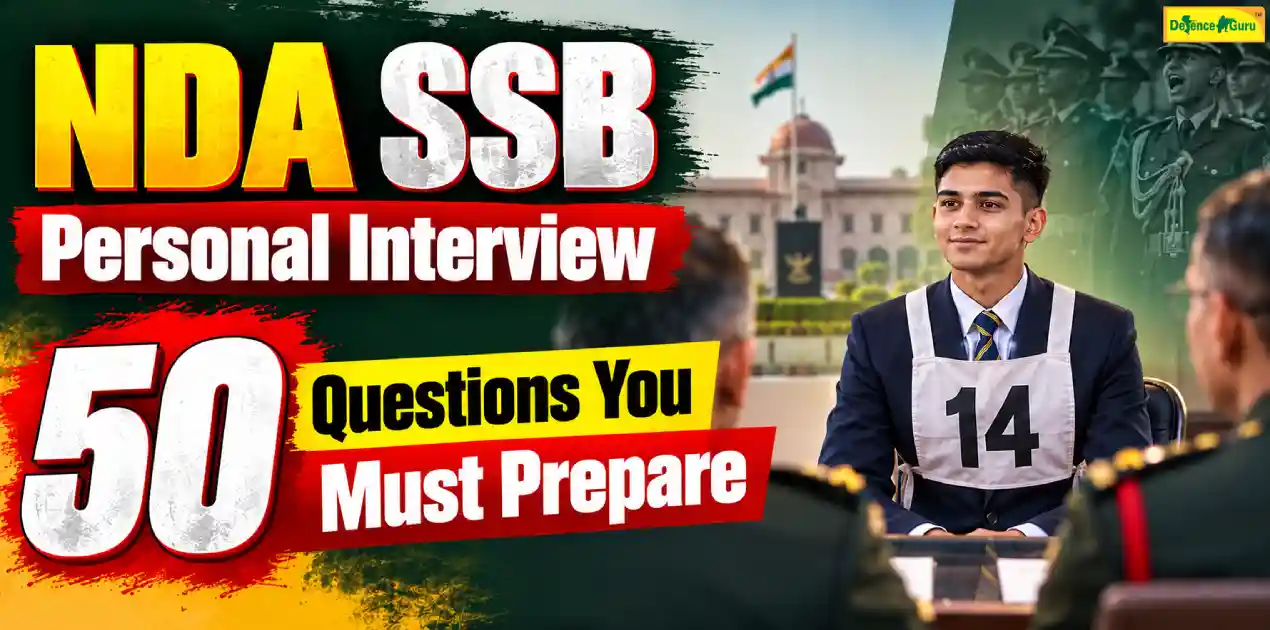
Clearing the NDA written exam is a big achievement, but the journey does not end there. The next major stage is the SSB interview, where the focus shifts from what you have studied to who you are as a person.
The NDA SSB Personal Interview is conducted by the Interviewing Officer (IO) and is an important part of Stage II of the Services Selection Board process. During the interview, you may be asked about almost anything connected to your life—your family, school, academics, friends, hobbies, sports, daily routine, achievements, failures, current affairs, and, of course, your motivation to join the Armed Forces.
The important thing to understand is that there is no fixed list of NDA SSB interview questions that every candidate will face.
Your answers can lead the IO in completely different directions.
For example, if you say that cricket is your hobby, you may be asked about your favourite player, your position, recent matches, rules of the game or even what you would do differently as a team captain.
That is why SSB Personal Interview preparation is not about memorising model answers. It is about knowing yourself, your experiences, and your surroundings well enough to have a natural conversation with the IO.
To help you prepare better, here are 50 NDA SSB Personal Interview questions divided into important categories.
What Is the NDA SSB Personal Interview?
The SSB process is designed to assess whether a candidate has the qualities and potential required to become an officer in the Armed Forces. Stage II includes the Interview, GTO tasks, Psychology Tests, and Conference.
The Personal Interview allows the Interviewing Officer to understand your personality, background, awareness, decision-making ability, communication, and motivation.
The interview can be conversational, but that does not mean it will always be easy.
The IO may start with simple questions and gradually move towards more detailed or situational questions. Your answer to one question can become the basis for the next five questions.
So, instead of asking, “What questions are going to come?”, prepare yourself for “What can they ask me about my life?”
50 NDA SSB Personal Interview Questions
1. Personal & Self-Awareness Questions
The interview usually begins with questions that help the IO understand you as an individual. These questions may look simple, but they can lead to detailed follow-ups.
- Tell me something about yourself.
- What are your three strongest qualities?
- What is one weakness you are currently working on?
- What is your biggest achievement so far?
- What has been your biggest failure, and what did you learn from it?
- What is one thing you have changed about yourself in the last year?
- What would your friends say about you?
- What is one quality you would like to develop in yourself?
Sample Answer 1: Tell me something about yourself.
Example:
“My name is Rahul, and I am from Lucknow. I recently completed my Class 12 with Science and Mathematics. Apart from academics, I regularly play cricket and participate in school activities. I also enjoy reading about defence and following current affairs. I would describe myself as consistent and responsible. I want to join the Armed Forces because I am interested in a career that combines responsibility, discipline, and teamwork.”
Sample Answer 2: What are your three strongest qualities?
Example:
“I would say consistency, willingness to learn, and responsibility are my three strongest qualities. Once I take up a task, I try to complete it on time. I also try to learn from my mistakes instead of repeating them. At home and in school, I have handled responsibilities such as helping with household work and managing group activities.”
Sample Answer 3: What is one weakness you are currently working on?
Example:
“Earlier, I used to spend too much time trying to make a task perfect, which sometimes affected my time management. I have been working on this by setting time limits for different tasks and prioritising important work first. I have improved compared to before, but I am still working on it.”
How to prepare
Do not simply memorise qualities such as “leadership”, “confidence” or “discipline”. If you mention a quality, be ready to support it with a real example from your life.
Similarly, when discussing a weakness, choose something genuine and explain what you are doing to improve it.
2. Family & Relationships
Your family is another important area for NDA SSB interview questions. The IO may want to understand your relationships, responsibilities, and social environment.
- Tell me about your family.
- What responsibilities do you handle at home?
- What have you learned from your parents?
- Who are you closest to in your family and why?
- What is one thing you disagree with your parents about?
- How do you handle disagreements with your family members?
- What would your parents consider your biggest weakness?
Sample Answer 1: Tell me about your family.
Example:
“We are a family of four. My father works in the private sector, my mother manages the household, and I have a younger sister who is studying in school. We share a close relationship and discuss important decisions together. I also help my parents with household responsibilities whenever required.”
Sample Answer 2: What have you learned from your parents?
Example:
“My father has taught me the importance of consistency and completing responsibilities on time. From my mother, I have learned patience and the importance of managing different responsibilities together. I try to apply these lessons in my studies and daily routine.”
Sample Answer 3: How do you handle disagreements with your family members?
Example:
“I first try to understand why the other person has a different opinion. If I still disagree, I explain my point calmly instead of arguing. Sometimes I realise that their point is more practical, and in that case I am comfortable accepting it. I believe disagreement does not necessarily have to become a conflict.”
How to prepare
Know basic details about your family members, including their education, occupation, interests, and your relationship with them.
Also think about the responsibilities you actually handle at home. The IO may ask follow-up questions based on your answers.
3. Academics & School Life
Your academic record can provide several directions for the IO to explore. Don't expect questions only about your favourite subject.
- Which subject do you like the most and why?
- Which subject do you find difficult?
- Why did you choose your present stream?
- Why did your marks increase or decrease in your last examination?
- Which teacher has influenced you the most?
- What responsibilities or positions have you held in school?
- Which school activity or competition are you most proud of?
Sample Answer 1: Which subject do you like the most and why?
Example:
“Mathematics is my favourite subject because I enjoy solving problems logically. I particularly like questions where I have to understand the problem first and then find a systematic solution. It also teaches me patience because sometimes the solution is not immediately obvious.”
Sample Answer 2: Why did your marks decrease in your last examination?
Example:
“My marks decreased mainly because I did not manage my preparation time properly. I focused more on a few subjects and gave less time to others. After analysing my result, I changed my study schedule and started taking regular practice tests. My performance improved in the following examinations.”
Sample Answer 3: Which teacher has influenced you the most?
Example:
“My Mathematics teacher influenced me the most because she always encouraged us to understand concepts instead of simply memorising formulas. She also gave me additional responsibility during group activities, which helped me become more confident while communicating with others.”
How to prepare
If you mention a school position, competition or achievement, remember the details.
The IO may ask:
- What exactly was your role?
- What did you contribute?
- How many students participated?
- What was the outcome?
- What did you learn from the experience?
Do not take credit for an achievement if you cannot explain your actual contribution.
4. Friends, Hobbies & Daily Routine
This is one of the most common areas in an SSB Personal Interview because it allows the IO to understand your interests and everyday behaviour.
- Who is your best friend and why?
- What qualities do you look for in a friend?
- Have you ever had a serious disagreement with a friend?
- What are your hobbies?
- How long have you been pursuing your main hobby?
- What have you learned from your hobby?
- What does your daily routine look like?
- How do you manage your time between studies, hobbies, and other activities?
Sample Answer 1: Who is your best friend and why?
Example:
“My best friend is Arjun. We have been friends since Class 9. I value his honesty and the fact that he gives me straightforward feedback whenever I make a mistake. We also study together and play cricket in our free time.”
Sample Answer 2: What are your hobbies?
Example:
“My main hobbies are reading and playing cricket. I usually read for around 30 minutes in the evening, mainly books related to biographies and history. I also play cricket with my friends on weekends.”
If you mention reading as a hobby, be prepared for questions about the books you have read, your favourite author, and what you learned from them.
If you mention cricket, you may be asked about your position, rules, players, teams and recent matches.
Sample Answer 3: What does your daily routine look like?
Example:
“I usually wake up around 6 a.m. and spend some time exercising. After breakfast, I attend my classes and complete my academic work. In the evening, I revise my subjects and spend some time playing cricket or exercising. I also keep some time for reading and current affairs before going to bed.”
How to prepare
Never mention a hobby simply because you think it sounds impressive.
Your hobby should be something you genuinely pursue.
The IO can easily explore whether your hobby is genuine by asking detailed follow-up questions.
5. Sports, Fitness & Lifestyle
For NDA aspirants, physical fitness and participation in sports can naturally become part of the conversation.
- Which sport do you play or follow?
- Who is your favourite sportsperson and why?
- What recent sporting event have you followed?
- How do you maintain your physical fitness?
- What do you usually do in your free time?
- How much time do you spend on social media or your phone?
Sample Answer 1: Which sport do you play or follow?
Example:
“I regularly play cricket and also follow athletics. I usually play as a middle-order batsman and occasionally bowl. I enjoy cricket because it requires both individual performance and teamwork. Playing regularly has also taught me to stay composed when the team is under pressure.”
Sample Answer 2: How do you maintain your physical fitness?
Example:
“I usually exercise in the morning. My routine includes running, push-ups, squats, and basic strength exercises. I also play outdoor sports regularly. I try to maintain a balanced diet and get adequate sleep because I believe fitness depends on the overall routine, not just exercise.”
Sample Answer 3: How much time do you spend on social media or your phone?
Example:
“I use my phone mainly for communication, study material, and keeping up with important news. I also spend some time on social media for entertainment. I try to keep my recreational screen time limited, especially during study hours, by keeping my phone away when I need to concentrate.”
How to prepare
There is no need to pretend that you never use your phone or social media.
The important thing is to demonstrate that you can manage your time and responsibilities sensibly.
6. NDA & Armed Forces Questions
If you are appearing for the NDA SSB interview, the IO will naturally want to know why you want to join the Armed Forces.
- Why do you want to join the Armed Forces?
- Why have you chosen NDA as your entry route?
- Why do you prefer the Army, Navy, or Air Force?
- What do you know about the National Defence Academy?
- What qualities do you think an Armed Forces officer should have?
- Who is your favourite military leader and why?
- What is the difference between a leader and a boss?
- What will you do if you are not recommended in your first SSB attempt?
Sample Answer 1: Why do you want to join the Armed Forces?
Example:
“I want a career that combines responsibility, discipline, teamwork, and service to the country. My interest in the Armed Forces developed through my exposure to defence-related activities and reading about military life. Over time, I realised that I am attracted to the challenges and responsibilities associated with being an officer. That is why I want to pursue this career through the NDA.”
Sample Answer 2: Why have you chosen NDA as your entry route?
Example:
“I see NDA as an opportunity to begin military training at an early stage and develop alongside cadets from the Army, Navy, and Air Force. I also like the idea of receiving academic education along with military training and learning in a joint-service environment. Since I want to join the Armed Forces after Class 12, NDA is the entry route I want to pursue.”
Sample Answer 3: What will you do if you are not recommended in your first SSB attempt?
Example:
“I would first analyse where I fell short instead of treating the result as the end of my goal. I would take feedback from reliable sources, work on the areas that genuinely need improvement, and prepare again. At the same time, I would continue improving my academics, fitness and overall personality.”
How to prepare
Do not limit your preparation to memorising facts about the NDA.
You should understand why you want this career.
If your answer is:
“I want to serve the nation.”
the IO may naturally ask:
“Why the Armed Forces? Why not another profession through which you can serve the country?”
Think about your own reasons, experiences, and aspirations before appearing for the interview.
7. Current Affairs & Defence Awareness
A future officer is expected to remain aware of what is happening around him. Therefore, current affairs for SSB should be an important part of your preparation.
- What recent national issue have you been following?
- What recent defence development caught your attention?
- What do you know about India's defence modernisation?
- What recent achievement of the Indian Armed Forces impressed you?
Sample Answer 1: What recent defence development caught your attention?
Example:
“One defence development that caught my attention was India's continued focus on indigenous defence production and modernisation. I find it interesting because developing equipment domestically can contribute to technological capability and reduce dependence on imports. I try to follow such developments through reliable news sources and official information.”
Sample Answer 2: What recent national issue have you been following?
Example:
“I have been following developments related to employment and skill development among young people. I find the issue important because education and employable skills are closely connected with opportunities for young people. I have been reading different perspectives on the subject rather than relying only on social media posts.”
Sample Answer 3: What do you know about India's defence modernisation?
Example:
“India's defence modernisation involves upgrading equipment, improving technology and strengthening capabilities across the Army, Navy and Air Force. It includes areas such as indigenous defence production, modern platforms, surveillance, communications and newer technologies. I am still learning about the subject, so I try to follow official announcements and credible defence reporting regularly.”
How to prepare
Do not try to memorise hundreds of headlines.
Instead, follow important developments related to:
- Indian defence
- National security
- International relations
- India's neighbourhood
- Defence technology
- Major government initiatives
- Sports
- Important national and international events
Also remember that your current affairs preparation should not stop after the NDA written examination. Continue following important developments while preparing for SSB.
8. Situational & Decision-Making Questions
The Personal Interview may also include questions that put you in a hypothetical situation.
- If your team is failing because nobody is taking responsibility, what will you do?
- If you strongly disagree with your senior's decision, how would you handle it?
Sample Answer 1: If your team is failing because nobody is taking responsibility, what will you do?
Example:
“I would first understand why the team members are not taking responsibility. If the task is divided among us, I would clarify the roles and encourage everyone to take ownership of their part. If something needs immediate attention, I would take responsibility for it rather than waiting for someone else. I would also keep the team focused on completing the task instead of blaming individuals.”
Sample Answer 2: If you strongly disagree with your senior's decision, how would you handle it?
Example:
“I would first try to understand the reason behind the decision. If I have relevant information or a genuine concern, I would respectfully present my point at an appropriate time. Once the decision is made, I would follow the instructions unless they involve something clearly improper or unlawful. I believe disagreement should be communicated respectfully rather than turning into an argument.”
How to prepare
These questions do not have one magical “SSB answer”.
The IO is interested in understanding how you think.
Your response should be practical and consistent with the situation. Do not force leadership into every answer simply because you are preparing for the Armed Forces.
Don't Prepare These 50 Questions as 50 Memorised Answers
This is probably the most important point for every NDA aspirant.
You may find hundreds of websites offering “SSB interview questions with answers” or “most asked SSB questions”. Such lists can certainly help you understand the areas you need to prepare, but memorising their answers can actually work against you.
The IO is not conducting a multiple-choice test.
Suppose the IO asks:
“What is your hobby?”
You answer:
“Playing cricket.”
That may lead to:
- Which position do you play?
- How long have you been playing?
- Who is your favourite player?
- Which team do you support?
- What was the last match you watched?
- What is the current performance of the team?
- What is your role when your team is under pressure?
Have you ever captained a team?
Suddenly, one question has become eight.
This is why PIQ-based SSB preparation is so important.
Your Personal Information Questionnaire can become one of the most useful preparation documents before the interview. Go through every detail you have mentioned and think about what follow-up questions the IO could ask.

How to Prepare for NDA SSB Personal Interview Questions
Instead of preparing hundreds of fixed answers, divide your preparation into different areas of your life.
Know Your PIQ
Read every entry carefully. Be ready to discuss your academic record, achievements, activities, responsibilities, hobbies, and other details you have mentioned.
Know Your Family
Know what your parents and siblings do, your relationship with them, and what responsibilities you take at home.
Know Your Academics
Revise your basic subjects and be prepared to explain your academic performance honestly.
Know Your Hobbies
Don't just know the name of your hobby. Know the subject well enough to have a meaningful conversation about it.
Follow Current Affairs
Read reliable news sources regularly, especially developments related to India, defence, international affairs, and national security.
Understand the NDA
Know the basic facts about the National Defence Academy, its role, training, and the three services.
Understand Your Motivation
Ask yourself:
“Why do I actually want to become an officer?”
Your answer should come from your own experiences and aspirations rather than a sentence you found online.
Common Mistakes Candidates Make in the SSB Personal Interview
Even a well-prepared candidate can make mistakes if the preparation becomes too artificial.
Giving memorised answers
The IO can ask follow-up questions, and memorised answers become difficult to maintain.
Bluffing
If you don't know an answer, don't invent one just to avoid saying “I don't know.”
Mentioning fake hobbies
Never add hobbies simply because you think they will impress the IO.
Giving exaggerated answers
You don't need to present yourself as perfect. The interview is about understanding your personality, not proving that you have never made a mistake.
Contradicting yourself
Your answers should be consistent with your PIQ, psychology responses, and other parts of the SSB process.
Ignoring current affairs
You don't need to become a walking newspaper, but you should know what is happening around you.
Trying too hard to display OLQs
Don't turn every answer into a leadership speech. Let your qualities come naturally through your experiences and responses.
What Makes a Good SSB Personal Interview Preparation Strategy?
A good strategy is simple:
Prepare your life, not a script.
Take a notebook and divide it into sections:
- About Me
- Family
- School
- Academics
- Friends
- Hobbies
- Sports
- Daily Routine
- Achievements
- Failures
- Current Affairs
- NDA
- Armed Forces
- Future Plans
Write down possible questions under each section.
Then practise answering them in your own words.
Don't worry about making every answer sound polished. Instead, focus on being clear, honest, and comfortable while speaking.
You can also ask a friend, teacher or mentor to conduct a mock SSB interview and keep asking follow-up questions based on your answers.
That will give you a much better idea of how a real conversation can develop.
Final Thoughts
The NDA SSB Personal Interview is not a competition to see who has memorised the largest number of questions and answers.
It is an opportunity for the Interviewing Officer to understand your background, interests, motivation, awareness, responsibilities, strengths, and areas where you still need to improve.
So, use these 50 NDA SSB interview questions as a starting point, not as a script.
Know your PIQ. Know your family. Understand your academics. Follow current affairs. Be aware of the Armed Forces. Be honest about your strengths and weaknesses.
And whenever you prepare an answer, ask yourself one more question:
“What could the IO ask me next?”
That simple habit can make your SSB interview preparation much more effective and help you walk into the Personal Interview with greater confidence and clarity.
Read more:
NDA SSB Psychology Tests: TAT, WAT & SRT Explained
NDA SSB Personal Interview Questions with Best Answer Approach