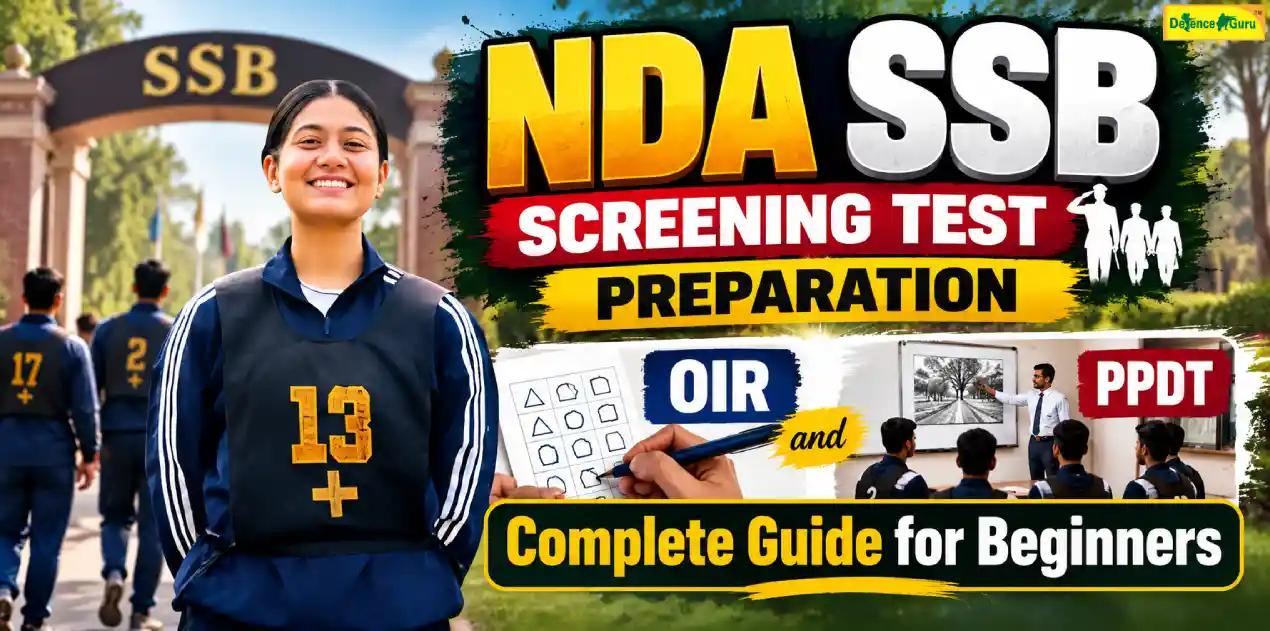
Clearing the NDA written examination is an important milestone, but the next challenge is preparing for the Services Selection Board (SSB) interview. The first stage of the SSB process is screening, which includes the Officer Intelligence Rating (OIR) test and the Picture Perception and Discussion Test (PPDT).
Both tests assess different abilities. OIR focuses on reasoning, observation, and problem-solving, while PPDT evaluates how candidates interpret a situation, write a story, express their ideas, and participate in a group discussion.
If you are preparing for your first NDA SSB interview, this guide covers the screening process, OIR practice questions, PPDT story-writing techniques, narration tips, group discussion strategies, and common mistakes to avoid.
What Is the NDA SSB Screening Test?
The NDA SSB screening test is the first stage of the selection process for candidates reporting to an SSB centre. It generally consists of two components:
- Officer Intelligence Rating (OIR): Verbal and non-verbal reasoning questions.
- Picture Perception and Discussion Test (PPDT): Picture observation, story writing, individual narration and group discussion.
Candidates are assessed on their overall screening performance. Performing well in only one component does not guarantee screening-in.
Candidates who clear Stage I proceed to Stage II, which includes psychological tests, Group Testing Officer (GTO) tasks, and a Personal Interview, followed by the applicable conference process.
1. OIR Test Preparation for NDA SSB
The OIR test evaluates reasoning ability, logical thinking, and problem-solving within a limited time. Questions commonly cover verbal and non-verbal reasoning.
Important OIR Topics
- Verbal reasoning
- Number and alphabet series
- Coding and decoding
- Analogy and classification
- Blood relations
- Direction sense
- Ranking and ordering
- Non-verbal reasoning
- Figure series and classification
- Mirror and water images
- Embedded figures
- Pattern completion
- Figure analogy
How to Prepare for OIR
Start by understanding the logic behind each question type. Practise for 20–30 minutes daily, gradually introducing timed exercises. After each session, review incorrect answers to identify whether the problem was a misunderstanding, calculation error or lack of time.
Avoid spending too long on a single question. Regular mock tests can help you improve speed while maintaining accuracy.
OIR Practice Questions
Try these sample questions before checking the answers.
Question 1: Number Series
Find the next number:
3, 7, 13, 21, 31, ?
A. 39
B. 41
C. 43
D. 45
Answer: C. 43
Explanation: The differences are +4, +6, +8, and +10. The next difference is +12, giving 43.
Question 2: Coding and Decoding
If CAT is written as DBU, how will DOG be written?
A. EPH
B. EOG
C. FPH
D. EPI
Answer: A. EPH
Explanation: Each letter is replaced by the next letter in the alphabet.
Question 3: Direction Sense
A candidate walks 5 metres north, turns right and walks 3 metres, then turns right again and walks 5 metres. Where is the candidate from the starting point?
A. North
B. South
C. East
D. West
Answer: C. East
Explanation: The northward and southward movements cancel each other out, leaving the candidate 3 metres east of the starting point.
2. PPDT Preparation: Picture Perception and Story Writing
PPDT tests how candidates interpret a visual situation and develop a logical story around it. It also assesses their ability to communicate their ideas and participate in a group discussion.
The exercise generally involves four steps:
- Observing the picture.
- Writing a story.
- Narrating the story individually.
- Participating in a group discussion.
The exact instructions and time limits should be confirmed at the SSB centre.
Step 1: Observe the Picture Carefully
When the picture appears, focus on the main details rather than trying to invent an elaborate situation.
Observe the number of characters, their apparent activities, the surroundings, and any visible problem. Identify details that can reasonably support your interpretation.
Avoid spending too much time guessing information that cannot be established from the picture.
Step 2: Write a Logical Story
A simple structure can make your story clearer:
- Character: Introduce the main character.
- Situation: Explain the circumstances or problem.
- Action: Describe the steps taken to address the situation.
- Outcome: Conclude with a believable result.
Your story should relate to the picture. Avoid unnecessary drama, unrealistic achievements, and memorised plots that do not fit the situation.
PPDT Sample Exercise
Imagine a picture showing three young people near a damaged village road, with a bicycle lying nearby and a few houses in the background.
Practice task: Write a story based on the picture in approximately four minutes.

Sample story:
Rahul, a 20-year-old college student, noticed that heavy rain had damaged a road in his village. The damaged section was creating difficulties for cyclists and pedestrians. He informed the village authorities and coordinated with nearby residents to place a visible warning near the unsafe area. He also helped guide people towards a safer route until repairs could be arranged. His initiative helped reduce the immediate risk and brought the problem to the attention of the responsible authorities.
Why does this story work?
- It connects with the visible situation.
- The character takes practical and believable action.
- The story follows a logical sequence.
- The outcome relates directly to the actions described.
There is no single model story that guarantees success. Use examples to understand story structure, then develop your own interpretation of each picture.
Many aspirants initially struggle to connect the visible details with a realistic story or explain their interpretation confidently. Practising under time limits and receiving feedback on story structure, narration, and participation can help them identify areas for improvement. Candidates looking for guided practice can also explore structured SSB preparation programmes offered by institutes such as Centurion Defence Academy, where screening-related exercises can complement individual preparation.
The aim should be to develop your own ability to interpret unfamiliar situations rather than memorise ready-made stories.
3. PPDT Narration Tips
After story writing, candidates generally narrate their stories individually before the group discussion. Clear narration helps others understand your interpretation.
To improve your narration:
- Start with the main character and situation.
- Explain the problem or objective.
- Describe the actions in the correct sequence.
- End with the outcome.
- Speak clearly at a natural pace.
Practise narrating your story in about a minute, adjusting the duration to the instructions provided during the test.
A useful exercise is to record yourself on your phone. Listen for unclear sentences, repeated words, unnecessary pauses, and rushed delivery. Repeat the exercise until you can communicate the story comfortably without memorising every sentence.
Remember, narration is about clarity rather than dramatic delivery. You do not need to use complicated English or imitate someone else's speaking style. Focus on expressing your ideas naturally and coherently.
4. PPDT Group Discussion Strategies
Group discussion can be challenging, especially when several candidates have different interpretations of the same picture. The objective is to communicate your ideas, listen to others, and contribute towards a reasonable common story.
Here are some practical tips:
- Express your interpretation clearly: Explain your main character, situation, and actions without repeating the entire story unnecessarily.
- Listen to other candidates: Their observations may help you identify details you overlooked.
- Build on relevant ideas: Acknowledge useful points and explain how they fit into the common interpretation.
- Disagree respectfully: Present a different viewpoint without interrupting or dismissing others aggressively.
- Participate actively: Do not remain silent throughout the discussion, but avoid speaking repeatedly without adding value.
- Help the group conclude: Where possible, connect relevant observations into a coherent sequence.
Group Discussion Practice Exercise
Suppose some candidates believe the main character is organising a community activity, while others think the character is responding to an emergency.
Instead of repeatedly defending your own story, consider the visible details and the reasoning behind each interpretation. Contribute a relevant observation and help the group develop a logical common story.
For example, you could explain which visible details support your interpretation and suggest how the group can use those observations to develop a coherent sequence.
Speaking the most does not automatically mean performing the best. Clear communication, listening, and constructive participation are equally important.
5. Common Mistakes to Avoid During Screening
Many candidates focus heavily on the NDA written examination and begin practising for SSB screening only shortly before their reporting date. This can leave little time to improve their reasoning speed, narration and discussion skills.
Avoid these common mistakes:
- Preparing only for OIR: Practise PPDT story writing, narration, and group discussion alongside reasoning questions.
- Writing unrealistic stories: Focus on believable actions rather than extraordinary achievements.
- Ignoring the picture: Keep your interpretation connected to the visible details.
- Memorising sample stories: Develop your own response to each new picture.
- Speaking aggressively: Confidence does not require interrupting or dominating the discussion.
- Remaining silent: Practise expressing relevant points instead of waiting for the perfect moment.
- Ignoring time management: Use timed exercises to become comfortable working within the allotted time.
- Trying to act like an officer: Focus on the task, logical thinking, and natural communication rather than artificial behaviour.
The most useful preparation method is to identify your mistakes after every practice session and work on them consistently.
6. Seven-Day NDA SSB Screening Preparation Plan
A structured routine can help you prepare for screening without feeling overwhelmed. If you are starting from scratch, the following seven-day plan is a practical starting point.
|
Day |
Preparation |
|
Day 1 |
Understand the screening process and practise verbal reasoning. |
|
Day 2 |
Solve non-verbal reasoning questions. |
|
Day 3 |
Attempt timed OIR practice sets. |
|
Day 4 |
Practise picture perception and write two PPDT stories. |
|
Day 5 |
Narrate your stories and review clarity and pace. |
|
Day 6 |
Participate in a mock group discussion. |
|
Day 7 |
Attempt a mock screening session and analyse your performance. |
After completing the first week, repeat the routine with new questions and pictures. Keep track of recurring mistakes and spend more time on the areas where you need improvement.
Candidates who find it difficult to evaluate their own performance can consider mock screening sessions or mentor-guided practice. For example, aspirants exploring SSB preparation at Centurion Defence Academy can assess whether its training approach, practice opportunities, and feedback align with their learning needs.
Self-study remains useful, but constructive feedback can help candidates recognise habits they may otherwise overlook. The key is to use feedback to improve your performance rather than simply collect model answers.
7. Should You Join Coaching for NDA SSB Screening?
Self-study is a practical starting point for NDA SSB preparation. Reasoning books, sample questions, picture exercises, and regular timed practice can help candidates build a foundation. However, evaluating your own narration and group discussion performance can sometimes be difficult.
Before selecting a coaching institute, consider the following:
- Regular OIR practice and mock tests.
- PPDT story-writing and narration exercises.
- Opportunities for group discussion practice.
- Specific feedback on individual performance.
- Mentors who explain how to improve rather than simply provide model answers.
Centurion Defence Academy is one option candidates can consider when exploring structured defence examination and SSB preparation. Aspirants who want to supplement independent study with guided exercises can review its SSB preparation programmes and compare the available training format, schedule and practice opportunities with their requirements.
Coaching is not compulsory, and no institute can guarantee screening-in. Consistent practice, honest self-assessment and familiarity with the test format remain important regardless of how you prepare.
Final Thoughts
NDA SSB screening preparation requires more than solving reasoning questions or writing an impressive story. It involves observation, logical thinking, time management, and clear communication.
Practise OIR regularly, develop your PPDT story-writing skills, work on narration, and participate in mock group discussions. Analyse your mistakes after every session and focus on steady improvement.
Starting early and following a consistent routine can help you approach your SSB screening test with greater confidence. Whether you prepare independently or explore guided training at an institute such as Centurion Defence Academy, focus on understanding the process, learning from feedback, and developing the ability to handle unfamiliar situations naturally.
Frequently Asked Questions
1. What are the main components of NDA SSB screening?
The two main components are the OIR test and PPDT, which includes picture perception, story writing, narration, and group discussion.
2. How can I improve my OIR performance?
Practise verbal and non-verbal reasoning daily, attempt timed mock tests, and review incorrect answers to improve speed and accuracy.
3. How do I write a good PPDT story?
Observe the picture, identify a plausible situation, describe practical actions, and conclude with a believable outcome. Keep your story connected to the visible details.
4. Can I clear SSB screening without coaching?
Yes. Self-study, reliable practice material, and regular mock tests can help candidates prepare independently. Coaching may provide additional structure and feedback, but it cannot guarantee selection.
5. What happens after screening-in?
Candidates proceed to Stage II testing, which includes psychological tests, GTO tasks, and a Personal Interview, followed by the applicable conference process.
6. Is speaking more important than listening during PPDT group discussion?
No. Candidates should communicate their ideas clearly while listening to others and contributing constructively. Speaking frequently without adding relevant points is not the objective.
Read more:
NDA 2 2026 Result Out – Next Steps, SSB Process & Preparation Tips
Shishir Dixit’s Ranneeti: Complete Guide for SSB Interview Preparation