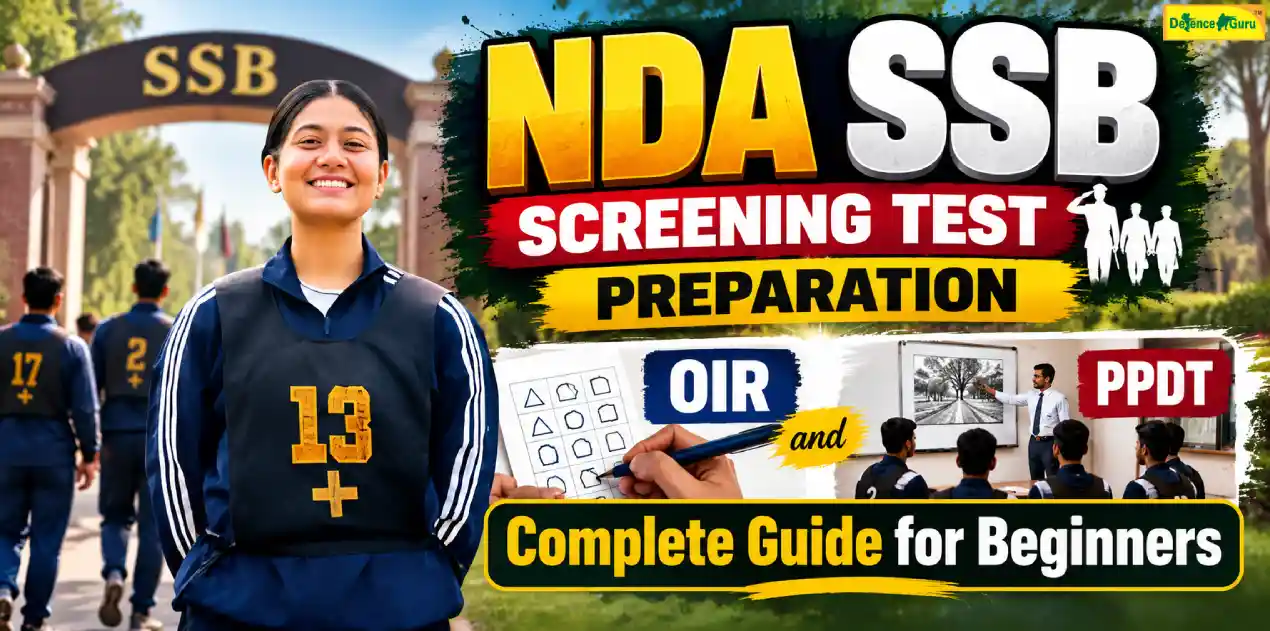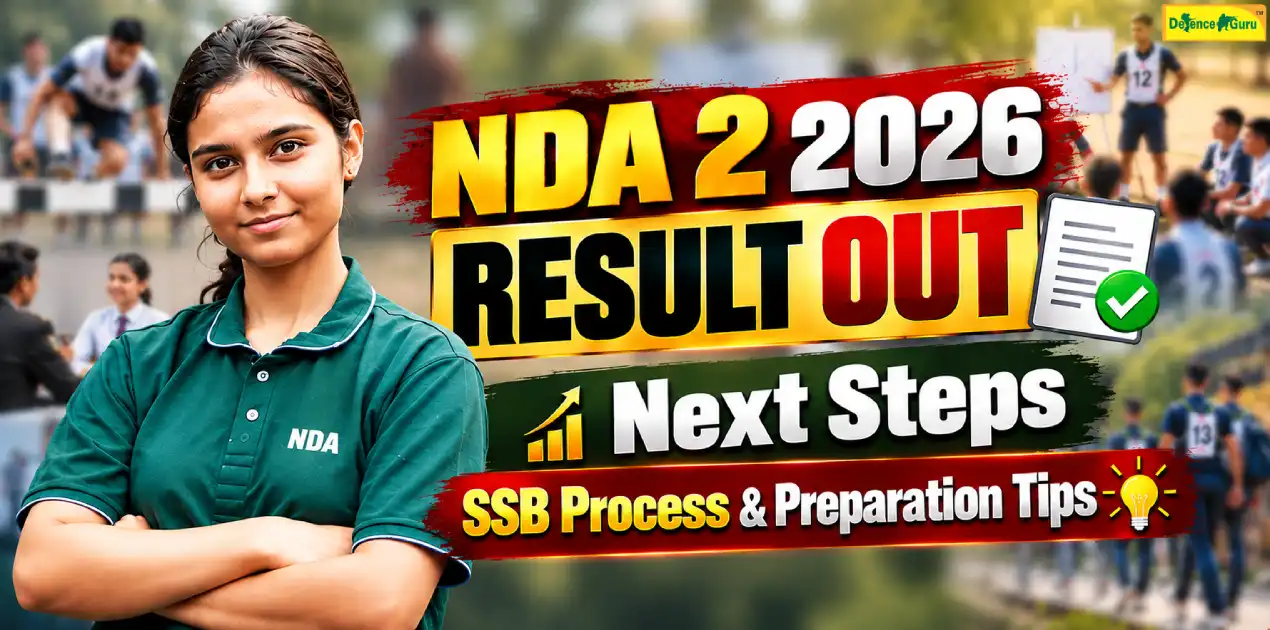
Clearing the NDA written exam is an important step towards becoming an officer in the Indian Armed Forces, but it is not the final stage of selection. After qualifying for the written exam, female candidates must clear the Services Selection Board (SSB) interview, which assesses their intelligence, personality, communication skills, teamwork, and potential to become officers.
The NDA SSB interview for girls follows the same core assessment process as for boys, including screening, psychological tests, Group Testing Officer (GTO) tasks, a personal interview, and the final conference. Candidates should prepare for each stage while developing the confidence, self-awareness, and practical thinking required during the assessment. The selection process also includes a medical examination and final merit preparation.
For girls preparing for NDA, understanding the SSB process in advance can make the experience less intimidating. Let’s look at each stage, how to prepare effectively, and the common questions you should be ready to answer.
What Is the NDA SSB Interview for Girls
The Services Selection Board interview assesses a candidate’s suitability for a career as an officer in the Armed Forces. It goes beyond academic knowledge and looks at how a candidate thinks, communicates, makes decisions, and works with others.
Female candidates became eligible for admission to the National Defence Academy through the common UPSC NDA examination, with the first batch of women cadets joining the academy in August 2022. The written examination is common, while vacancies and merit lists for male and female candidates are prepared separately as specified in the applicable examination notification.
The main objective of the SSB is to assess Officer Like Qualities (OLQs), such as effective intelligence, reasoning ability, social adaptability, cooperation, responsibility, initiative, and the ability to take decisions.
You do not need to be perfect in every activity. What matters is how you approach a situation, interact with others, learn from your experiences, and demonstrate your potential.
NDA SSB Interview Process for Girls
The SSB selection process is divided into two stages. Stage I is the screening stage, while Stage II includes psychological tests, GTO tasks, the personal interview, and the conference. Stage II is generally conducted over the following four days.
Here is a breakdown of the process.
Stage I – Screening Test
Screening takes place on the first day of reporting. It includes two major assessments.
1. Officer Intelligence Rating Test (OIR)
The OIR test checks your verbal and non-verbal reasoning abilities. Questions may involve:
- Number and letter series
- Coding and decoding
- Analogy and classification
- Spatial reasoning
- Pattern recognition
- Basic logical reasoning
The best way to prepare is to practise different question types regularly, improve your speed, and learn to manage time without making careless mistakes.
2. Picture Perception and Discussion Test (PPDT)
In PPDT, candidates observe a picture for a limited time and write a story based on what they perceive. They then narrate their stories and participate in a group discussion to arrive at a common or acceptable conclusion.
For example, the picture may show a person standing near a vehicle or a group of people in an unfamiliar setting. You need to interpret the situation, identify a practical course of action, and build a logical story.
During the discussion, focus on expressing your ideas clearly and listening to others. Avoid shouting, interrupting repeatedly, or forcing your story on the group.
Candidates are screened based on their performance in the OIR test and PPDT. Those who do not clear Stage I do not proceed to Stage II.
Stage II – Psychological Tests
Candidates who clear screening proceed to the next stage, which evaluates their thought process, reactions, and understanding of themselves and their surroundings.
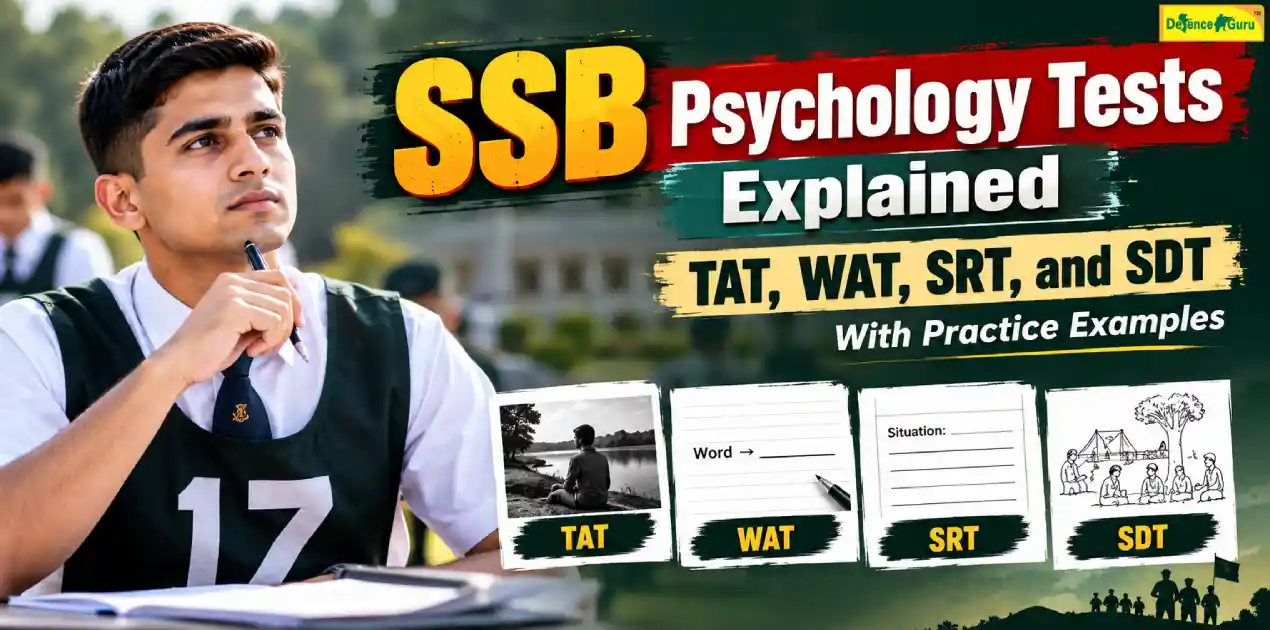
The main psychological tests include the following.
|
Test |
What it assesses |
|
Thematic Apperception Test (TAT) |
Your ability to interpret pictures and develop meaningful stories |
|
Word Association Test (WAT) |
Your spontaneous responses to words |
|
Situation Reaction Test (SRT) |
Your approach to everyday problems and challenging situations |
|
Self-Description Test (SDT) |
Your understanding of your strengths, weaknesses, and how others perceive you |
These tests are not simply about writing positive sentences. Your responses should reflect realistic thinking, responsibility and practical decision-making.
For instance, in a situation where a teammate struggles to complete a task, a sensible response would consider the problem, available resources and how you could help. It would not simply describe yourself as a perfect leader.
Preparation tip: Practise writing within time limits, observe situations around you and reflect on how you respond to everyday challenges. Do not memorise ready-made TAT stories or WAT responses.
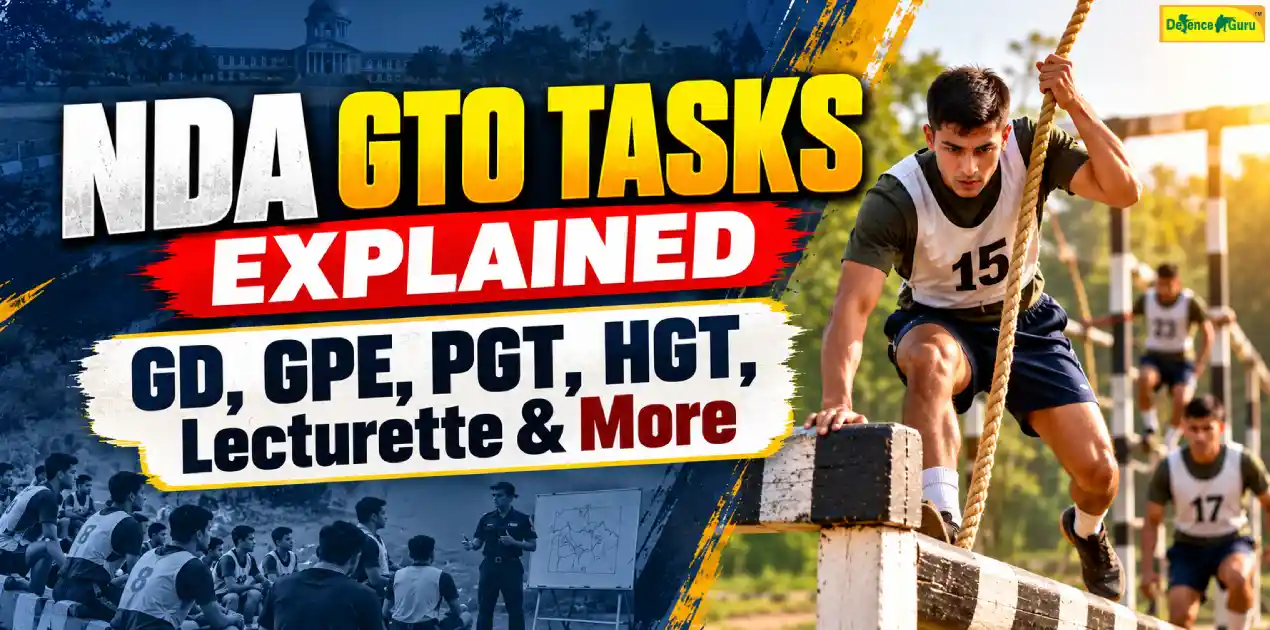
Stage II – Group Testing Officer Tasks
GTO tasks evaluate how you work in a group, communicate ideas, solve problems, and handle responsibilities.
These activities include indoor and outdoor assessments, such as:
- Group Discussion (GD)
- Group Planning Exercise (GPE)
- Progressive Group Task (PGT)
- Half Group Task (HGT)
- Individual Obstacles
- Group Obstacle Race
- Command Task
- Lecturette
- Final Group Task (FGT)
The exact activities and sequence may vary according to the assessment schedule.
During these tasks, you may need to discuss a problem, plan a solution, cross obstacles with your group, or take responsibility for a particular activity.
For girls preparing for NDA, it is important to remember that GTO tasks are not a competition to prove physical strength alone. They also assess practical intelligence, cooperation, initiative, courage, resourcefulness, and the ability to work with a team.
Build your general fitness, practise basic physical activities safely, and develop the habit of contributing useful ideas during group activities. You do not have to dominate every task to demonstrate your potential.
Stage II – Personal Interview
The personal interview is an opportunity for the Interviewing Officer to understand your background, interests, motivations, habits, achievements and overall personality.
Questions may cover your family, school life, academic performance, hobbies, friends, responsibilities, career goals, and awareness of current affairs.
The interviewer may also ask follow-up questions based on your answers. For example, if you mention that you enjoy playing a sport, you may be asked about the rules, your experience, or the lessons you have learned from it.
The most effective preparation is to understand your own profile thoroughly. Review the information you provide in your Personal Information Questionnaire (PIQ) and be prepared to explain your experiences honestly.
Final Stage – Conference
The conference takes place towards the end of the SSB process. The assessors review your performance across the different assessments and discuss your suitability for recommendation.
You may be asked a few questions about your experience at the board, your performance, or any aspect of your assessment. The interaction is generally brief, although the format can vary.
Do not treat the conference as an opportunity to give a rehearsed speech. Answer naturally, remain composed, and be respectful.
A recommendation at the SSB is followed by the applicable medical examination and merit-based selection process. Clearing the interview does not automatically guarantee final admission.
How Girls Can Prepare for the NDA SSB Interview
Preparing for SSB does not have to mean spending every day solving interview questions. A balanced routine that develops communication, reasoning, self-awareness, and fitness can help you become more comfortable with the process.
1. Develop a Clear Understanding of Yourself
Start by reviewing your academic background, interests, achievements, responsibilities, and personal experiences.
Think about the activities you enjoy, the challenges you have faced, and the areas where you want to improve. Be ready to explain your decisions and what you learned from your experiences.
You can also ask your parents, teachers, and friends how they would describe your strengths and areas for improvement. Compare their observations with your own understanding.
The goal is not to create an impressive personality on paper. It is to understand yourself honestly and work on areas that need improvement.
2. Practise Communication Every Day
Good communication does not mean speaking fluent English or using complicated vocabulary. It means expressing your thoughts clearly, listening carefully, and responding appropriately.
You can improve these skills through simple daily activities:
- Read a newspaper and summarise one important news story aloud.
- Discuss a current-affairs topic with friends.
- Practise speaking for two to three minutes on a familiar subject.
- Participate in group discussions without interrupting others.
- Work on expressing your ideas in English or Hindi, as appropriate.
The aim is to become comfortable communicating your thoughts rather than trying to sound impressive.
3. Build Awareness of Current Affairs
An NDA aspirant should understand important national and international developments, especially those related to defence, science, technology, sports, international relations and government policies.
Instead of memorising headlines, try to understand the background of an issue, why it matters and what its possible effects are.
For example, when reading about a defence exercise, learn which countries or forces participated, its purpose and the broader significance of the exercise.
This habit can support your personal interview, lecturette and group discussions.
4. Practise OIR and PPDT Regularly
Set aside time for reasoning practice and picture-based storytelling.
For OIR, begin with basic questions and gradually increase the difficulty and speed. After each practice session, review your mistakes rather than simply counting the questions you attempted.
For PPDT, practise identifying the characters, understanding the situation, and creating a logical story with a clear course of action.
During narration, keep your story organised and speak at a comfortable pace. During group discussions, focus on adding relevant points and helping the discussion move forward.
5. Understand Psychological Tests Through Practice
TAT, WAT, SRT and SDT require candidates to respond within specific time limits. Familiarity with the format can help reduce hesitation.
However, avoid memorising answers from coaching notes or online question banks. Prepared responses may not reflect how you actually think or react.
Instead, practise with different situations, write naturally, and review whether your responses are realistic, responsible, and relevant to the problem.
6. Improve Physical Fitness Gradually
Physical activity can help you feel more energetic and prepared for outdoor GTO tasks.
Build a routine that includes walking or jogging, basic strength exercises, mobility work, and other activities suited to your current fitness level. Increase intensity gradually and pay attention to recovery.
You do not need to compare your fitness with other candidates. Focus on improving your own stamina, coordination and confidence while following safe exercise practices.
7. Develop Teamwork and Decision-Making Skills
You can practise teamwork in everyday life through sports, school projects, group activities and community initiatives.
Try taking responsibility for small tasks, listening to different opinions and helping your group find practical solutions.
During group exercises, avoid assuming that leadership means giving instructions to everyone. A good contribution may involve suggesting an idea, supporting a teammate, identifying a problem or helping the group complete its task.
8. Prepare Your Personal Interview Profile
Review the information you have provided in your application and PIQ. Think about your school subjects, academic results, hobbies, achievements, daily routine, family responsibilities, and future plans.
If you have a weak subject or a gap in your performance, prepare to discuss it honestly. Do not invent achievements or make excuses for every setback.
A clear and truthful explanation is more useful than an answer designed only to impress the interviewer.
Common NDA SSB Interview Questions for Girls
There is no fixed list of questions that every female candidate will be asked. The questions depend on the candidate’s background, experiences and responses during the interview.
However, the following areas are useful for preparation.
|
Topic |
What you should prepare |
|
Personal introduction |
Your background, interests, achievements and future goals |
|
Family |
Family members, responsibilities and lessons learned at home |
|
Education |
Favourite subjects, academic performance and areas for improvement |
|
Hobbies |
Your interests, level of involvement and knowledge of the activity |
|
Defence motivation |
Why you want to join the Armed Forces and what you understand about military life |
|
Current affairs |
Important national, international and defence-related developments |
|
Situational questions |
How you approach problems, disagreements and unexpected challenges |
|
Strengths and weaknesses |
Genuine examples of your strengths and areas you are working to improve |
|
Teamwork and leadership |
Experiences involving cooperation, responsibility and decision-making |
|
Future plans |
Your goals, expectations from NDA training and willingness to take on responsibility |
Examples of Common Personal Interview Questions
Use these examples to practise organising your thoughts. They are illustrative questions, not a guaranteed or official list of SSB interview questions.
Personal background
- Tell me about yourself.
- How would your teachers or friends describe you?
- What responsibilities do you handle at home or school?
Education and interests
- Which subject do you enjoy the most and why?
- What do you do in your free time?
- What have you learned from a recent achievement or setback?
Motivation for joining the Armed Forces
- Why do you want to become an officer through NDA?
- What do you understand about the life of a cadet at NDA?
- What challenges do you expect in military training?
Situational judgement
- How would you handle a disagreement within a team?
- What would you do if your plan failed at the last moment?
- How would you respond if a teammate needed help completing an important task?
General awareness
- What are the major national and international developments you have been following?
- Which recent defence development interests you and why?
- What do you know about your preferred service and its responsibilities?
While practising, focus on the reasoning behind your answers. You should be able to explain your views, provide examples from your life, and respond naturally to follow-up questions.
Do Girls Face Different Questions in the NDA SSB Interview
The core assessment process is the same for male and female NDA candidates. Girls should prepare for the same broad areas of screening, psychological assessment, GTO tasks, personal interview, and conference.
Questions about personal motivation, family, education, responsibilities, and future goals may come up for any candidate. Some questions will naturally differ because every candidate has a different background and set of experiences.
Do not assume that you need to prepare a separate set of answers simply because you are a girl. Your preparation should be based on the qualities being assessed and your own profile.
The focus should remain on demonstrating sound judgement, responsibility, cooperation, confidence and the willingness to learn.
Common Mistakes Girls Should Avoid During SSB Preparation
Even candidates who prepare consistently can make avoidable mistakes. Keep the following points in mind.
- Memorising answers: Rehearsed responses can make it difficult to answer follow-up questions naturally.
- Trying to portray a perfect personality: Everyone has areas for improvement. Understand yours and work on them.
- Dominating group discussions: Speaking more does not automatically mean contributing more.
- Ignoring physical fitness: Outdoor activities require preparation, coordination, and safe physical effort.
- Giving exaggerated answers: Be honest about your achievements, experiences and limitations.
- Neglecting current affairs: Develop a regular reading habit instead of relying on last-minute revision.
- Comparing yourself with other candidates: Focus on your own performance, progress, and areas for improvement.
- Preparing for SSB only after the written exam: Build communication, awareness, reasoning, and fitness habits alongside your NDA academic preparation.
A Simple 30-Day NDA SSB Preparation Plan for Girls
If you are new to SSB preparation, a structured routine can help you get started. The following plan is a practice framework, not an official schedule or a guarantee of recommendation.
|
Period |
Main focus |
Suggested activities |
|
Days 1–7 |
Self-awareness and reasoning |
Review your personal profile, practise OIR questions, and begin reading current affairs |
|
Days 8–14 |
Communication and PPDT |
Write picture-based stories, practise narration and participate in discussions |
|
Days 15–21 |
Psychology and teamwork |
Practise TAT, WAT, SRT and SDT formats; take part in group activities |
|
Days 22–26 |
Interview preparation |
Review personal questions, hobbies, academics, and defence awareness |
|
Days 27–30 |
Integrated practice |
Attempt timed practice sessions, review mistakes and work on areas needing improvement |
Throughout these 30 days, maintain a regular fitness routine and continue following current affairs. If your NDA written examination is approaching, give it the time it requires as well. SSB preparation should complement your written exam preparation, not replace it.
Final Thoughts
The NDA SSB interview is not about giving perfect answers to every question. It is about demonstrating your potential through your thinking, behaviour, communication, and performance across different assessment situations.
For girls aspiring to join the Armed Forces through NDA, the best starting point is simple: understand yourself, stay informed, practise consistently, maintain your fitness, and learn to work effectively with others.
Start with small daily improvements. Read, observe, communicate, take responsibility, and learn from your mistakes. Over time, these habits can help you approach the SSB process with greater clarity and confidence.
Frequently Asked Questions About NDA SSB Interview for Girls
1. Is the NDA SSB interview process the same for girls and boys?
Yes. The core assessment stages are the same for male and female candidates. These include screening, psychological tests, GTO tasks, a personal interview and the conference.
2. How many days does the NDA SSB interview take?
The process generally spans five days: the first day is devoted to screening, followed by approximately four days of Stage II assessments for candidates who qualify. Candidates should follow the reporting instructions and schedule provided by their allotted selection centre.
3. What are the main tests in the NDA SSB interview?
The main assessments include the OIR test, PPDT, TAT, WAT, SRT, SDT, GTO tasks, the personal interview and the conference.
4. Do girls need to prepare separately for GTO tasks?
No separate core assessment process is prescribed for girls. Candidates should develop physical fitness, teamwork, practical reasoning, communication and the ability to work responsibly with others.
5. Is fluent English compulsory for the SSB interview?
Fluent English should not be confused with effective communication. Candidates should focus on expressing their thoughts clearly, listening carefully and responding confidently in the language permitted by the selection board.
6. What kind of questions are asked in the NDA SSB personal interview?
Questions commonly cover personal background, family, education, hobbies, achievements, current affairs, motivation for joining the Armed Forces, and responses to practical situations. The actual questions vary from candidate to candidate.
7. Can a girl clear the NDA SSB interview without coaching?
Yes, candidates can prepare independently using reliable resources, regular practice, self-assessment, and feedback from others. Coaching is one possible way to understand the test formats and receive structured feedback, but it cannot guarantee a recommendation.
8. When should girls start preparing for the NDA SSB interview?
It is useful to begin developing communication, reasoning, general awareness, teamwork, and physical fitness while preparing for the NDA written examination. This gives you time to build consistent habits instead of trying to develop everything at the last moment.
9. What happens after a candidate clears the SSB interview?
Candidates who are recommended proceed through the applicable medical examination and final merit process. Admission depends on meeting the prescribed eligibility and medical standards, merit position and available vacancies.
Read more:
NDA 2027 की तैयारी हिंदी में कैसे शुरू करें?
NDA GTO Tasks Explained: GD, GPE, PGT, HGT, Lecturette & More