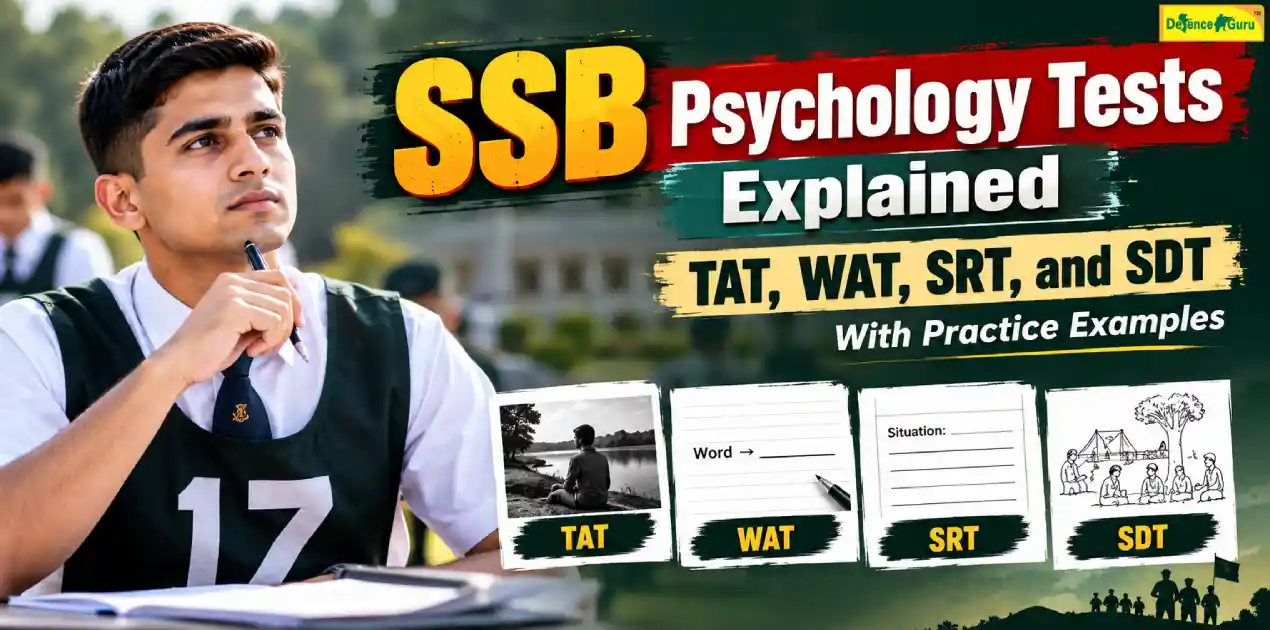
Preparing for the Services Selection Board (SSB) interview involves much more than clearing the written examination or practising interview questions. Candidates also need to understand their own behaviour, make practical decisions under pressure, and express their thoughts clearly. This is where the SSB psychology tests become an important part of the selection process.
The SSB psychology test battery consists of four tests: Thematic Apperception Test (TAT), Word Association Test (WAT), Situation Reaction Test (SRT), and Self-Description Test (SDT). Each test uses a different format to help the psychologist understand a candidate's thought process, decision-making approach, self-awareness, and personality.
The key to preparing for these tests is not memorising ideal answers. It is learning to think clearly, practise within the allotted time, and respond in a way that reflects your real personality. Let's understand how each test works, explore practical examples, and look at how you can prepare more effectively.
What Are SSB Psychology Tests?
SSB psychology tests are part of Stage II of the selection process for candidates who clear the initial screening. They form one part of the broader assessment, alongside Group Testing Officer (GTO) tasks and the personal interview.
These tests generally examine how candidates interpret situations, respond to different stimuli, handle everyday challenges, and understand their own strengths and weaknesses. The assessment considers the Officer Like Qualities (OLQs) expected of candidates entering the Armed Forces.
The four tests serve different purposes:
|
Test |
Full Form |
What It Explores |
|
TAT |
Thematic Apperception Test |
Storytelling, interpretation, initiative, and problem-solving |
|
WAT |
Word Association Test |
Spontaneous thinking and associations with words |
|
SRT |
Situation Reaction Test |
Practical judgment and responses to everyday situations |
|
SDT |
Self-Description Test |
Self-awareness, strengths, weaknesses and personal development |
Although each test has its own format, they contribute to a broader understanding of the candidate. Therefore, preparing separately for each test is useful, but developing consistent habits across all four is equally important.
1. Thematic Apperception Test (TAT): Turning Pictures Into Stories
What Is TAT?
In the Thematic Apperception Test, candidates are shown a series of pictures and asked to write a story based on each one. The pictures are usually ambiguous enough to allow different interpretations.
The standard format commonly consists of 11 pictures followed by one blank slide. Candidates typically get around 30 seconds to observe each picture and four minutes to write the corresponding story. The exact instructions provided at the SSB should always take priority.
The task is not simply to describe what appears in the picture. Candidates need to develop a coherent story that explains the situation, identifies a challenge or objective, describes the main character's actions, and concludes with a plausible outcome.
How to Approach a TAT Story
A useful way to organise your thoughts is to consider four elements:
- Background: What might have led to the situation?
- Present situation: What is happening, and what needs attention?
- Action: What does the main character do to address the situation?
- Outcome: What happens as a result of those actions?
This structure helps you write a complete story without spending too much time on unnecessary details.
TAT Practice Example
Practice picture scenario: Imagine a picture showing a young person standing near a damaged bicycle on a village road while two other people look on.
This is a hypothetical practice scenario, not an actual SSB test picture.
Sample approach:
Rahul, a college student, was returning home when he noticed a cyclist struggling with a damaged bicycle. He stopped to check the problem and found that the chain had come loose. After ensuring that the road was safe, he helped the cyclist move the bicycle to the roadside and fix the chain. He also suggested checking the brakes before continuing the journey. Once the bicycle was working properly, the cyclist thanked him, and Rahul continued home.
What makes this example useful?
The story follows a clear sequence of events. The main character notices a problem, takes initiative, considers safety, and helps resolve the situation. The response remains realistic rather than turning an ordinary incident into an exaggerated act of heroism.
There is no guarantee that a particular story will receive a favourable assessment. The purpose of this example is to demonstrate clear and practical storytelling.
Common TAT Mistakes
Candidates sometimes focus so much on presenting themselves positively that their stories become unrealistic. A character may solve every problem instantly, display extraordinary courage in ordinary situations, or achieve a major success without explaining how it happened.
Another common mistake is writing a long introduction while leaving little time to describe the actual action.
To improve, practise writing stories with a clear beginning, meaningful action, and believable conclusion. After completing each story, ask yourself whether the character genuinely did something to address the situation.
2. Word Association Test (WAT): Responding to Words Naturally
What Is WAT?
The Word Association Test presents candidates with a series of words, one after another. They must write a sentence or meaningful response associated with each word within a short time.
The standard format generally includes 60 words, with approximately 15 seconds available for each. The rapid pace makes it difficult to construct lengthy or heavily rehearsed answers.
The purpose is to understand the patterns of thought and associations reflected in the candidate's responses. It is not simply an English vocabulary test.
How to Prepare for WAT
The most useful preparation is to practise forming short, meaningful sentences without overthinking every word.
For example, if the word is responsibility, a candidate might naturally think about completing assigned work, supporting a team, or accepting accountability for a decision.
You do not need to force every sentence to sound heroic or motivational. Ordinary, practical observations can also reflect constructive thinking.
WAT Practice Examples
The following examples demonstrate possible responses. They are not official model answers to memorise.
|
Stimulus Word |
Illustrative Response |
|
Failure |
Failure helps identify gaps and improve future performance. |
|
Team |
A team achieves better results through cooperation and clear communication. |
|
Challenge |
A challenge encourages preparation and practical problem-solving. |
|
Responsibility |
Responsibility requires timely action and accountability. |
|
Time |
Effective planning helps make productive use of time. |
|
Mistake |
A mistake becomes useful when its cause is understood and corrected. |
|
Courage |
Courage involves facing difficulties while making sensible decisions. |
|
Learning |
Regular practice improves understanding and performance. |
These examples use direct language and connect each word with an understandable thought or action. However, candidates should not reproduce the sentences mechanically during the actual test.
What If a Word Feels Negative?
Words such as fear, failure, conflict, or weakness can make candidates uncomfortable. Some try to avoid the word's meaning altogether, while others force an excessively positive sentence.
A more useful approach is to think about the word realistically. For instance, fear can encourage someone to prepare carefully, while conflict can be addressed through communication and a fair solution.
The goal is not to deny that difficulties exist. It is to practise responding to them thoughtfully.
Common WAT Mistakes
- Trying to create a perfect sentence for every word.
- Repeating the same motivational ideas across multiple responses.
- Writing generic statements that do not express a clear thought.
- Spending too long correcting grammar or rewriting a sentence.
- Memorising lists of supposedly ideal responses.
To build speed, practise with a timer and accept that your first clear response may be more useful than a complicated sentence written after excessive thought.
3. Situation Reaction Test (SRT): Making Practical Decisions Under Pressure
What Is SRT?
The Situation Reaction Test presents candidates with a booklet containing everyday situations and asks them to write how they would respond.
The standard format generally contains 60 situations to be attempted in 30 minutes. This leaves limited time for each response, so candidates must identify the main problem and decide on a practical course of action.
Situations may involve studies, family responsibilities, teamwork, emergencies, time management, disagreements, or unexpected difficulties.
SRT is not about finding a dramatic solution to every problem. It is about demonstrating sensible judgment, responsibility, initiative, and the ability to act within realistic limits.
How to Approach an SRT Situation
Before writing a response, quickly consider three questions:
- What is the immediate problem?
- What action is necessary and realistic?
- What outcome or responsibility needs attention?
The answer should focus on action rather than lengthy explanations. Where safety is involved, the response should account for the situation's risks and the need for appropriate assistance.
SRT Practice Examples
Situation 1: You are preparing for an important examination when a family member suddenly needs medical attention.
Illustrative response: He arranges immediate medical assistance for the family member, informs the relevant family members, and adjusts his study schedule after the situation is under control.
Why this approach works: It recognises that an urgent responsibility may take priority over a planned activity. It also shows an attempt to manage the remaining commitments.
Situation 2: During a group project, two members disagree strongly and the work is falling behind schedule.
Illustrative response: He listens to both members, helps identify the project's requirements, encourages a practical discussion, and coordinates the division of pending tasks.
Why this approach works: It addresses the disagreement while keeping the common objective in focus.
Situation 3: While travelling, he notices an injured person following a road accident.
Illustrative response: He alerts emergency services, seeks assistance from nearby people, and helps the injured person within his training and safety limits until professional help arrives.
Why this approach works: It combines initiative with concern for safety and appropriate medical assistance.
Situation 4: He realises that he has made an important error in a report shortly before submission.
Illustrative response: He informs the concerned person, corrects the error after checking the relevant information, and submits the revised report as soon as possible.
Why this approach works: It focuses on accountability and correction rather than hiding the problem or blaming someone else.
How to Improve SRT Performance
The best way to improve is to practise a range of everyday situations rather than repeatedly solving only dramatic emergencies.
Build familiarity with common responsibilities, practical decision-making, teamwork, time management, and basic safety. Learn when to act independently and when to involve someone with the right expertise.
During timed practice, avoid writing an entire paragraph for a situation that can be answered clearly in one or two lines. At the same time, do not reduce every response to vague phrases such as "he solves the problem" without explaining what he actually does.
Common SRT Mistakes
Candidates may try to solve every problem single-handedly, ignore practical limitations, or write idealistic responses that do not explain the next step. Others spend too long on the first few situations and leave several unanswered.
Practising with a timer can help you recognise these habits. Review your answers afterwards to see whether they are realistic, specific, and consistent with how you would actually behave.
4. Self-Description Test (SDT): Understanding Yourself Honestly
What Is SDT?
The Self-Description Test asks candidates to describe themselves from different perspectives. It helps explore their understanding of their strengths, limitations, relationships, and areas for improvement.
The exact prompts and time allocation may vary according to the instructions given during the assessment. A commonly used format asks candidates to write about:
- What their parents or guardians think of them.
- What their teachers or supervisors think of them.
- What their friends or colleagues think of them.
- How they see themselves.
- What they would like to improve.
This test can feel more difficult than the others because it requires personal reflection rather than an invented story or an immediate reaction to a situation.
How to Prepare for SDT
Start by reflecting on your real experiences. Consider the responsibilities you handle at home, your participation in studies or work, your relationships with others, and the feedback you have received.
Identify strengths that you can support with examples. If you consider yourself dependable, think about a time when you completed a commitment or helped someone meet a deadline.
Also, identify areas where you genuinely need improvement. Self-awareness does not mean presenting yourself as flawless. It means understanding your limitations and being willing to work on them.
SDT Practice Example
Suppose a candidate is a college student who participates in group activities and sometimes struggles with time management.
Parents' perspective: My parents consider me responsible and supportive. They encourage me to plan my daily activities more carefully when I have several commitments.
Teachers' perspective: My teachers appreciate my participation and willingness to learn. They have advised me to be more consistent with deadlines during busy periods.
Friends' perspective: My friends find me approachable and cooperative. They often rely on me to help coordinate group activities.
My own perspective: I consider myself hardworking, approachable, and willing to accept responsibility. However, I sometimes underestimate the time required to complete a task.
Areas for improvement: I am working on setting realistic deadlines, prioritising important work, and reviewing my progress regularly.
Use this example to understand the structure only. Your actual description should reflect your own experiences and the feedback you have genuinely received.
Why Honesty Matters in SDT
One common mistake is describing yourself differently in every section simply to create an ideal impression. A candidate might claim to be highly organised while admitting no difficulty with deadlines, or describe excellent teamwork without recognising any real-life experience.
Your description does not need to be identical across all sections, because different people may notice different aspects of your personality. However, it should remain believable and consistent with your experiences.
Another mistake is treating weaknesses as something that must be hidden. It is more useful to recognise a genuine area for improvement and explain what you are doing to address it.
The aim is not to write a perfect biography. It is to present a thoughtful and realistic picture of yourself.
Timed Practice: How to Build Speed Without Losing Clarity
Understanding the format is only the first step. Candidates also need to practise working under time constraints because a response that takes ten minutes to develop may not be practical in a test that allows only a few seconds.
A simple practice routine can help you gradually build both speed and clarity.
|
Test |
Common Practice Format |
Main Practice Goal |
|
TAT |
30 seconds to observe and 4 minutes to write per picture |
Develop a complete, realistic story |
|
WAT |
One word every 15 seconds |
Write a spontaneous, meaningful response |
|
SRT |
60 situations in 30 minutes |
Respond concisely and practically |
|
SDT |
Practise the complete description within the allotted time |
Reflect honestly and organise your thoughts |
These are commonly used formats for practice. Always follow the actual instructions provided at your SSB.
A Four-Week Preparation Plan
Week 1: Understand your natural responses
Begin with a few TAT stories, WAT words, and SRT situations without reading sample answers beforehand. Review your work and identify recurring habits. Do you hesitate too much? Do your stories lack action? Are your SRT responses too vague?
The purpose is to understand your starting point rather than judge every answer.
Week 2: Build consistency
Practise each test in short sessions. Work on story structure in TAT, spontaneous sentence formation in WAT, and concise decision-making in SRT. Draft your SDT after reflecting on actual experiences and feedback.
Week 3: Introduce timed practice
Use a timer to follow the standard test pace. Avoid pausing the clock to improve a sentence or rewrite an answer. Review your work only after the practice session ends.
Week 4: Review and refine
Attempt complete practice sets under conditions similar to the actual assessment. Check whether your responses are realistic, clear, and consistent. Use the remaining time to work on specific weaknesses rather than memorising more sample answers.
The schedule can be adjusted to your preparation timeline. If you have less than four weeks, shorter daily sessions and regular review are still useful.
How to Review Your Answers Effectively
Simply completing practice sets is not enough. The real benefit comes from reviewing how you think and respond.
After each session, ask yourself:
- Clarity: Is my response easy to understand?
- Action: Have I explained what the main character or I would actually do?
- Realism: Is the response practical in the given situation?
- Responsibility: Have I considered the consequences of my actions?
- Consistency: Does the response reflect my real behaviour and values?
- Time management: Did I complete the task within the allotted time?
You can maintain a simple notebook to record recurring difficulties. For example, if you regularly write long TAT introductions, spend the next session practising stories with shorter backgrounds and clearer actions.
If you struggle to identify your own habits, feedback from an experienced mentor or a structured mock assessment can help. A good review should explain why a response needs improvement and encourage you to think through alternatives, rather than simply provide a sentence to memorise.
Can You Prepare for SSB Psychology Tests Without Coaching?
Yes. Candidates can begin independently by understanding the test formats, practising with a timer, observing real-life situations, and reviewing their responses honestly.
However, self-assessment has limitations. It can be difficult to recognise patterns in your own writing or understand why your responses seem unrealistic, repetitive, or inconsistent.
Some candidates therefore benefit from guided practice, personalised feedback, and full-length mock assessments. A structured SSB preparation programme can provide opportunities to practise all four tests, review individual responses, and understand how psychological preparation fits into the wider selection process.
For aspirants considering professional guidance, institutions such as Centurion Defence Academy offer SSB preparation support. When comparing coaching options, look beyond the number of practice questions or sample answers provided. Consider whether the programme encourages original responses, provides useful feedback, and helps candidates understand their own strengths and areas for improvement.
Ultimately, coaching should support self-awareness and better practice habits, not replace a candidate's personality with a collection of rehearsed responses.
Common Myths About SSB Psychology Tests
Myth 1: Every response must sound positive.
Reality: Responses should be realistic and constructive where appropriate. Forced positivity can make answers vague or disconnected from the situation.
Myth 2: Memorised answers improve performance.
Reality: Memorised stories and sentences may not fit the actual prompts or reflect your natural thinking. Practising response structures is more useful than memorising fixed answers.
Myth 3: TAT requires extraordinary stories.
Reality: An ordinary situation handled sensibly can provide a clear example of initiative and problem-solving. Dramatic events are not necessary for every story.
Myth 4: SDT should contain only strengths.
Reality: Meaningful self-description includes an honest understanding of limitations and a willingness to improve.
Myth 5: Completing every question guarantees success.
Reality: Speed matters, but completion alone does not establish suitability. The overall assessment considers the quality and consistency of a candidate's responses alongside other parts of the SSB process.
Final Thoughts
TAT, WAT, SRT, and SDT may look like four separate tests, but preparing for them involves several common skills: clear thinking, practical judgment, self-awareness, and the ability to express ideas under time pressure.
Start with the basics, practise regularly, and review your responses with an open mind. Learn from examples without copying them, and treat feedback as an opportunity to understand your habits rather than a list of answers to reproduce.
Most importantly, do not approach psychological preparation as an exercise in pretending to be an ideal candidate. Focus on developing sound decision-making, taking responsibility in everyday life, and understanding yourself honestly. These habits make preparation more meaningful and help you approach the SSB process with greater clarity and confidence.
Frequently Asked Questions (FAQs)
1. What are the four psychology tests in SSB?
The four tests are the Thematic Apperception Test (TAT), Word Association Test (WAT), Situation Reaction Test (SRT), and Self-Description Test (SDT). Each explores different aspects of a candidate's thinking, responses, and self-understanding.
2. How much time is given for SSB psychology tests?
Commonly used formats include around four minutes to write each TAT story after 30 seconds of picture observation, 15 seconds per WAT word, and 30 minutes for 60 SRT situations. SDT is often allotted approximately 15 minutes. Candidates should follow the instructions given by their SSB.
3. Can I memorise TAT, WAT, and SRT answers?
Memorising fixed answers is not a reliable preparation strategy. It is better to practise the format, improve response speed, and learn to express practical thoughts naturally.
4. How many TAT pictures are shown in SSB?
The standard format generally includes 12 slides: 11 pictures followed by one blank slide. Candidates are typically given 30 seconds to observe each slide and four minutes to write a story.
5. How can I improve my WAT speed?
Practise with a timer set to 15 seconds per word. Focus on writing one clear, meaningful response rather than searching for an impressive sentence. Review repetitive or unclear responses after the session.
Read more:
NDA SSB Screening Test Preparation: OIR and PPDT Complete Guide for Beginners