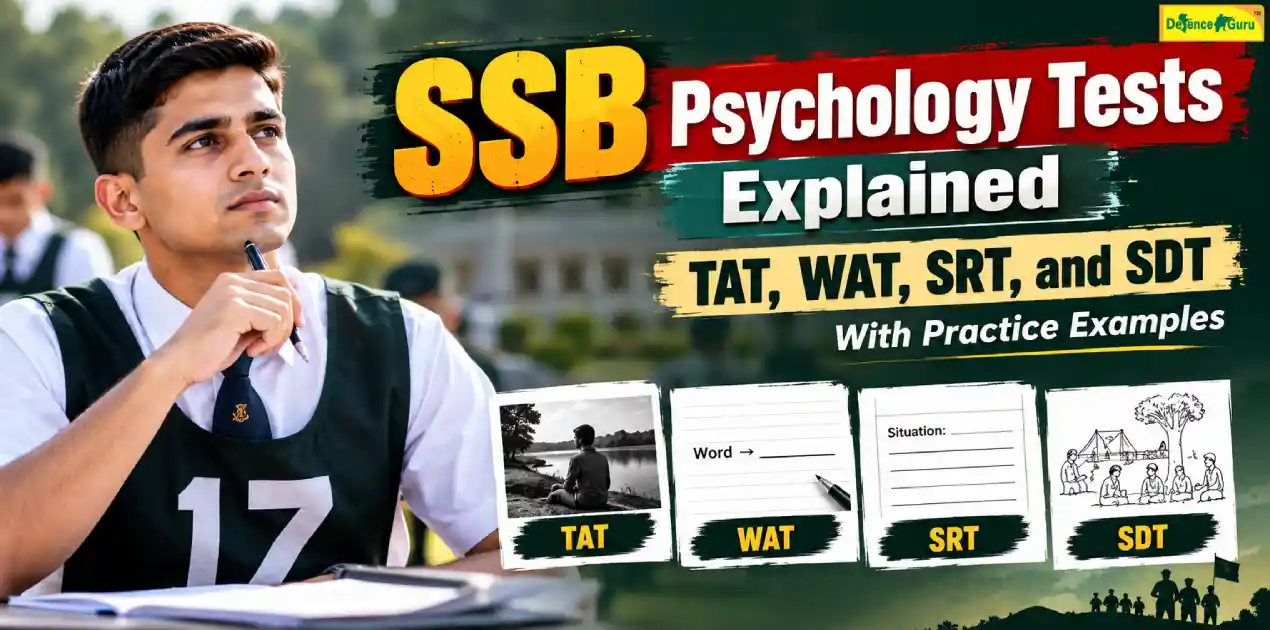
The Situation Reaction Test (SRT) is an important part of the Psychological Tests conducted during the Services Selection Board (SSB) interview. It evaluates how candidates respond to everyday challenges, unexpected problems, responsibilities and difficult situations. This article includes 100 SSB SRT practice situations divided into 10 categories, along with 40 sample answers covering effective intelligence, organising ability, initiative, leadership, social adaptability, responsibility, self-confidence, determination, emotional stability and decision-making.
If you are preparing for the SSB interview, practising these SRT situations can help you understand how to approach problems logically and respond with clarity. However, the objective is not to memorise standard answers. It is to develop a practical approach that reflects your natural thinking, sense of responsibility and ability to take appropriate action.
What Is the Situation Reaction Test (SRT) in SSB?
The Situation Reaction Test (SRT) is one of the four psychological tests conducted during the SSB selection process. In this test, candidates are presented with different real-life situations and are expected to write how they would react to each situation.
The standard SRT consists of 60 situations, which candidates are required to attempt in 30 minutes. These situations may involve personal responsibilities, academic challenges, teamwork, emergencies, social interactions or unexpected difficulties.
The SRT primarily helps assess how a candidate approaches problems and makes decisions in different circumstances. The responses provide psychologists with an understanding of the candidate's thought process, practical judgement, emotional stability and behavioural tendencies.
Unlike a general knowledge examination, the SRT does not test how much information you have memorised. It focuses on how you apply your thinking when faced with a situation.
100 SSB SRT Practice Questions Based on 10 Important Qualities
The following 100 SSB SRT practice situations are divided into 10 categories. Each category focuses on a different aspect of personality and provides opportunities to practise responding to practical challenges.
Category 1: Effective Intelligence and Problem Solving (Questions 1–10)
Effective intelligence is reflected in the ability to understand a problem, identify possible solutions and take practical action without unnecessary delay.
The situations in this category involve unexpected problems where candidates need to think logically and find workable solutions
- He reached the examination centre and found that his photograph on the admit card was unclear.
- He was travelling to an important interview when his vehicle developed a mechanical problem in an isolated area.
- While preparing for an examination, he discovered that an important chapter had been left out of his preparation.
- During a community programme, the planned electricity supply failed just before the event began.
- While working on a laboratory project, he noticed that one of the readings appeared inconsistent with the others.
- During a journey, he discovered that the group had taken the wrong route and was already far from the planned destination.
- He was conducting a workshop when the projector stopped working.
- During a practical examination, the equipment assigned to him stopped functioning.
- He had to submit an important application online, but the website stopped responding close to the deadline.
- His team had completed most of a project when their main source of data became unavailable.
Sample SRT Answers
Q1. He reached the examination centre and found that his photograph on the admit card was unclear.
Answer: He contacted the examination authorities, showed his valid identity proof and requested verification before entering the examination hall.
Q2. He was travelling to an important interview when his vehicle developed a mechanical problem in an isolated area.
Answer: He checked the vehicle, contacted a nearby mechanic and arranged alternative transport to reach the interview venue on time.
Q3. While preparing for an examination, he discovered that an important chapter had been left out of his preparation.
Answer: He prioritised the chapter, studied its important concepts and practised relevant questions to cover the topic.
Q4. During a community programme, the planned electricity supply failed just before the event began.
Answer: He arranged backup lighting and a generator, coordinated with the organisers and continued the programme.
What to focus on: Identify the actual problem, consider available resources and take timely action. Avoid panicking or wasting time blaming circumstances.
Category 2: Organising Ability and Planning (Questions 11–20)
Organising ability involves managing available resources, setting priorities, coordinating activities and completing responsibilities within a given timeframe.
These situations test how candidates handle multiple tasks, limited resources and unexpected changes in plans.
- He was given responsibility for maintaining the records of a club, but several old entries were incomplete.
- He received two important assignments with deadlines falling on the same day.
- He was responsible for arranging accommodation for a group, but the booked rooms were not available on arrival.
- He was selected to represent his college, but his regular classes were scheduled at the same time as the practice sessions.
- He was responsible for collecting money for a group activity, but the amount collected was less than required.
- While preparing an event budget, he discovered that the estimated expenses were higher than the available funds.
- He was asked to organise a competition with participants from several institutions, but the schedule became overcrowded.
- He was responsible for distributing essential material, but the quantity received was insufficient for everyone.
- He was responsible for arranging transport for a group, but one vehicle became unavailable at the last moment.
- He was given responsibility for a project that had already fallen behind schedule because of poor planning.
Sample SRT Answers
Q11. He was given responsibility for maintaining the records of a club, but several old entries were incomplete.
Answer: He reviewed the available records, contacted concerned members to verify missing details and updated the register systematically.
Q12. He received two important assignments with deadlines falling on the same day.
Answer: He assessed the workload, prioritised both assignments, prepared a timetable and completed them before the deadlines.
Q13. He was responsible for arranging accommodation for a group, but the booked rooms were not available on arrival.
Answer: He contacted nearby accommodation providers, arranged suitable alternative rooms within the budget and informed the group.
Q14. He was selected to represent his college, but his regular classes were scheduled at the same time as the practice sessions.
Answer: He discussed the schedule with his teachers and coach, arranged suitable practice timings and maintained his academic commitments.
What to focus on: Prioritise important tasks, distribute responsibilities sensibly, manage available resources and prepare alternatives wherever necessary.
Category 3: Initiative and Proactive Action (Questions 21–30)
Initiative means taking the first step when a situation requires attention instead of waiting for someone else to provide instructions.
This category includes situations where candidates must respond independently, take responsibility and ensure that work continues despite unexpected difficulties.
21. While conducting a school event, the chief guest informed him at the last moment that he would arrive two hours late.
22. During a sports event, the person responsible for announcing the results was absent.
23. While organising a blood donation camp, fewer volunteers arrived than expected.
24. He was returning home when he noticed smoke coming from a closed shop.
25. He was asked to deliver a speech without prior preparation because the scheduled speaker was absent.
26. He found that a notice containing an important deadline had not reached several students.
27. He was responsible for opening a programme, but the person carrying the keys had not arrived.
28. He was preparing a team for a competition when the best performer became unavailable due to an unavoidable reason.
29. He was responsible for arranging transport for a group, but one vehicle became unavailable at the last moment.
30. He was organising a cultural programme when two performers informed him that they could no longer participate.
Sample SRT Answers
Q21. While conducting a school event, the chief guest informed him at the last moment that he would arrive two hours late.
Answer: He rearranged the programme schedule, conducted the available activities first and welcomed the chief guest upon arrival.
Q22. During a sports event, the person responsible for announcing the results was absent.
Answer: He collected the verified scores, prepared the result sheet and announced the results accurately.
Q23. While organising a blood donation camp, fewer volunteers arrived than expected.
Answer: He redistributed the available volunteers, contacted additional volunteers and coordinated with the medical team to conduct the camp efficiently.
Q24. He was returning home when he noticed smoke coming from a closed shop.
Answer: He alerted the fire brigade and nearby authorities, warned people to maintain a safe distance and helped clear the surrounding area.
What to focus on: Recognise what needs to be done, take responsibility and act without waiting unnecessarily for directions. Initiative should always be supported by sound judgement.
Category 4: Leadership and Team Management (Questions 31–40)
Leadership is not simply about giving instructions. It involves bringing people together, understanding their strengths, resolving disagreements and guiding a team towards a common objective.
The following situations help candidates practise handling different personalities and team-related challenges.
31. He was leading a group of students on a nature trail when one member refused to follow the marked route.
32. He was appointed captain of a team whose members had never played together before.
33. His team was losing confidence after failing in the first two rounds of a competition.
34. He was leading a group exercise when one member continuously ignored the agreed plan.
35. He was given responsibility for training a group, but the members had very different levels of ability.
36. He was selected for a leadership role, but some team members were older and more experienced than him.
37. He was appointed coordinator of a project whose members had different opinions about the final objective.
38. He was given a leadership assignment, but the team initially showed little interest in cooperating with him.
39. He had to make an important decision for his team, but there was very little time available, and the members had different opinions.
40. He had to choose a team for an important assignment, but several capable members were equally suitable for the available positions.
Sample SRT Answers
Q31. He was leading a group of students on a nature trail when one member refused to follow the marked route.
Answer: He explained the safety risks, convinced the member to follow the marked route and ensured that the group stayed together.
Q32. He was appointed captain of a team whose members had never played together before.
Answer: He assessed their abilities, assigned suitable positions, organised practice sessions and encouraged coordination among members.
Q33. His team was losing confidence after failing in the first two rounds of a competition.
Answer: He discussed the shortcomings, motivated the members, improved their strategy and prepared them for the next round.
Q34. He was leading a group exercise when one member continuously ignored the agreed plan.
Answer: He discussed the issue with the member, explained the importance of coordination and assigned responsibilities according to the agreed plan.
What to focus on: Understand the team, communicate clearly, involve members in decisions where appropriate and maintain focus on the common goal.
Category 5: Social Adaptability and Cooperation (Questions 41–50)
Social adaptability refers to the ability to adjust to different people, situations and environments while maintaining healthy relationships.
These situations involve disagreements, group discussions, cooperation and understanding the concerns of others.
41. During a group discussion, two participants began arguing, and the discussion was losing its purpose.
42. He was assigned to survey a village, but the villagers were initially unwilling to cooperate.
43. While travelling by bus, he noticed an elderly passenger struggling to find a place to sit.
44. He noticed that a classmate was being unfairly blamed for a mistake made by the entire group.
45. He was managing a team project when two members refused to work together because of a personal disagreement.
46. He was asked to choose between completing his individual task and helping a teammate who was struggling with a critical assignment.
47. His team completed a difficult task successfully, but one member was not given credit for his contribution.
48. He noticed that a new student was having difficulty adjusting to the class and was avoiding everyone.
49. He was participating in a debate when the opposing team made an incorrect claim about his team's facts.
50. During a group activity, one member repeatedly criticised every proposed solution without suggesting an alternative.
Sample SRT Answers
Q41. During a group discussion, two participants began arguing, and the discussion was losing its purpose.
Answer: He listened to both participants, redirected the discussion towards the topic and encouraged everyone to share their views constructively.
Q42. He was assigned to survey a village, but the villagers were initially unwilling to cooperate.
Answer: He introduced himself, explained the purpose of the survey politely and gained their cooperation through clear communication.
Q43. While travelling by bus, he noticed an elderly passenger struggling to find a place to sit.
Answer: He offered his seat to the elderly passenger and helped him settle comfortably.
Q44. He noticed that a classmate was being unfairly blamed for a mistake made by the entire group.
Answer: He explained the actual circumstances, shared the group's responsibility and helped resolve the misunderstanding.
What to focus on: Listen to others, respect different opinions, cooperate with team members and address disagreements constructively.
Category 6: Responsibility and Sense of Duty (Questions 51–60)
A responsible person understands the importance of commitments, rules and duties. Such a person does not ignore problems simply because they are inconvenient.
The situations in this category focus on honesty, accountability, discipline and concern for others.
51. While returning from college, he noticed that a wallet containing cash and important documents had fallen near a crowded market.
52. His friend asked him to conceal a mistake that could affect the entire team's performance.
53. He was organising a cleanliness drive when some participants started leaving garbage at the same place they had cleaned.
54. He noticed that confidential papers had accidentally been left unattended in a common area.
55. He noticed that his team was repeatedly arriving late despite having fixed reporting times.
56. His team discovered an error in a report after it had already been submitted to the supervisor.
57. He noticed that a public facility was being misused and several people were ignoring the rules.
58. While supervising an activity, he noticed that the available safety arrangements were inadequate.
59. He was responsible for maintaining discipline during an event when a few participants refused to follow the instructions.
60. He noticed that a junior was repeatedly avoiding responsibility by blaming others for his mistakes.
Sample SRT Answers
Q51. While returning from college, he noticed that a wallet containing cash and important documents had fallen near a crowded market.
Answer: He secured the wallet, checked for identification and handed it over to the owner or the nearest police station.
Q52. His friend asked him to conceal a mistake that could affect the entire team's performance.
Answer: He advised his friend to disclose the mistake, informed the concerned authority and helped correct it.
Q53. He was organising a cleanliness drive when some participants started leaving garbage at the same place they had cleaned.
Answer: He reminded the participants about the objective, arranged dustbins and ensured proper waste collection.
Q54. He noticed that confidential papers had accidentally been left unattended in a common area.
Answer: He secured the papers and handed them over to the authorised person responsible for their custody.
What to focus on: Be honest, acknowledge mistakes, fulfil commitments and take appropriate action to protect people and resources.
Category 7: Self-Confidence and Courage (Questions 61–70)
Self-confidence is the ability to face unfamiliar situations and challenges without losing faith in one's capabilities. Courage involves taking appropriate action even when circumstances are difficult.
These situations test how candidates respond to pressure, unfamiliar responsibilities and challenging environments.
61. He was leading a trek when the weather suddenly became unfavourable, and visibility decreased.
62. His senior gave him a task that he had never performed before and expected it to be completed by the next morning.
63. He was asked to deliver a speech without prior preparation because the scheduled speaker was absent.
64. His teammate became nervous just before an important performance and wanted to withdraw.
65. During a college election, false information about his team began circulating among students.
66. He was selected for a leadership role, but some team members were older and more experienced than him.
67. He was asked to lead a group discussion on a topic about which he had limited knowledge.
68. He was travelling to an unfamiliar city for an important assignment and his planned accommodation was unexpectedly unavailable.
69. He was on his way to attend a selection trial when he received information that the venue had been shifted to another location.
70. His team was asked to complete a task in an area where they had never worked before.
Sample SRT Answers
Q61. He was leading a trek when the weather suddenly became unfavourable, and visibility decreased.
Answer: He stopped the trek, gathered the group at a safe location, checked everyone's condition and followed the safest route back.
Q62. His senior gave him a task that he had never performed before and expected it to be completed by the next morning.
Answer: He understood the requirements, sought necessary guidance, prepared a plan and completed the task within the deadline.
Q63. He was asked to deliver a speech without prior preparation because the scheduled speaker was absent.
Answer: He confidently accepted the responsibility, organised his thoughts and delivered a brief, relevant speech.
Q64. His teammate became nervous just before an important performance and wanted to withdraw.
Answer: He encouraged his teammate, helped him regain confidence and accompanied him for the performance.
What to focus on: Remain composed, assess your abilities, seek information when required and approach unfamiliar responsibilities with confidence.
Category 8: Determination and Perseverance (Questions 71–80)
Determination is the ability to remain committed to a goal despite setbacks. Perseverance involves making continued efforts, learning from difficulties and finding ways to move forward.
The following situations deal with failure, limited resources, unexpected changes and challenging deadlines.
71. His project team received negative feedback one day before the final submission.
72. He had prepared thoroughly for a competition, but the rules were modified shortly before it began.
73. His team had limited resources to complete a project, and several members suggested abandoning it.
74. His younger brother wanted to quit an activity after failing in it several times.
75. While cycling to an important appointment, he got a flat tyre several kilometres away.
76. During a long journey, one member of his group became exhausted and wanted to stop before reaching the destination.
77. His team reached the final stage of a competition but discovered that their main equipment had been damaged.
78. His team was given only one day to complete work that normally required several days.
79. He was preparing for a competitive examination when his study material was damaged unexpectedly.
80. He was leading a volunteer group when heavy rain forced them to reconsider their planned outdoor activity.
Sample SRT Answers
Q71. His project team received negative feedback one day before the final submission.
Answer: He reviewed the feedback, discussed the corrections with his team and improved the project before submission.
Q72. He had prepared thoroughly for a competition, but the rules were modified shortly before it began.
Answer: He studied the revised rules, adjusted his strategy and participated according to the new requirements.
Q73. His team had limited resources to complete a project, and several members suggested abandoning it.
Answer: He identified alternative resources, divided the remaining work among members and completed the project with the available facilities.
Q74. His younger brother wanted to quit an activity after failing in it several times.
Answer: He encouraged his brother, identified the areas needing improvement and helped him practise regularly.
What to focus on: Do not give up at the first setback. Review the situation, modify your approach and continue making realistic efforts towards the objective.
Category 9: Emotional Stability and Self-Control (Questions 81–90)
Emotional stability is reflected in the ability to remain calm and balanced during stressful situations. It also involves controlling impulsive reactions and dealing with disagreements maturely.
These situations test how candidates handle criticism, conflicting instructions, personal commitments and emotionally challenging circumstances.
81. He was asked to mentor a junior who was repeatedly making mistakes despite receiving instructions.
82. He noticed that a classmate was being unfairly blamed for a mistake made by the entire group.
83. He was managing a team project when two members refused to work together because of a personal disagreement.
84. His teammate became nervous just before an important performance and wanted to withdraw.
85. During a college election, false information about his team began circulating among students.
86. He had promised to help his friend prepare for an examination, but an urgent family responsibility arose at the same time.
87. He received contradictory instructions from two seniors regarding the same assignment.
88. He noticed that a friend was spending excessive time on distractions despite having an important examination approaching.
89. During a group activity, one member repeatedly criticised every proposed solution without suggesting an alternative.
90. He was assigned to inspect a facility and found several minor issues that could become serious if ignored.
Sample SRT Answers
Q81. He was asked to mentor a junior who was repeatedly making mistakes despite receiving instructions.
Answer: He remained patient, identified the junior's difficulties, explained the task again and guided him through regular practice.
Q82. He noticed that a classmate was being unfairly blamed for a mistake made by the entire group.
Answer: He calmly explained the facts, acknowledged the group's collective responsibility and resolved the misunderstanding.
Q83. He was managing a team project when two members refused to work together because of a personal disagreement.
Answer: He listened to both members, resolved their differences through discussion and divided responsibilities according to their abilities.
Q84. His teammate became nervous just before an important performance and wanted to withdraw.
Answer: He reassured his teammate, helped him relax and encouraged him to participate confidently.
What to focus on: Avoid impulsive reactions, understand the circumstances and respond calmly. Handle disagreements through communication and practical solutions.
Category 10: Decision-Making, Judgement and Adaptability (Questions 91–100)
Decision-making involves analysing available information, considering possible consequences and choosing an appropriate course of action.
Adaptability is equally important because plans do not always work as expected. These situations focus on making sensible decisions when circumstances change.
91. He was responsible for a team presentation, but one team member failed to submit his assigned portion on time.
92. His team had practised for a competition for several weeks, but the venue was suddenly changed.
93. He was travelling with important documents when heavy rain made the road ahead difficult to cross.
94. While conducting an outdoor activity, he realised that one participant had wandered away from the group.
95. He was travelling to a remote area for a social service activity when the communication network stopped working.
96. He was coordinating a school trip when one student's parents suddenly requested that the student return home.
97. He was assigned a task requiring information from another department, but the required information was delayed.
98. He was conducting an activity for children when one child became separated from the group.
99. He discovered that a teammate had misunderstood an important instruction and the mistake could affect the entire task.
100. He was responsible for coordinating a group during a long-distance journey when one member lost his essential belongings.
Sample SRT Answers
Q91. He was responsible for a team presentation, but one team member failed to submit his assigned portion on time.
Answer: He contacted the member, redistributed the pending work among available members and completed the presentation before the deadline.
Q92. His team had practised for a competition for several weeks, but the venue was suddenly changed.
Answer: He verified the new venue, arranged transport, informed all team members and revised the reporting schedule.
Q93. He was travelling with important documents when heavy rain made the road ahead difficult to cross.
Answer: He stopped at a safe place, assessed the road conditions and continued through an alternative safe route when possible.
Q94. While conducting an outdoor activity, he realised that one participant had wandered away from the group.
Answer: He informed the supervising authority, organised a search with designated members and ensured that the remaining group stayed safe.
What to focus on: Evaluate the situation, consider the safety and interests of everyone involved, and make timely decisions based on available information.
How to Prepare for the SSB Situation Reaction Test
Practising 100 SRT situations is a good starting point, but simply reading situations will not improve your performance. You need to develop the habit of thinking practically and responding naturally.
Here are some useful ways to approach SRT preparation.
1. Understand the Situation Before Responding
Read each situation carefully and identify the actual problem. Sometimes, candidates focus on unnecessary details and miss the main issue.
For example, if a vehicle breaks down while travelling to an important interview, the immediate concern is to arrange an alternative means of transport and reach the destination safely.
2. Focus on Practical Solutions
Your response should reflect what you can realistically do with the resources available.
Avoid solutions that depend on extraordinary circumstances, unrealistic assistance or actions beyond your control.
3. Develop a Sense of Responsibility
Take ownership of the situation instead of shifting responsibility to someone else.
Whether you are handling an individual task or leading a group, your response should demonstrate accountability and concern for the outcome.
4. Practise Time-Bound Responses
The standard SRT consists of 60 situations in 30 minutes. Regular practice can help you read situations, identify the problem and formulate responses without spending too much time on a single situation.
You can begin by practising 10 situations at a time and gradually increase the number as your speed and confidence improve.
5. Avoid Memorising Standard Responses
There is no single universal response for every situation. Two situations may appear similar but require different actions depending on the circumstances.
For example, a teammate who is nervous before a performance may need encouragement, while a teammate who repeatedly ignores safety instructions may require firm and appropriate intervention.
6. Be Natural and Consistent
Your responses should reflect your actual personality and approach towards everyday situations. Trying to portray an artificially perfect personality can make responses unrealistic or inconsistent.
Common Mistakes Candidates Should Avoid in SRT
While practising SRT situations, candidates should pay attention to a few common mistakes.
- Overthinking simple situations: Avoid spending too much time analysing problems that have straightforward solutions.
- Writing unrealistic responses: Do not assume that every problem can be solved through extraordinary efforts or immediate external assistance.
- Ignoring safety: In emergencies, prioritise the safety of yourself and others before continuing an activity.
- Avoiding responsibility: Do not leave every difficult situation for seniors or authorities to handle when you can take appropriate action.
- Giving aggressive responses: Confidence and courage should not be confused with unnecessary confrontation.
- Repeating similar answers: Understand the context of every situation instead of applying the same response everywhere.
- Focusing only on the result: The method you choose to solve a problem is equally important.
Final Thoughts
The Situation Reaction Test is not about finding a perfect answer to every problem. It is about understanding a situation, taking responsibility and responding in a practical and balanced manner.
These 100 SSB SRT practice situations and 40 sample answers provide an opportunity to work on different aspects of your personality, from problem-solving and organising ability to teamwork, emotional stability and decision-making.
Remember that SSB preparation goes beyond practising psychological test questions. Developing these qualities in your everyday life through academics, sports, group activities and personal responsibilities can help you become more confident and better prepared for the selection process.
Frequently Asked Questions About SSB SRT
1. What is the SRT in the SSB interview?
The Situation Reaction Test (SRT) is a psychological test in the SSB selection process. Candidates are presented with different situations and asked to write their reactions, helping psychologists understand their approach to problem-solving, responsibilities and interpersonal challenges.
2. How many situations are given in the SSB SRT?
The standard SRT contains 60 situations, which candidates are required to attempt within 30 minutes. The situations cover different aspects of everyday life, including personal, academic, social and group-related challenges.
3. What qualities are assessed through the SRT?
SRT responses help assess behavioural aspects related to the 15 Officer Like Qualities (OLQs), including effective intelligence, organising ability, initiative, leadership, social adaptability, cooperation, responsibility, self-confidence, determination and emotional stability.
4. How should I write answers in the SRT?
Write short, clear and practical responses that explain how you would handle the given situation. Focus on identifying the problem, taking appropriate action and achieving a sensible outcome.
5. Can I prepare for SRT by memorising answers?
Memorising answers is not a recommended approach. The SRT evaluates your natural reactions and thought process. Practising different situations and understanding how to approach them logically is more useful than learning fixed responses.
6. How can I improve my SRT performance?
Practise regularly, improve your decision-making ability, develop practical problem-solving habits and learn to manage unexpected situations calmly. Reviewing your responses can also help you identify areas where your thinking needs improvement.
7. Are sample SRT answers enough to clear the SSB interview?
No. Sample answers can help candidates understand how to approach different situations, but the SSB selection process evaluates overall personality through psychological tests, GTO tasks and the personal interview. Consistent personality development and practical experience are equally important.
Read more:
50 Important WAT Words for Upcoming SSB Interview 2026-27
SSB OIR Test: 200 Practice Questions with Answers, Preparation Tips & PDF
How to Choose an SSB Coaching Institute: Mentors, GTO Ground and Mock Interviews