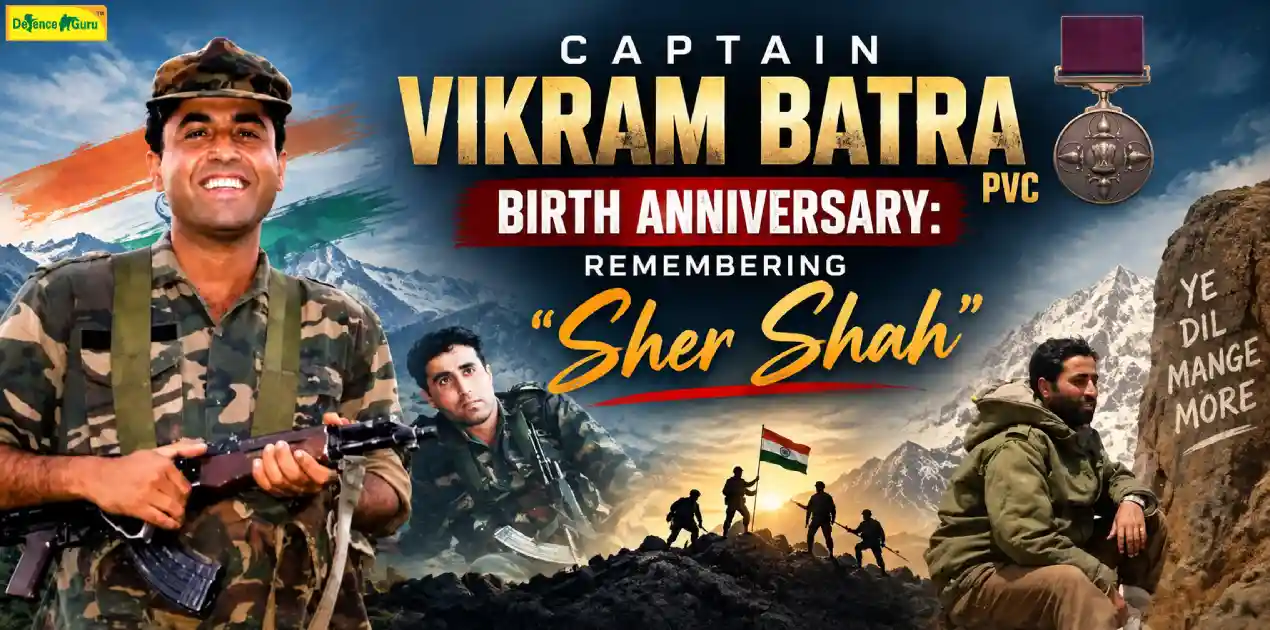
Captain Vikram Batra was one of the most renowned warriors during the Kargil War of 1999. Called Sher Shah by his comrades, he has become a synonym for the valor and guts shown by Indian soldiers during the war. His contribution towards the war effort as well as his ultimate sacrifice are what make him a household name in the country even to this day. On his birth anniversary, the nation remembers him and his legacy of supreme dedication and sacrifice that can serve as an example for every Indian soldier who follows in his footsteps.
Who Was Captain Vikram Batra, PVC?
Captain Vikram Batra was born on 9 September 1974 in Palampur, Himachal Pradesh. He was born into a family of educated and disciplined parents who instilled in him the values of education, discipline, and service to the nation.
Vikram had a great desire to join the Armed Forces since his childhood days.
Before joining the Army, Vikram pursued his studies in Himachal Pradesh and later joined DAV College, Chandigarh, to continue his studies. During his school days, he developed traits like self-confidence, discipline, and leadership.
Vikram had always dreamt of joining the Indian Army and serving the country. He joined the Indian Military Academy (IMA), Dehradun, and trained there for a long time for the Indian Army. Finally, he joined the Indian Army.
Journey to the Indian Army
Captain Vikram Batra belonged to the 13 Jammu and Kashmir Rifles, which is renowned for its glorious history and heroic exploits. This young captain joined the army and was dedicated to his job. Moreover, he learned how to perform his duties better and took responsibility for his subordinates.
His time spent in the Army showed him the main things and circumstances connected with war and made him professional enough to fight with all his best efforts. This soldier became known to all the people in the country during the Kargil War.
Indeed, in 1999, due to the aggression of Pakistan and the occupation of its soldiers in the area of the Line of Control, the Indian Army was forced to expel the attackers. The task was really challenging because of the difficult territory where the soldiers had to fight and perform their tasks.
challenging. Captain Batra and his unit were deployed in the Kargil sector as the Indian Army made its attempt to recover the captured heights.
The Kargil War
Captain Vikram Batra was one of the central figures in the Kargil War. One of the most notable episodes associated with him was the campaign to capture the strategic peak of Point 5140 in the Kargil sector.
During the operation, Captain Batra displayed exemplary leadership skills, guiding his men through the thick of the fighting and helping them achieve a significant tactical victory. At the battle’s end, his bold, if not reckless, words, “Yeh Dil Maange More,” became famous nationwide.
However, Captain Batra’s fate was not to live a quiet life enjoying the fruits of his labor. He was soon engaged in another battle, this time for Point 4875, which was surrounded on three sides by sheer cliffs, making the assault especially challenging.
Again, the captain displayed his outstanding leadership skills, rushing to the attack. During the battle for the point, he took sniper fire while trying to save one of his wounded soldiers and was martyred on 7 July 1999. Vikram Batra, the legendary war hero, gave his last at the age of only 24.
His heroic deed during the Kargil conflict showed his soldiers spirit and willingness to fight even at the most daunting odds. His example of a courageous officer who puts his men and country before his personal life and safety will live forever in the annals of the Indian Army.
Remembering his Valour and Sacrifice
Captain Vikram Batra's contribution to the Kargil War remains memorable to every citizen of our country. His call sign 'Sher Shah' was inspired by his bravado and leadership on the battlefield. For his immense contribution and role in the Kargil War, Captain Vikram Batra was awarded the Param Vir Chakra, India's highest honor for valor and bravery in the face of the enemy.
His story continues to live on, not only because of his achievements and recognition as a decorated soldier, but also because he is remembered for the responsibilities and difficult decisions he undertook at the front as an officer. At a young age, he displayed that the core responsibilities of an officer in the Armed Forces require a strong sense of responsibility, valor, courage, and leading by example.
His sacrifice also symbolizes the overall contribution of the Indian Armed Forces during the Kargil War, where soldiers were bravely fighting to regain several strategic ridges under difficult circumstances.
What Defence Aspirants Can Learn from Captain Vikram Batra PVC
For defence aspirants, Captain Vikram Batra's life has many qualities to adopt.
The first among these qualities is courage. Being brave does not mean one is not afraid. It indicates how a person does their duty regardless of the challenges ahead.
The second quality is related to leadership. Captain Vikram always led his men from the front and did not shy away from any challenges. For future officers, leadership means shouldering the responsibility for subordinates rather than just giving orders.
His life teaches us to be persistent in our decisions. Military operations are usually complicated affairs with many difficulties and crises. A defence aspirant needs to develop the ability to pursue a goal rather than escape from problems.
Furthermore, his life teaches us to understand the responsibility for subordinates. A military leader bears a great burden of the fate of people who have placed their trust and reliance on him.
Finally, the Captain's life shows us that joining the Army is not just a change of uniforms. It means developing a spirit of enterprise and professionalism in the workplace and the ability to be indifferent to one's personal comfort for the sake of the mission and the country.
Conclusion
Captain Vikram Batra was and perhaps remains one of the most celebrated war heroes in the history of the Kargil conflict. His journey from a young man choosing to dedicate his life to the Indian Army to a legendary commander during one of the country’s bloodiest battles is an inspiration to many.
While the nation remembers the legendary captain on his birth anniversary, people are bound to assess his significance in the annals of Indian military history. Apart from being a top performer during the 1999 conflict, his legacy serves as a reminder to all defence aspirants that there is more to experience and education than what the classrooms and training grounds can teach.
Read more:
Group Captain Abhinandan Varthaman Retires from IAF Begins, New Journey as Commercial Pilot