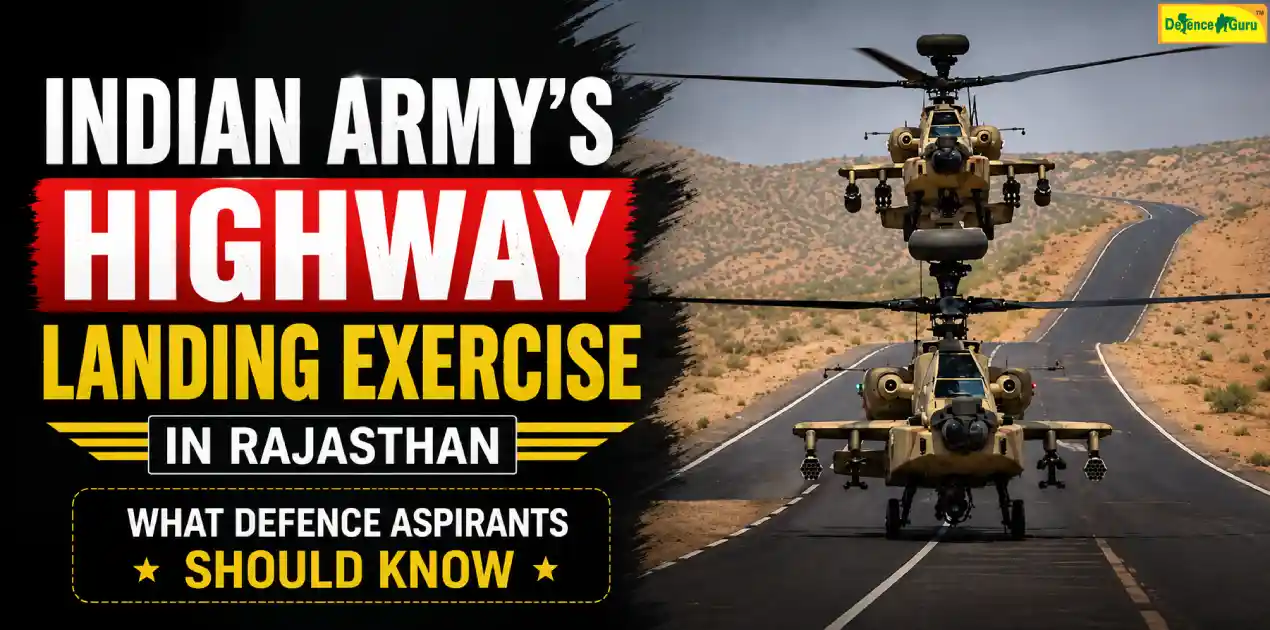
Indian Army conducted a training exercise in Jaisalmer, Rajasthan, near the India-Pakistan border. The main aim behind the exercise was to test the ability of its helicopters to operate from a highway and to test the preparedness of the army. The exercise involved the Army Aviation Corps and featured combat helicopters such as the AH-64E Apache and the indigenous HAL RUDRA. The exercise was conducted for two days on the 20th and 21st of August 2026.
This exercise points out the importance of flexibility and mobility in Military operations. For the Indian Army, this exercise was very useful, as in the future there may be no airfields or helipads available in the nearby areas.
Key Points of the Event
First of all, the location of the exercise is strategically important. Because of the location. Jaisalmer, the desert sector, establishes a significant part of India’s Western frontier. The training has been conducted by the Aviation Corps.
According to a report, more than half a dozen combat and attack helicopters took part in the drill. Among all these helicopters were the two most important helicopters: the AH-64E Apache and the HAL Rudra of the indian army’s aviation wing.
The main point of the exercise was “highway landing capability”. The helicopter practised landing and taking off from a selected stretch of highway rather than depending upon a traditional military airfield or established helipads.
The exercise was conducted in the desert environment of Jaisalmer, allowing the army to assess its operational preparedness under tough terrain conditions. Training in these conditions is necessary because armed forces operating on the western border need to be prepared for any situation.
What Is Highway Landing Capability?
Highway landing capability refers to the ability of military planes or helicopters to use specific sections of roads/highways for landing and take-off when necessary.
Usually, during peace or even in times of war, military helicopters carry out all operations from air bases, helipads, or other landing centers. However, military activities can create conditions where these established landing sites might not be available or might be at great distances, and a nearby highway or road can be appropriate and suitable for take-off and landing, given the specific operational needs.
The recent Indian Army exercise of helicopter landing and take-off from a highway in Rajasthan is a display of the aforementioned capability. For the defence services, this kind of training has significance since it is not simply about landing on a road. It is about training these services to make the most of alternate landing sites and conduct training exercises for enhanced operational readiness.
This is especially important concerning helicopters since they offer more flexibility in terms of landing sites than airplanes. Helicopters can carry out many operations from closer alternate landing sites, and are a valuable asset in terms of rapid troop movements.
Why is highway landing capability important for the Indian Army?
Operational flexibility
The ability to carry out operations from alternate landing sites would provide the Indian Army with enormous operational flexibility, as it would then have more options at its disposal. In a military scenario, the existing air bases, helipads, and other landing sites may be rendered unavailable for use, and army aviation can turn to nearby suitable road stretches for landing and take-off.
Rapid deployment
Army helicopters play a huge role in rapidly deploying troops in terms of both men and material. Alternate landing sites would be extremely helpful in terms of rapid response.
Preparedness in border areas
The fact that this training exercise was carried out in Jaisalmer, Rajasthan, which is close to the India-Pakistan border, is important. The training would have familiarized military personnel in the region with alternate landing sites, considering the operational needs in border areas. The desert environment in Rajasthan is significantly different from the conditions in other parts of the country.
Minimising dependence on existing infrastructure
It is important to understand that the armed forces cannot rely solely on permanent infrastructure. Alternate options, such as those provided by the ‘highway landing capability,’ are important, given the need to counter unforeseen circumstances.
Modern military operations require troops to operate from flexible and dispersed locations, and such training exercises would prepare the Indian Army for these requirements.
Importance for defence aspirants
This news item is of interest to NDA, CDS, AFCAT, and SSB aspirants since it can offer insight into the operational preparedness and capabilities of the Indian Army. Defence aspirants should be aware of the basic functions of the Army Aviation Corps and understand the value of helicopters in military operations.
India possesses a variety of helicopters, such as the AH-64E Apache, which is a specialised attack helicopter, and the HAL Rudra, which is based on the Advanced Light Helicopter. Knowing the basic difference between them is important, as questions with respect to Army Aviation can be raised during the SSB interview.
Instead of simply learning helicopter names, candidates should try to associate them with their respective capabilities. A candidate should highlight how this exercise reflects the need for operational flexibility and rapid response and the various ways in which it prepares military personnel for modern military operations.
This news item can also be used by the candidates to showcase their knowledge and interest in the Indian defence services’ localisation efforts. The HAL Rudra typifies India’s efforts at manufacturing its own combat aircraft, while the AH-64E Apache showcases India’s procurement strategy with respect to advanced state-of-the-art attack helicopters.
Conclusion
The Indian Army’s exercise of landing and takeoff of helicopters in Rajasthan underlines the operational flexibility and readiness of the Indian Army, especially with regard to operations along India’s porous and strategically significant borders. The participation of the AH-64E Apache and the HAL Rudra in the exercise is a pointer towards the increasing role of Army Aviation in modern military operations. (The Times of India)
Highway landing capability offers the Indian Army additional options, especially with respect to military operations. Using suitable road stretches for landing and take-off can provide the Indian Army with enormous flexibility, and such training exercises enable personnel to operate from alternate, dispersed, and closer sites.
For defence aspirants, this news item is of special significance, as it encapsulates many topics of relevance to the NDA, CDS, AFCAT, and SSB interviews. It can serve as an important current affairs discussion point, as it reflects India’s operational preparedness and highlights the concepts of border security, operational flexibility, modern military operations, and indigenous defence production. In short, it can be an important tool for helping defence aspirants move beyond learning when it comes to current affairs and understand concepts that have direct relevance to the defence services.
Read more:
India-Armenia Defence MoU 2026: Strengthening Bilateral Defence Cooperation
India-US EOD (Explosive Ordnance Disposal) Exercise 2026: 5-day exercise at Kochi