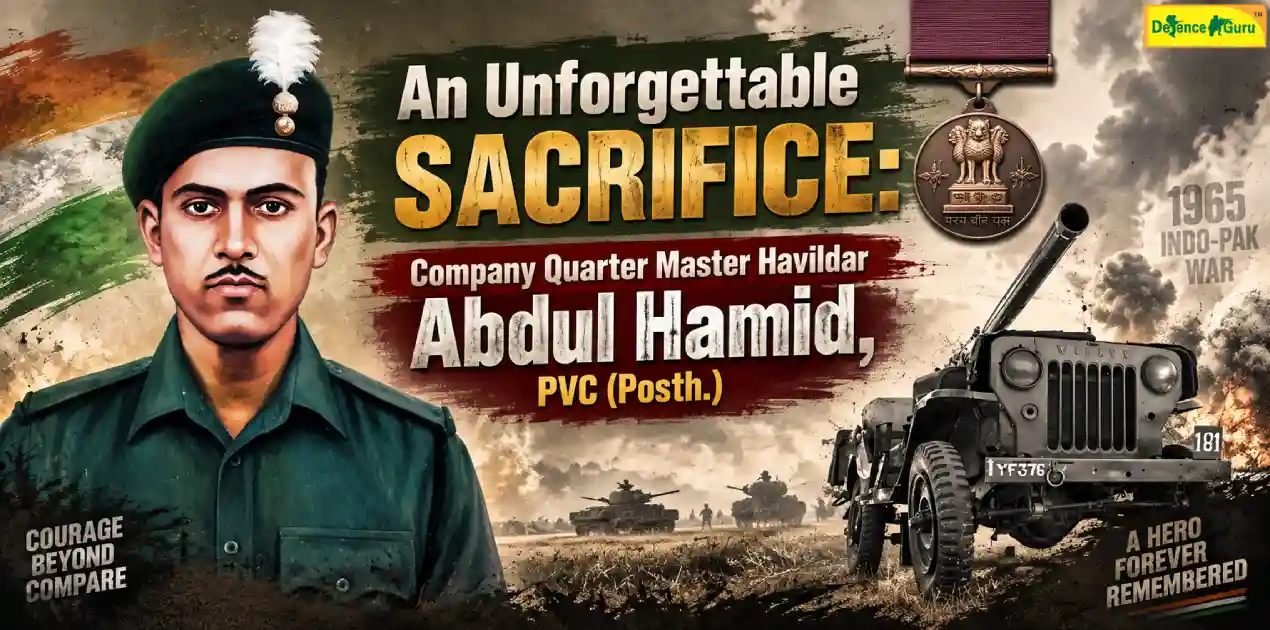
Every year on 10 September, the nation honors the valor and supreme sacrifice of Company Quartermaster Havildar Abdul Hamid, one of the country's most celebrated heroes. On 10 September 1965, Abdul Hamid was martyred while fighting Pakistani armoured forces in the Battle of Asal Uttar in the Khem Karan sector during the 1965 Indo-Pak War. He was engaged in combat against heavily armored Pakistani Patton tanks when he was hit by Pakistani machine gun fire. Abdul Hamid displayed great courage and determination in the face of overwhelming odds and was posthumously awarded the Param Vir Chakra (PVC), India's highest wartime gallantry award.
Abdul Hamid's valor inspires us that battlefield courage is measured not by the size of a weapon, but by the determination and sense of duty of the soldier who uses it.
A Brief Look at His Early Life
Havildar Abdul Hamid was born on 1st July 1933 in Dhamupur village of Ghazipur district in the state of Uttar Pradesh. He belonged to a poor family; his father was a tailor by profession. Abdul Hamid displayed his strength right from his childhood and took to wrestling and swimming.
Abdul Hamid joined the Indian Army at the age of 20. He was posted in the 4 Grenadiers and took part in the 1962 Indo-China War in the North-East Frontier Agency (NEFA). His experience in the Indian Army made him ready for the tasks ahead during the 1965 war.
The 1965 Indo-Pak War
The Indo-Pak war of 1965 was fought on the western front against Pakistan and saw tremendous fighting involving infantry, guns, tanks, and aircraft. One such place where the battle was fierce was the Khem Karan sector in Punjab.
The Pakistani army made a big push in this sector using heavily armored Patton tanks. This was a great challenge to the Indian troops defending this area, and it called for exceptional valor to meet this challenge.
It was in this battle that Abdul Hamid's name figured in Indian history.
The Battle of Asal Uttar
The Battle of Asal Uttar was one of the most significant tank battles fought during the 1965 war, and it took place on the morning of 10 September. The Pakistani Patton tanks attacked a strategically important feature on the road to Chima village in the Khem Karan sector. Before the attack began, there was a massive shelling of Pakistani troops, and it seemed that the enemy had pierced the forward defenses.
At that moment, Company Quarter Master Havildar Abdul Hamid, who was leading his recoilless gun detachment mounted on a jeep, moved to a favorable position to open fire on the attacking enemy tanks. Despite the heavy shelling and tank fire, he managed to take a good shot and knock out the leading Patton tank.
Hamid then moved his jeep to another position and fired at the second tank, causing it to catch fire. He demonstrated outstanding presence of mind and heroism under fire. Subsequently, the enemy tanks opened fire on his jeep with machine guns and high-explosive shells.
However, Abdul Hamid did not retreat and kept firing at the enemy tanks. He waited until his jeep had been fired upon several times before he knocked out the second enemy tank. The enemy tanks were able to spot him, and they opened fire on his jeep with machine guns and high-explosive fire, but he kept advancing.
The Sacrifice
While fighting another enemy tank, Abdul Hamid was mortally wounded by an enemy high-explosive shell. He died due to his injuries on 10 September 1965, while fighting.
His actions had a tremendous effect on his fellow soldiers, as mentioned in his citation for the Param Vir Chakra. It says that his extraordinary courage inspired his men to fight and stop a huge enemy assault of tanks. His incredible fighting spirit and willingness to sacrifice his life by not caring about his safety and fighting under heavy enemy fire have been cited as examples to his unit and the whole division.
For his services and bravery, Abdul Hamid was awarded the Param Vir Chakra posthumously with effect from 10 September 1965. Until today, his name is remembered by all as one of India’s bravest soldiers.
Lessons for Defence Aspirants
The life, sacrifice, and bravery of Havildar Abdul Hamid can teach us many lessons to guide our choices, decisions, and actions.
Courage in adverse circumstances:
While fighting an overwhelming armoured attack by the enemy, Havildar Abdul Hamid never allowed himself to despair and lose his nerve. Defence aspirants must strive to cultivate courage in all circumstances, even when in the face of pressure and uncertainty.
Presence of mind:
Abdul Hamid's quick and decisive action to draw his weapon and move to a flanking position, and to keep firing despite being fired at, shows his level of presence of mind and judgement under pressure.
Duty before self: Even as his position was being targeted by enemy fire, he kept doing his job, showing that a soldier's duty must always take precedence over any personal feelings or considerations.
Determination:
Abdul Hamid's example shows that whenever circumstances are not to our liking, we must not automatically consider quitting or going back,k but instead must have the determination and presence of mind to carry on with whatever it is we believe is right. A soldier shall always perform his duties with determination, courage, and discipline.
For the defence aspirant, remembrance of Havildar Abdul Hamid is a lesson in fortitude, discipline, determination, presence of mind, and service before self.
Conclusion
Havildar Abdul Hamid laid down his life in the line of duty on 10 September 1965. This great martyr fought against an entire armour of the enemy and never faltered even when he came under heavy fire. The gallantry shown by Abdul Hamid inspired all his comrades and will continue to be remembered for la ong time to come as an example of valor on the battlefield.
Abdul Hamid is a great role model for today's youth. Even years after his death, his name continues to motivate thousands of Indians to join the Indian Army so that they too can make a difference like Veer Havildar Abdul Hamid. It is truly heartwarming to see his martyrdom on this day being commemorated.
The sacrifice of Veer Havildar Abdul Hamid will forever remain etched in the hearts and minds of every Indian.
Veer Havildar Abdul Hamid's sacrifice will always remain unforgettable!
Read more:
Captain Vikram Batra PVC Birth Anniversary: Remembering “Sher Shah”
Group Captain Abhinandan Varthaman Retires from IAF Begins, New Journey as Commercial Pilot