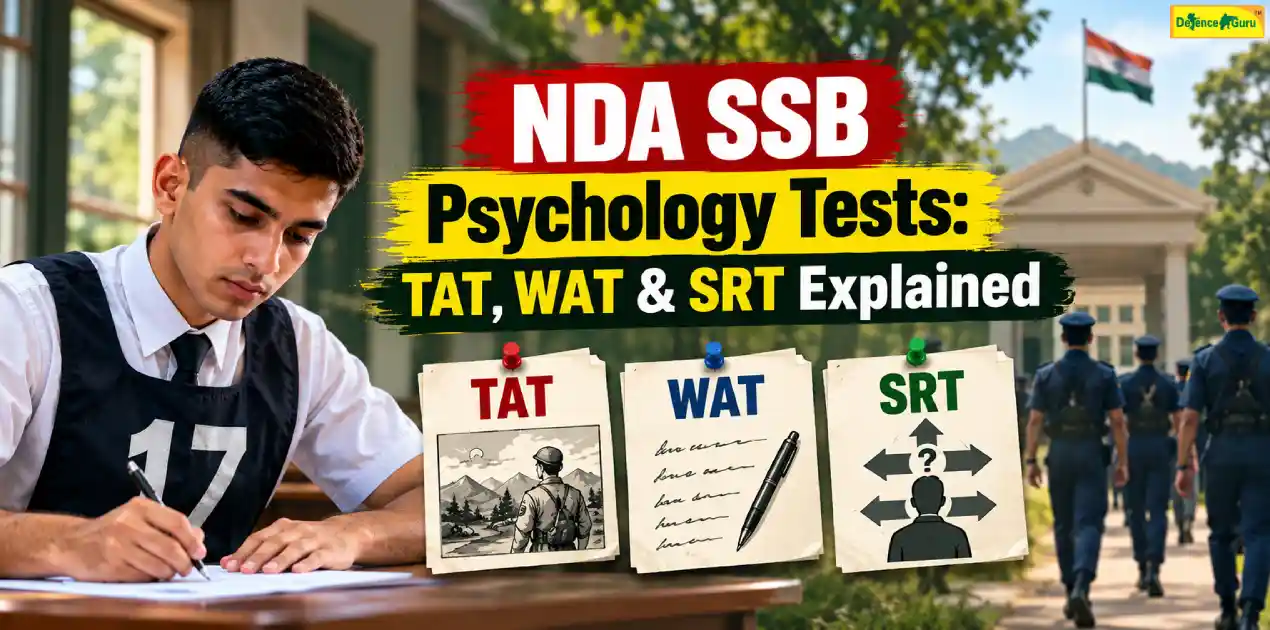
Clearing the NDA written exam is a major achievement, but it is only the first step towards joining the Armed Forces through the National Defence Academy. After qualifying the written exam, candidates have to appear for the SSB Interview, where they are assessed through different techniques.
One of the most important parts of this process is the SSB Psychology Test.
For many NDA aspirants, terms like TAT, WAT, and SRT sound confusing at first. Some candidates start looking for ready-made stories, model answers, and “perfect” responses. But SSB Psychology Tests are not about memorising answers.
They are designed to understand how you perceive situations, think under pressure, and respond to everyday problems.
So, instead of worrying about finding the “perfect answer”, focus on developing a practical, natural and consistent approach.
What Are NDA SSB Psychology Tests?
The Psychology Test in SSB is one of the major components of the overall SSB assessment. It generally includes four techniques:
- TAT: Thematic Apperception Test
- WAT: Word Association Test
- SRT: Situation Reaction Test
- SDT: Self Description Test
These tests are conducted under time pressure. The candidate's responses are considered along with performance in the other parts of the SSB assessment.
The objective is not to check your academic knowledge. Instead, the psychologist gets an opportunity to understand your thought process, perception, reactions, decision-making, and personality traits through your responses.
This is why SSB Psychology preparation is different from preparing for a normal competitive examination.
What Is TAT in SSB?
TAT stands for Thematic Apperception Test.
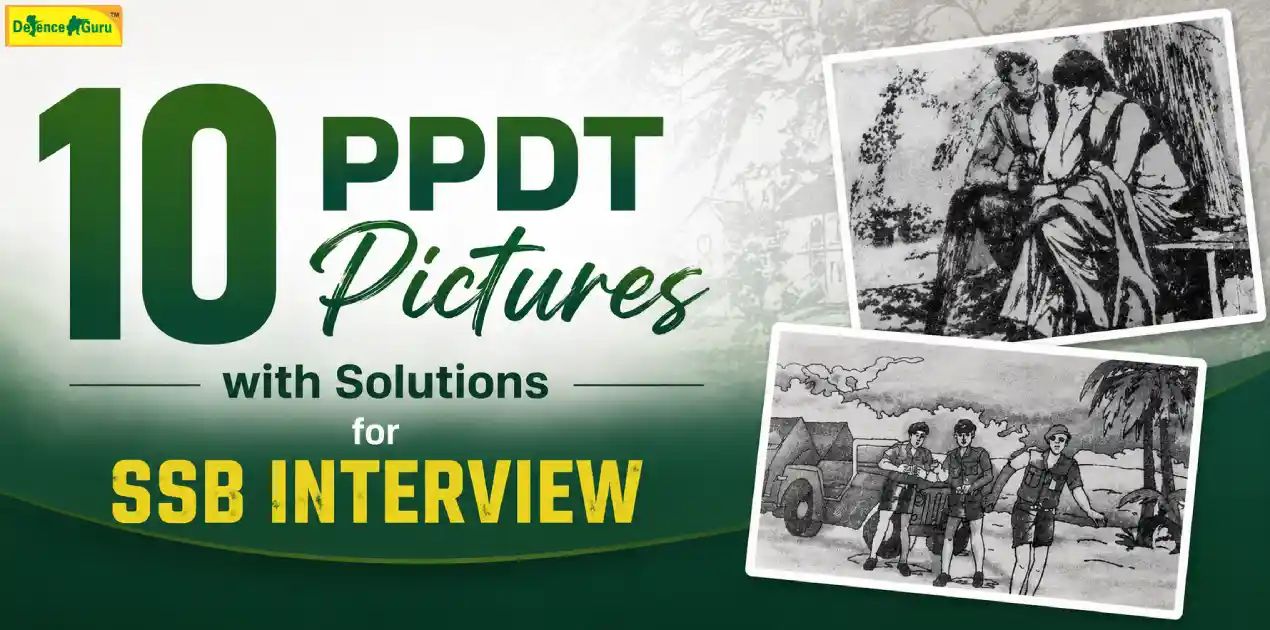
In TAT, candidates are shown a series of pictures and asked to write a story based on what they perceive in the picture.
The story generally revolves around the situation shown, the characters involved, what may have happened before the situation, and what happens afterwards.
The important thing is that you are not expected to describe the picture like an examination answer. You have to develop a meaningful story around it.
How to approach TAT
When a picture appears, quickly think about:
- Who are the people?
- What is happening?
- What could have happened before?
- Is there a problem or challenge?
- What can the main character do?
- What is the realistic outcome?
For example, imagine a picture showing a young man near a damaged road.
Instead of simply describing the road, you could create a story about a student who notices that villagers are facing problems because of the damaged road. He discusses the issue with local people, informs the concerned authorities, and helps coordinate a practical temporary solution until repair work begins.
The point is not to make the character a superhero.
A simple, logical, and realistic story is better than an unnecessarily dramatic one.
What should you focus on in TAT?
Your story can naturally demonstrate qualities such as:
- Initiative
- Responsibility
- Problem-solving
- Planning
- Teamwork
- Decision-making
- Social adaptability
- Confidence
Do not force all these qualities into every story. Let the situation guide your response.
What Is WAT in SSB?
WAT stands for Word Association Test.
In WAT, individual words are shown one after another for a very short period. You have to write the first meaningful thought or sentence that comes to your mind.
This is where speed becomes important.
For example, if the word is “Failure”, you could write:
“Failure helps identify mistakes and improve performance.”
If the word is “Team”, you could write:
“A coordinated team can complete difficult tasks efficiently.”
Notice that neither sentence is complicated.
You don't need impressive vocabulary or motivational quotes. You need to express a clear thought quickly.
Should you memorise WAT sentences?
It is better not to depend on memorised sentences.
Many aspirants prepare hundreds of model WAT responses and try to reproduce them during the SSB. But when the actual word is different, they may struggle to think naturally.
Instead, practise generating your own thoughts.
Take a word and ask yourself:
“What does this word immediately make me think about?”
Then write the thought in a simple sentence.
This improves your WAT speed, spontaneity, and confidence.
What Is SRT in SSB?
SRT stands for Situation Reaction Test.
In SRT, candidates are given different real-life situations and asked to write how they would react.
The situations may involve:
- Emergencies
- Family problems
- Friends
- Travel
- Accidents
- Team situations
- Time pressure
- Social problems
- Responsibilities
- Unexpected difficulties
For example:
Situation: You are travelling for an important examination when you see an elderly passenger fall and require help. What will you do?
A practical response could be:
“I would help the person safely, arrange necessary medical assistance, and inform the appropriate people before continuing for the examination.”
The response is short, but it shows a clear sequence:
Identify the problem → Take immediate action → Arrange help → Move ahead with responsibility.
That is the approach you should develop during SSB SRT preparation.
TAT vs WAT vs SRT
Although TAT, WAT, and SRT are all part of the SSB Psychology Test, they assess your responses through different situations.
|
Test |
You Are Given |
Your Task |
|
TAT |
Pictures |
Write a story based on your perception |
|
WAT |
Words |
Write the first meaningful thought |
|
SRT |
Situations |
Write your practical reaction |
|
SDT |
Questions about yourself |
Describe yourself honestly |
The major difference is the nature of the stimulus.
TAT tests your ability to perceive and develop a situation.
WAT requires quick association and expression.
SRT focuses on how you respond to practical situations.
Because the three tests work differently, your preparation should also be slightly different.
Is There a Correct Answer in TAT, WAT and SRT?
This is one of the biggest questions among NDA aspirants.
There is no universal list of “100% correct” TAT stories, WAT sentences, or SRT responses.
For example, two candidates may respond differently to the same situation, and both responses can be practical.
The mistake is trying to guess what the psychologist wants to read.
Instead, focus on being:
- Natural
- Practical
- Logical
- Consistent
- Action-oriented
Your response should make sense in the real world.
For example, if an accident occurs, you do not need to write that you will single-handedly rescue everyone, arrange everything, and solve the entire situation.
Think realistically.
You can assess the situation, ensure safety, call for appropriate help, and assist wherever possible.
That is a much more practical approach.
How to Prepare for NDA SSB Psychology Tests?
The best NDA SSB Psychology preparation strategy is simple:
Understand → Practise → Time Yourself → Review → Improve
1. Practise TAT regularly
Take a few unfamiliar pictures and write stories within the prescribed time.
After completing each story, ask:
- Is it realistic?
- Is there a clear situation?
- Does the main character take action?
- Is the solution practical?
- Does the story have a logical conclusion?
Do not worry about creating a perfect story every time.
The objective is to improve your thinking speed.
2. Practise WAT every day
Take 15–20 random words and give yourself a strict time limit.
Write the first meaningful thought that comes to mind.
Avoid checking model answers immediately. First develop your own response.
This gradually improves your ability to think and write quickly.
3. Practise SRT under time pressure
Take a set of real-life situations and respond to them quickly.
Ask yourself:
What is the immediate problem?
What is the priority?
What can I realistically do?
What should happen next?
This approach helps you avoid unnecessary explanations and develop concise responses.
4. Work on self-awareness
Psychology preparation is not limited to TAT, WAT, and SRT.
For Self Description, think honestly about:
- Your strengths
- Your weaknesses
- Your habits
- Your relationship with parents
- Your relationship with teachers
- Your relationship with friends
- Your goals
- Areas where you need improvement
You do not need to present yourself as perfect.
Self-awareness is more useful than creating a fake personality.
Common Mistakes in SSB Psychology Tests
Trying to sound perfect
Candidates sometimes write what they believe the psychologist wants to see. This can make their responses artificial.
Be natural.
Memorising TAT stories
A memorised story may not fit the picture you actually receive.
Practise the process of creating stories instead.
Memorising WAT sentences
WAT requires quick thinking. Memorised sentences can make your responses mechanical.
Writing unrealistic SRT responses
You do not have to become a superhero in every situation. Think about what a responsible person can realistically do.
Using complicated English
The Psychology Test is not an English vocabulary competition. Use simple language that you can write clearly and quickly.
Ignoring the clock
Even a good response is not useful if you spend too much time on one question.
Speed and clarity matter.
Does the Psychology Test Alone Decide Your SSB Result?
No.
The SSB assessment is broader than TAT, WAT, and SRT. The candidate is assessed through different techniques involving the Psychologist, Group Testing Officer, and Interviewing Officer.
Therefore, NDA aspirants should not prepare only for the Psychology Test.
Your preparation should also include:
- SSB Screening
- Personal Interview
- GTO Tasks
- Group Discussion
- Group Planning Exercise
- Lecturette
- Outdoor tasks
- Communication
- General awareness
- Personality development
The aim is to prepare yourself for the complete SSB process, not just one test.
Final Tips for TAT, WAT and SRT
Before appearing for the NDA SSB, keep these points in mind:
- For TAT: Observe the picture and create a realistic story. Don't memorise fixed stories.
- For WAT: Think quickly and write naturally. Don't waste time searching for fancy sentences.
- For SRT: Understand the problem and respond practically. Don't try to become a superhero.
- For SDT: Be honest and self-aware. Don't create a completely different personality on paper.
Most importantly, don't treat the SSB Psychology Test like a normal written examination.
You are not preparing a list of answers.
You are developing the ability to observe, think, decide, and respond under time pressure.
Conclusion
The NDA SSB Psychology Tests TAT, WAT and SRT can seem difficult when you first learn about them. But once you understand the format and start practising regularly, they become much easier to approach.
You don't need hundreds of memorised stories.
You don't need complicated English.
And you don't need to find a “perfect” answer for every situation.
Instead, focus on developing a practical mindset, improving your response speed, and understanding your own strengths and weaknesses.
Remember:
- TAT is about how you perceive a situation.
- WAT is about how you associate and express your thoughts.
- SRT is about how you respond to practical situations.
Prepare with consistency, stay natural, and focus on developing yourself rather than trying to manufacture an artificial SSB personality.
That approach will help you not only in the NDA SSB Psychology Test, but also throughout the wider SSB selection process.

FAQs on NDA SSB Psychology Tests
1. What are the Psychology Tests in NDA SSB?
The major Psychology Tests include TAT, WAT, SRT, and Self Description Test (SDT).
2. What is TAT in SSB?
TAT stands for Thematic Apperception Test. Candidates are shown pictures and asked to develop stories based on their perception.
3. What is WAT in SSB?
WAT stands for Word Association Test. Candidates see words for a short time and write the first meaningful thought or sentence that comes to mind.
4. What is SRT in SSB?
SRT stands for Situation Reaction Test. Candidates are given different situations and asked to write how they would respond.
5. Should I memorise TAT stories?
No. Practise developing logical and realistic stories from unfamiliar pictures instead of memorising fixed stories.
6. How can I improve my WAT performance?
Practise regularly with a timer. Focus on generating simple and meaningful thoughts quickly.
7. How can I prepare for SRT?
Practise different real-life situations under time pressure. Focus on practical action, prioritisation, and decision-making.
8. Is English important in the Psychology Test?
You should be able to express your thoughts clearly, but complicated vocabulary is not necessary. Simple and clear language is sufficient.
9. Is Psychology preparation enough for NDA SSB?
No. Psychology is only one part of the complete SSB assessment. Candidates should also prepare for the Interview, GTO, and other stages.
10. What is the best way to prepare for TAT, WAT and SRT?
Understand the format, practise regularly, use a timer, and review your responses. Most importantly, stay natural and focus on developing practical thinking.
Read more:
10 SSB TAT Pictures with Sample Stories for Upcoming SSB